BTSF in chronological order (most recent articles appear first):

Monday, February 18, 2019

New Fruit

At this point, it's obvious that I have no longer been updating By Their Strange Fruit. I have attempted for some time to return to this discipline that has been so formative for me over the years, but it has become clear that it's time for me to focus on new fruit.

Maybe now that I’m daily living out my justice convictions in my work at UM Church for All People, rather than writing from the sidelines of academia, I don’t feel the same need for the outlet of expression.

Maybe in this post-post-racial era of blatant bigotry, pointing out the subtly pernicious manifestations of systemic racism felt too trite.

Maybe after the election of Trump, my heart just needed to find new modes of resistance.

Maybe after the many repeated unarmed killings there is simply nothing more to say. Simply, "see too many previous posts": Michael Brown, Jordan Davis, Tamir RiceSarah Lee Circle BearRalkina JonesJohn Crawford, Trayvon Martin, Trye King, on and on and on. Say their names.

Or maybe after nearly 10 years, every act of resistance just has its season. Time to bear new fruit.


Racism is no less prevalent, Christ is no less relevant.
In fact, both are arguably much more so now than ever before.
The work continues.

I have so much love and gratitude for these years of learnings and relationships that have come out of this space. What began as a simple medium for my own self-education, grew deeper, richer, and much larger than I had ever anticipated. I am so grateful for the many who were so crucial  to the journey.

I will leave the site up, both for my own reference and for others’ use, as long as the internets allow. I
Check out the
"All People Podcast
"
may even use it for the occasional outlet to speak up on specific issues as they arise, or as a platform to promote ongoing visibility for justice work happening around the country.

As this chapter draws to close, I include some links below to revisit a few of my favorite BTSF posts from over the years. Going forward, I’ll be hosting a new podcast in collaboration with Pastor Greg Henneman, in which we explore being a Church for All People, and the practices that we believe are critical for building the fully just and inclusive Body of Christ. Check it out and subscribe here.

I continue to yearn to know how we as Christians can and will get out ahead of this ever-evolving beast we call racism. There are so many brilliant, talented groups and individuals do the work to whom I will always be grateful.

And so, what say you readers?
How have you been coping in this new era? How do you continue to resist?

With so much love, gratitude, and hope,
Katelin


A few BTSF favorites from over the years:
          Is God Colorblind?
          White Savior Complex
          They Will Know We Are Christians
          Timeline of Racism
          White History Month
          Logical Fallacies: Model Minority
          That Mascot Doesn't Honor Anyone

Click here for the full BTSF topical index


Sunday, January 28, 2018

Fred Korematsu Day

On January 30th, we celebrate 'Fred Korematsu Day of Civil Liberties and the Constitution,' in honor of his birthday. Korematsu (是松 豊三郎) is the first Asian American to have a day named after him.

Korematsu was living in California when Franklin D. Roosevelt issued Executive Order 9066 in 1942, stripping American citizens of their legal rights, and allowing their indefinite imprisonment without due process. Thousands of Americans of Japanese descendants were removed from their homes and detained in internment camps (See post: Racial Profiling and the Japanese American Internment). Having broken no laws, hundreds of thousands suffered the undue loss of their freedom and property.

Rather than surrender to military detention, Korematsu went into hiding, only to be captured and arrested several weeks later. He contested his detainment as unconstitutional, but in their 1944 ruling on Korematsu v. United States, the Supreme Court of the United States upheld the constitutionality of  Executive Order 9066.

It was later shown that during the course of the proceedings, Solicitor General Charles Fahy suppressed legal documents that stated "there was no evidence Japanese Americans were disloyal, were acting as spies or were signaling enemy submarines." Through it all, white Americans either voiced support for the internment program or simply remained silent. Indeed, the ACLU largely sided with the FDR administration.

Korematsu and his family were eventually sent to the Topaz internment camp, where he had a horse stall for his living quarters. He was forced to work long hours in the labor fields, receiving $12/month. After his release, Korematsu was still strapped with a federal conviction, affecting his ability to get work, even above the racial discrimination faced by his peers.

Having spent his early years as shipyard welder aiding in the defense of the USA, he worked welding water tanks in Utah. He soon learned he was being paid only half of what his white colleges were earning. After asking for equal pay, he was threatened with arrest and was forced to leave his job.

Receiving the
Presidential Medal of Freedom
Four decades after his arrest, Korematsu's conviction was finally vacated. To the judge, he said "According to the Supreme Court decision regarding my case, being an American citizen was not enough. They say you have to look like one, otherwise they say you can’t tell a difference between a loyal and a disloyal American....I would like to see the government admit that they were wrong and do something about it so this will never happen again to any American citizen of any race, creed, or color." He continued, "If anyone should do any pardoning, I should be the one pardoning the government for what they did to the Japanese-American people."

Though his name was cleared as an individual, the 1944 Supreme Court ruling in favor of Roosevelt's Executive Order 9066 still stands today. In Korematsu's words, "As long as my record stands in federal court, any American citizen can be held in prison or concentration camps without a trial or a hearing. That is if they look like the enemy of our country."

After September 11, 2001 Korematsu fervently urged the public not treat American Muslims as Japanese Americans had been treated during WWII. He also spoke out against detainments in Guantanamo Bay, maintaining that “full vindication for the Japanese-Americans will arrive only when we learn that, even in times of crisis, we must guard against prejudice and keep uppermost our commitment to law and justice.”

With Rosa Parks
To his death, he maintained “I'll never forget my government treating me like this. And I really hope that this will never happen to anybody else because of the way they look, if they look like the enemy of our country.” He knew that  "No one should ever be locked away simply because they share the same race, ethnicity, or religion as a spy or terrorist. If that principle was not learned from the internment of Japanese Americans, then these are very dangerous times for our democracy."

January 30th is Korematsu's birthday. How will you remember his legacy?

"Don't be afraid to speak up. One person can make a difference, even if it takes forty years." 
- Fred T. Korematsu

Sunday, January 14, 2018

Guidelines for a Constructive Church

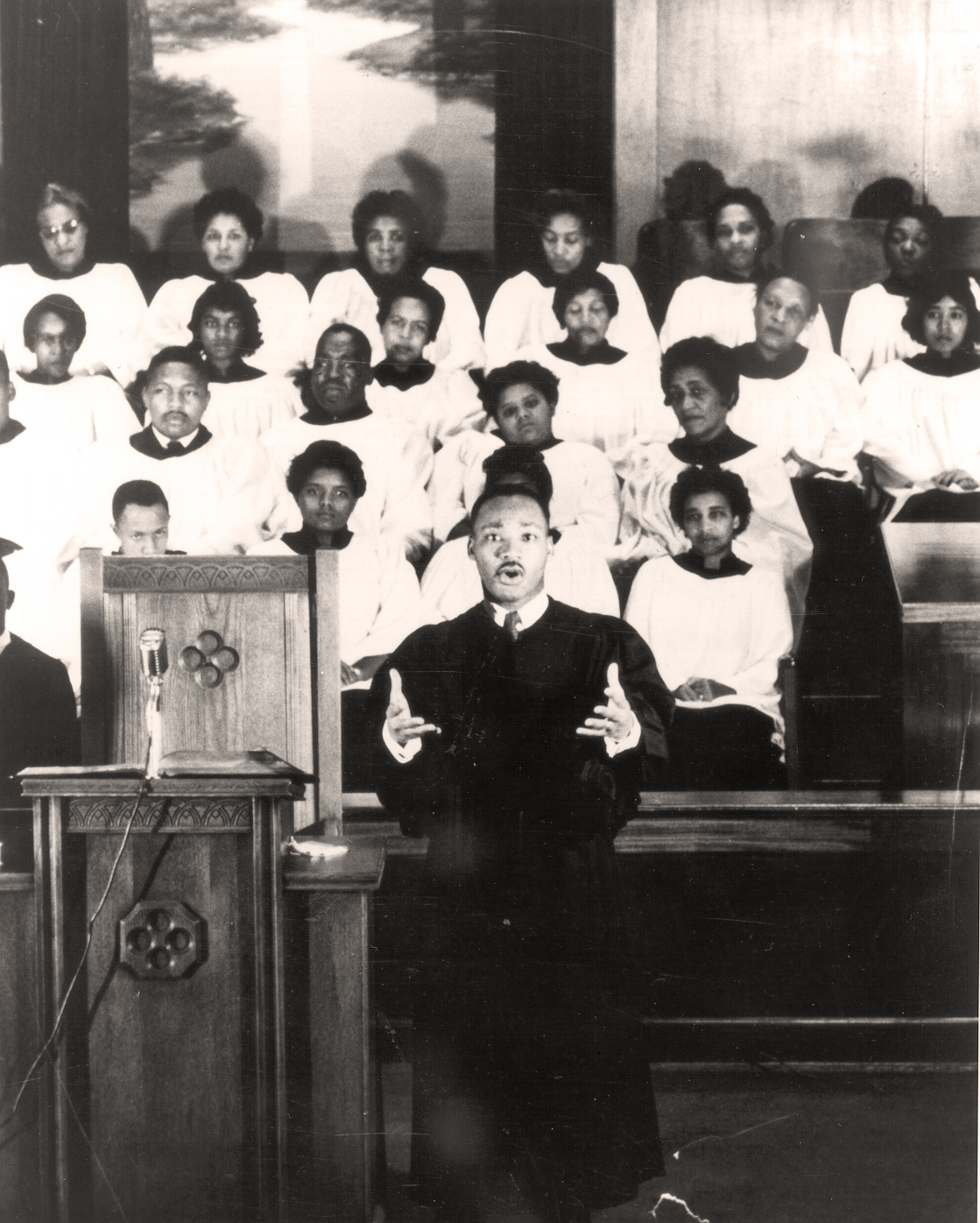
Image result for Guidelines for a Constructive ChurchIn honor of MLK today, enjoy this speech he delivered at Ebenezer Baptist Church on June 5, 1966. Like so many of his words, this address feels every bit as prescient today as it did then. The full transcript and a recording can be found here

I would like to preach from the subject: "Guidelines for a Constructive Church." Over the last several weeks now, we've been reading a good deal in our newspapers about guidelines. Now this word has been applied basically to the public school systems across our nation, particularly in the South.

The Supreme Court of our nation rendered a decision back in 1954 declaring segregation in the public schools unconstitutional. And that next year in 1955 it came back stating that every school district was to integrate "with all deliberate speed."

And yet we came into 1966 with the terrible realization that only 5.2 percent of the Negro students of the South had been placed in integrated schools, which meant in substance that we haven't made 1 percent progress a year. And if it continued at that pace it would take another ninety-six years to integrate the public schools of the South.

Image result for mlk ebenezer
And so the Department of Education decided that the process had to be speeded up on the basis of the Civil Rights Bill of 1964. And this department decided to set forth certain basic guidelines that had to be followed. The guidelines stated in substance that the process of integration had to be speeded up; that all grades had to be integrated; that even faculties had to be integrated.

And this plan, or these guidelines, was submitted to every school district and that school district had to decide whether it would follow the guidelines. If it refused to follow the guidelines then federal funds would be cut off. If it complied with the guidelines then federal funds would be continued. And so today there is a great discussion all over the educational world and the public school system about whether a school district or a school board will follow the guidelines.

This morning I would like to submit to you that we who are followers of Jesus Christ, and we who must keep his church going and keep it alive, also have certain basic guidelines to follow. Somewhere behind the dim mist of eternity, God set forth his guidelines. And through his prophets, and above all through his son Jesus Christ, he said that, "There are some things that my church must do. There are some guidelines that my church must follow."

Image result for mlk ebenezerAnd if we in the church don't want the funds of grace cut off from the divine treasury, we've got to follow the guidelines. The guidelines are clearly set forth for us in some words uttered by our Lord and Master as he went in the temple one day, and he went back to Isaiah and quoted from him. And he said, "The Spirit of the Lord is upon me, because he hath anointed me to preach the gospel to the poor, he hath sent me to heal the broken-hearted, to preach deliverance to the captives, and recovering of sight to the blind, to set at liberty them that are bruised, to preach the acceptable year of the Lord." These are the guidelines.

You see, the church is not a social club, although some people think it is. They get caught up in their exclusivism, and they feel that it’s a kind of social club with a thin veneer of religiosity, but the church is not a social club. The church is not an entertainment center, although some people think it is. You can tell in many churches how they act in church, which demonstrates that they think it’s an entertainment center. The church is not an entertainment center. Monkeys are to entertain, not preachers.

But in the final analysis the church has a purpose. The church is dealing with man's ultimate concern. And therefore it has certain guidelines that it must follow.

Now I wish time permitted me to go into every aspect of this text, but I want to just mention a few. Let us first think of the fact that if the church is following its guidelines, it seeks to heal the broken-hearted. Now there is probably no human condition more tantalizing than a broken heart. You see, broken-heartedness is not a physical condition; it’s a condition of spiritual exhaustion.

And who here this morning has not experienced a broken heart? I would say broken-heartedness comes basically from the trying experience of disappointment. And I don't believe there are many people here this morning under the sound of my voice who have not been disappointed about something.

Here is a young man or a young woman dreaming of some great career and setting out in school to try to make that career possible, only to discover that they don't quite have the mental faculties, the technical know-how, to achieve excellence in that particular field. And so they end up having to choose life’s second best, and because of this they end up with a broken heart.

Here is a couple standing before the altar in a marriage that seems to be born in heaven, only to discover that six months or a year later the conflicts and the dissensions begin to develop; arguments and misunderstandings begin to unfold. And that same marriage which a year earlier seemed to have been born in heaven ends up in the divorce court, and the individuals are left with a broken heart.

Here is a family, a mother and father striving desperately to train their children up in the way that they should go. Working hard to make their education possible; working hard to give them a sense of direction, praying fervently for their guidance. And yet, in spite of all of this, one or two of the children end up taking the wrong road, moving toward some strange and tragic far country. And the parents end up having to acknowledge that the children that they raised are prodigals lost in a far country, and they end up with a broken heart.

And then there comes life’s ultimate tragedy, that something that always makes for a broken heart. Who this morning hasn't experienced it? When you must stand before the bier of a loved one. That day when the casket rolls down the aisle. That experience called death, which is the irreducible common denominator of all men. And no one can lose a loved one, no one can lose a mother or father, sister, brother, a child, without ending up with a broken heart. Broken-heartedness is a reality in life.

And Sunday after Sunday, week after week, people come to God’s church with broken hearts. They need a word of hope. And the church has an answer—if it doesn't, it isn't a church. The church must say in substance that broken-heartedness is a fact of life. Don’t try to escape when you come to that experience. Don't try to repress it. Don't end up in cynicism. Don't get mean when you come to that experience.

The church must say to men and woman that Good Friday is a fact of life. The church must say to people that failure is a fact of' life. Some people are only conditioned to success. They are only conditioned to fulfillment. Then when the trials and the burdens of life unfold, they can't stand up with it. But the church must tell men that Good Friday’s as much a fact of life as Easter; failure is as much a fact of life as success; disappointment is as much a fact of life as fulfillment. And the church must tell men to take your burden, take your grief and look at it, don't run from it. Say that this is my grief and I must bear it. Look at it hard enough and say, "How can I transform this liability into an asset?"

This is the power that God gives you. He doesn't say that you're going to escape tension; he doesn't say that you're going to escape disappointment; he doesn't say that you’re going to escape trials and tribulations. But what religion does say is this: that if you have faith in God, that God has the power to give you a kind of inner equilibrium through your pain. So let not your heart be troubled.

"If ye believe in God, ye believe also in me." Another voice rings out, "Come unto me, all ye that labor and are heavy laden." As if to say, "Come unto me, all ye that are burdened down. Come unto me, all ye that are frustrated. Come unto me, all ye with clouds of anxiety floating in your mental skies. Come unto me, all ye that are broke down. Come unto me, all ye that are heartbroken. Come unto me, all ye that are laden with heavy ladens, and I will give you rest."

And the rest that God gives is the rest that passeth all understanding. The world doesn't understand that kind of rest, because it’s a rest that makes it possible for you to stand up amid outer storms, and yet you maintain inner calm. If the church is true to its guidelines, it heals the broken-hearted.

Secondly, when the church is true to its guidelines, it sets out to preach deliverance to them that are captive. This is the role of the church: to free people. This merely means to free those who are slaves. Now if you notice some churches, they never read this part. Some churches aren't concerned about freeing anybody. Some white churches face the fact Sunday after Sunday that their members are slaves to prejudice, slaves to fear. You got a third of them, or a half of them or more, slaves to their prejudices. And the preacher does nothing to free them from their prejudice so often.

Then you have another group sitting up there who would really like to do something about racial injustice, but they are afraid of social, political, and economic reprisals, so they end up silent. And the preacher never says anything to lift their souls and free them from that fear. And so they end up captive. You know this often happens in the Negro church. You know, there are some Negro preachers that have never opened their mouths about the freedom movement. And not only have they not opened their mouths, they haven’t done anything about it.

And every now and then you get a few members: "They talk too much about civil rights in that church." I was talking with a preacher the other day and he said a few of his members were saying that. I said, "Don't pay any attention to them. Because number one, the members didn't anoint you to preach. And any preacher who allows members to tell him what to preach isn't much of a preacher."

For the guidelines made it very clear that God anointed. No member of Ebenezer Baptist Church called me to the ministry. You called me to Ebenezer, and you may turn me out of here, but you can’t turn me out of the ministry, because I got my guidelines and my anointment from God Almighty. And anything I want to say, I'm going to say it from this pulpit.

It may hurt somebody, I don’t know about that; somebody may not agree with it. But when God speaks, who can but prophesy?The word of God is upon me like fire shut up in my bones, and when God’s word gets upon me, I've got to say it, I’ve got to tell it all over everywhere. And God has called me to deliver those that are in captivity.

Some people are suffering. Some people are hungry this morning. Some people are still living with segregation and discrimination this morning. I'm going to preach about it. I’m going to fight for them. I’ll die for them if necessary, because I got my guidelines clear. And the God that I serve and the God that called me to preach told me that every now and then I'll have to go to jail for them. Every now and then I’ll have to agonize and suffer for the freedom of his children. I even may have to die for it.

But if that’s necessary, I'd rather follow the guidelines of God than to follow the guidelines of men. The church is called to set free those that are captive, to set free those that are victims of the slavery of segregation and discrimination, those who are caught up in the slavery of fear and prejudice.

And then the church, if it is true to its guidelines, must preach the acceptable year of the Lord. You know the acceptable year of the Lord is the year that is acceptable to God because it fulfills the demands of his kingdom. Some people reading this passage feel that it’s talking about some period beyond history, but I say to you this morning that the acceptable year of the Lord can be this year. And the church is called to preach it.

The acceptable year of the Lord is any year when men decide to do right.
The acceptable year of the Lord is any year when men will stop lying and cheating.
The acceptable year of the Lord is that year when women will start using the telephone for constructive purposes and not to spread malicious gossip and false rumors on their neighbors.
The acceptable year of the Lord is any year when men will stop throwing away the precious lives that God has given them in riotous living.
The acceptable year of the Lord is that year when people in Alabama will stop killing civil rights workers and people who are simply engaged in the process of seeking their constitutional rights.
The acceptable year of the Lord is that year when men will learn to live together as brothers.
The acceptable year of the Lord is that year when men will keep their theology abreast with their technology.
The acceptable year of the Lord is that year when men will keep the ends for which they live abreast with the means by which they live.
The acceptable year of the Lord is that year when men will keep their morality abreast with their mentality.
The acceptable year of the Lord is that year when all of the leaders of the world will sit down at the conference table and realize that unless mankind puts an end to war, war will put an end to mankind.
The acceptable year of the Lord is that year when men will beat their swords into plowshares, and their spears into pruning hooks: and nations will not rise up against nations, neither will they study war anymore.
The acceptable year of the Lord is that year when men will allow justice to roll down like waters, and righteousness like a mighty stream.
The acceptable year of the Lord is that year when we will send to Congress and to state houses of our nation men who will do justly, who will love mercy, and who will walk humbly with their God.
The acceptable year of the Lord is that year when every valley shall be exalted, and every mountain will be made low; the rough places would be made plain, and the crooked places straight; and the glory of the Lord shall be revealed, and all flesh shall see it together.
The acceptable year of the Lord is that year when men will do unto others as they will have others do unto themselves.
The acceptable year of the Lord is that year when men will love their enemies, bless them that curse them, pray for them that despitefully use them.
The acceptable year of the Lord is that year when men discover that out of one blood God made all men to dwell upon the face of the earth.
The acceptable year of the Lord is that year when every knee shall bow and every tongue shall confess the name of Jesus. And everywhere men will cry out, "Hallelujah, hallelujah! The kingdom of this world has become the kingdom of our Lord and His Christ, and He shall reign forever and ever. Hallelujah, hallelujah!"

The acceptable year of the Lord is God’s year.

These are our guidelines, and if we will only follow the guidelines, we will be ready for God’s kingdom, we will be doing what God’s church is called to do. We won’t be a little social club. We won’t be a little entertainment center. But we’ll be about the serious business of bringing God’s kingdom to this earth.


It seems that I can hear the God of the universe smiling and speaking to this church, saying, "You are a great church because I was hungry and ye fed me. You are a great church because I was naked and ye clothed me. You are a great church because I was sick and ye visited me. You are a great church because I was in prison and ye gave me consolation by visiting me."

And this is the church that’s going to save this world. "The spirit of the Lord is upon me because he has anointed me to heal the broken-hearted, to set at liberty them that are captive, and to preach the acceptable year of the Lord."

Monday, January 8, 2018

Be the Light

Related imageSometimes it feels like everything is just awful. Like things just can't get any worse.
All around, we see division, anger, hatred. So much brokenness. So much injustice.

Yet the Church has an opportunity in this moment. We have a chance to cast a vision of God's restored Kingdom. To embody a Holy dream. To lead.

Too often we focus on the brokenness, the violence, and the injustice. That's what get's the most attention, and riles people's emotions.

It's good to point out what's missing in this world. It's good to identify the things that break God's heart. But too often we just stay there. The the world is good at pointing out what's wrong. God's people are called to shine on what is right.

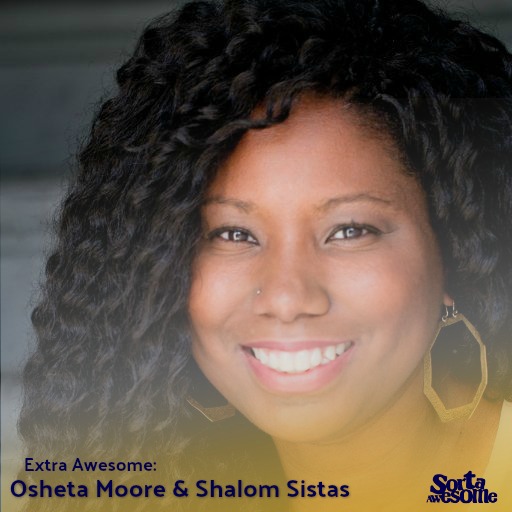
I am reminded of a recent MennoNerds conversation I had with Osheta Moore, author of Shalom Sistas: Living Wholeheartedly in a Brokenhearted World. She observes, "I am surrounded by people who are so eager to notice the brokenness in the world." Doing the work of shalom is not about "camping out in the broken," Osheta continues, "because we don't have to go too far to find the broken. The broken is as close as our Facebook feed. Our job is to say, yeah that's broken, but God's dream for it is this picture of wholeness. God's dream for it is this being restored."
Image result for osheta moore shalom

Osheta reminds us that a call for true shalom is a call into a vision of something whole, something just, something greater than what the world proposes.

It's not that we should ignore the injustice and the brokenness. We know the issues are real, with devastating consequences for ourselves and for our neighbors. But what if, because we know these issue are real, what if we framed the issues around what could be, and not just what isn't?

The world already spends too much energy denigrating our communities, telling us what we don't have and what's wrong with us. And too often our churches are the first to contribute to the barrage of negativity and shame, pointing out everything that is wrong and how far we have fallen.

We do it because we care. Because we know it's not what God would have for us. We do it to provoke change. But we end up missing the Imago Dei in the very people we are trying to champion.

Image result for shalom wholeness
Instead, if we will allow God light of hope, of wholeness and shalom, to be our focus, we will inspire each other into truly living into our call as the hands and feet of Christ on this earth. The energy will shift, and we will realize that we are already equipped to achieve the change we are seeking. We will move out of our guilt and into redemption. We will no longer be paralyzed in heartbreak and despair, but will mobilize our communities into something better.

The world looks around and sees darkness, despair, and disillusionment. But that's not who God is. "God says there is more. There is beauty, there is flourishing, there is hope. There is the Holy Spirit. There is good." God says "let there be light!"

We believe in a world filled with equity and with justice. We believe that everyone deserves to live. We believe every culture is beautiful and worthy. We believe children can be fed and healthy. We believe that every vote should count, and that laws should be fair. We believe schools can be safe and healthcare can be affordable. We believe all neighborhoods can be prosperous and all people can be truly free.

The world will tell us it cannot be done. But Jesus says, "yes it can."

This is the work of the Church--the work of hope. Let us reclaim our place as prophetic witnesses to God's vision for the world. And then let us partner with God in bringing about that Kingdom "on earth as it is in Heaven"

It's a new year. It's the season of Epiphany.
Let's us be the Light, Church.
Be the Light. 

Monday, December 11, 2017

Rise Up...and Build!

The following is adapted from a brief address given at the 2017 All People Conference in Columbus, OH. The theme for the event was based on Nehemiah 2:18--"Rise Up...and Build!"

UM Church for All People (C4AP) grew out of the relationships formed in the Free Store. It is through these diverse relationships of mutually and accompaniment that we believe we will come to know God better

And it was out of these relationships that the church was formed. Folks began praying together, and worshiping together. And so in 2002, C4AP was born. And it grew.

We host the All People Conference over a Sunday on purpose so that you can get take a deep dive into experiencing the palpable energy of the koinonia in this place. Our pastor is a bit of a Greek scholar so he uses words like that when describing C4AP. Best I can tell though, the literal translation of koinonia must just be “holy chaos,” because that sure can be what it’s like around here.

If you get a chance, I invite you to experience C4AP on a Sunday morning…and you got experience it to believe it. But I want to describe it a little bit for you here, in the meantime.

One of the other ways that’s reflected is in the worship music. We have an excellent band that can play hymns, Black gospel, CCM, Appalachian bluegrass, and much more. We worship with all kinds of music because we want to represent the full range of who we are, and indeed who we are yet to be become…either for the next visitor that walks through the door, or for when we join together with the heavenly chorus.

And this comes with it’s challenges. Rev. James Forbes notes that “a truly diverse congregation where anybody enjoys more than 75% of what’s going on is not thoroughly integrated.” If everyone’s always comfortable, that’s not integration…that assimilation. That’s cultural hegemony disguised as unity.

Too often the multicultural church owes its success to the people of color in the congregation simply willing to 'take it for the team' and give up their own beautiful heritage for the sake of white folks being comfortable.

So what are the rest of us willing bring as a sacrifice of praise?

This also means that if I’m doing my job as minster of music, no one is happy with me all of the time, but everybody is happy with me some of the time.

We are a Church for All People. But not all people like all people.
But we have to move from tolerance to acceptance, to affirmation, yes even to love.
We have to take these elements into ourselves and learn and grow from them.

The world will teach us tolerance…and that’s fine, there’s a place for that.
But the cross calls us to so much more.

When I come home at the end of the day I do NOT what my husband to say “baby, I tolerate you.”
Maybe that’s the truth. Sometimes tolerance is a good place to start.
But’s not what scripture says.

"Tolerate your enemies"
"Tolerate your neighbor as you tolerate yourselves."
"Tolerate one another as I have tolerated you."

No. Christ calls us to love.
But sometimes loving is hard. It’s uncomfortable.
Nobody said church was supposed to be comfortable.
It sooths, it nourishes, it comforts…but it’s not comfortable!

Here’s another distinctive element that sometimes makes our guests uncomfortable at C4AP: the sharing of joys and concerns. That’s right my friends, brace yourselves, we pass the mic! And that can bother our middle-class, and time-oriented culture friends in the room.

But let me tell you, it’s the high holy moment of the service. More than the sermon, sometimes even more than communion. It is a moment when folks that do not often get their voices heard. And they’re not voiceless...just unheard. But its a holy moment where those voices are lifted together in prayer.

It matters that someone can stand up and share that her gas is cut off, and winter is coming, and she's scared. And's she's not necessarily asking anyone to fix it, but asking for us to pray with her about it. And then the very next person may stand up and tell us that their last kid just went off to college, and their excited, but their also sad because now they're empty-nesters. And they know no one can fix it, but they're asking for us to pray with them about it. It matters that these two prayers are lifted equally before the ears of God.

And every week we also pray the Lords Prayer. That's not so special, lots of churches do that. And we, like you, pray “give us this day.” But I have to tell you tell you I don’t really believe that prayer. I never have. I believe I went to school, got a degree, got a job. I get a paycheck and go to the grocery store. I give me my daily bread. But it matters that I'm in a pew next to someone who doesn't necessarily know where dinner is coming from tonight, but for a fact that it's God that is providing it. And they're teaching me that it's just as true in my life as well.

I sit next to folks in worship that are diligent and practiced in relying on God, when all I know how to do is rely on myself. We worship with folks that know how to listen for God’s still small voice, and how to wait upon the Lord.

And so when my back’s against a while and I’m in my troubled times, I know who I’m turning to to ask for prayer. Every single person that walks through these doors is poor...some of us are just so poor that all we have is money.

So some folks come to C4AP because they don't feel welcome through the doors of any other church. That’s a travesty, friends. Some folks come out of deep desire to be of service for an under-privileged community. Which is good too.

Confessionally, I came for more selfish reasons. I have not come to serve the poor. I have come to sit at the feet of those that can show me the face of Christ. I come to C4AP out of a conviction that isolating ourselves among believers of similar backgrounds only deprives our own souls of God's majesty.

Rich, diverse community is how we will know who God is.
In that regard, I am really spoiled at C4AP.

Every Sunday morning, I have the privilege of worshiping with a beautiful body of believers.
We worship with old folks, young folks, wealthy, unemployed, folks who’ve done time, PhDs, GEDs, physical illnesses, mental illnesses, addictions, many races, many nationalities, many sexualities,
many backgrounds…And a whole lot of joy in the Lord. It’s holy chaos.

And I am convinced that in doing so, we draw nearer to God.
In a time when mainline denominations are wringing their hands about declining membership
and aging…buildings. I’ll let you in on a little secret: the answer is simple. I joined this church because it was a church actually, doing, the work of a church. Being what the church was supposed to be

In Rev 7:9 we see a picture of what heaven will be like someday, that "every tribe, every tongue, every nation" will worship before the thrown. So why not start now? Indeed, don’t we also pray each week, "let it be on earth as it is in heaven."

And our Triune God is our model: diverse, and unified as One. Isolation within our own groups is not what God would have for us.

My husband and I moved onto the block in a hard-living neighborhood on the South Side of Columbus to be in relationship with the surrounding community. And we adopted a value of downward mobility, not as a charitable endeavor, but as one fundamental to our own souls. And it is fundamental to life of Christ’s church on earth.

As Christians, we should be on the forefront of inclusively, not limping along in the rear.
What message does it send the world when we will not unite together to worship our Jesus?
What witness does it give when someone is more welcome on a street corner than they are in a pew?
What does it say about Christ if meth dealers are less discriminating than our churches?
What does mean when hate groups run better outreach campaigns?

As Christians, we all love Jesus.
But maybe we need to relearn what that means.
Are we Christians that love Jesus…as long as He sticks to our social norms, and knows how to behave? And knows how to put on a good face? And knows how run a meeting using Roberts Rules of order.

What about when Jesus smells funny, or speaks with a slur? Do we love him then?
Or when his music too loud, his clothes are too baggy, or his body is pierced….oh wait, it was.

Do we love Jesus when it puts our own egos is at risk?
When he ask us to lay down our own self-importance, our own desire to save the day?
Sometimes we just like to fix things, more than we actually like to love.
Do we love Jesus if we’re not called to fix it?

You may serve food at a soup kitchen, but have you eaten at the table as well?
You may pray for the poor, but do you ask for their prayers as well?

What I hope to convince you of before you leave the All People Conference this weekend is that community development is congregational development. Too often we separate service and salvation, as though that 'love thy neighbor' is something to do in the Church's spare time.

If your church disappeared tomorrow, would your neighborhood notice that you were missing?

It matters that nearly 1,000 people walk through the doors of our church each week. And it matters that we sit in in the pews together as we pray about what God has next for our community. It matters that it’s those same folks that are serving produce in our Fresh Market, and shopping in our Free Store, and working in our bike shop.

In a church where most folks make less than $20,000 per year, we see the widow’s mite go into the offering plate every single week. And it’s out of those pennies, and nickels, and dimes that we’ve done $60 million in affordable housing. We absolutely believe that. We just do.

We take the relationships that we have formed and we invest them in building the inclusive body of Christ, which then has an energy and a momentum, a holy chaos, that we are able to invest in whatever God is doing next.

We contend that we will draw nearer to God when we are in fellowship with the fuller range of God’s people. And when you draw nearing to God, powerful things start to happen.

Don't talk to me about the dying church. All this wringing of hands is driving me crazy. Let us live, and live abundantly! Isaiah 61:4 says "they will rebuild the ancient ruins and restore the places long devastated; they will renew the ruined cities that have been devastated for generations."

We’re at a critical moment in this neighborhood, indeed in this country. We’re being told it, can’t be done. That’s people cannot come together, cannot bridge the divided.
This is a moment for the Church

Th church can cast the vision for the diverse and inclusive body of Christ and then boldly live into it as a beacon to the world.

We can build a Church for All People, we can build a Columbus for All People, and dare I say it…an America for All People. Let us rise up...and build!

Sunday, November 5, 2017

Local Elections: Vote!

Tuesday is another election day.
Are you registered? Do you know your polling place?

I've always made it a point to vote in all elections, local and national, that were available to me, just on basic stubborn principle. Recent years have emphasized to me how truly important local elections are, even as a matter of life and death.

In Ferguson, Police Chief Thomas Jackson was appointed by the elected mayor (via city manager). The St. Louis County Chief of Police, Jon Belmar, was also appointed by elected officials (county executive and city council).  In Beavercreek, the Ohio city where John Crawford was killed, the elected city council members, city manager, and city mayor were the ones to appoint the Chief of Police Dennis Evers and the ones who determine police budgeting allocations. These are the folks overseeing the police force chains-of-command that establish protocols, that train their officers, that give the orders, that the lead internal investigations, and that buy military equipment for their departments.

And state-level elections matter too. The special prosecutor for the Crawford shooting, Mark Piepmeier, was appointed by State Attorney General Mike DeWine. Florida State Attorney Angela Corey was elected to office in 2008 before famously failing to convict George Zimmerman of murder, even while prosecuting Marissa Alexander to the fullest extent of the law. And it was Florida Governor Rick Scott who first assigned Corey to the Zimmerman case.


County executive? Attorney General? City Council? County Sheriff? State Attorney? When is the last time you paid close attention to who was elected to these offices? But these are the elected positions that had direct influence on the most prominent racial cases of recent history.

Though the narrative is sometimes convoluted, it's the local ballot elections that are at the center of most racial justice issues today. They determine who will be prosecuted under New Jim Crow laws, which legislatures might propose a new Kill-At-Will bill or a mandatory sentencing law. It's the county commissioners, governors, and state officials that determine how your local taxes are spent, whether on police militarization or on public transportation. It's the school board members that decide whether to feed the School-to-Prison Pipeline or to actively reverse systemic educational disparity. It's also these local elections that regulate housing affordabilityenvironmental justice, and discrimination laws--all decisions made at the local level, and with immediate consequences for racial justice.
Source

But as important as off-year voting is, it's not always made easy. Municipal elections are often held during odd-numbered years (as is the case in Ferguson and Beavercreek), those without major national elections, and thus with lower expected voter turnout. States may enact restrictive laws that reduce voter participation (see post: The Trouble with Voter ID Laws). While Ohio, like most states, allows for early voting, the law is getting more prohibitive, the Supreme Court having recently eliminated all evening voting hours and reduced weekend voting from 24 to 16 hours.

Clearly, laws such as these disproportionately affect working-class folk who hold one or more jobs to make ends meet. Of note, it is also elected local officials, like Ohio Secretary of State Jon Husted, who regulate the elections themselves.

Shouldn't we laud an increase in voter turnout rather than trying to suppress it? Shouldn't we want more citizens to become engaged in electoral proceedings, not fewer? How does decreased participation enhance the democratic process?

Perhaps there is a fear of allowing more people to vote in a democratic society. But if a political party makes gains from voter suppression, what does it say about that party’s platform? Clearly not that it is formed with the benefit all citizens in mind.

Years of disenfranchisement leads to a foundation of legal precedent and accumulated power that perpetuate disparity and injustice. It’s no coincidence that that the Senate is still 94 percent white. As Christians, we know God says to “choose some wise, understanding and respected men from each of your tribes, and I will set them over you” (Deuteronomy 1:13), but some groups are still embarrassingly absent from our leadership.

Christians have a legacy of electing leaders, and we have a responsibility to protect this right for all of our sisters and brothers. The early church decided that it would be good for them to “choose seven men from among you who are known to be full of the Spirit and wisdom. We will turn responsibility over to them” (Acts 6:3). Indeed, we are to “select capable men from all the people — men who fear God, trustworthy men who hate dishonest gain — and appoint them as officials over thousands, hundreds, fifties and tens” (Exodus 18:21). When we exercise the right to vote, we participate in a history passed down to us from both our political and spiritual forebears.

This year, make plans to ensure that you cast your ballot for local elections. Most states allow no-excuse absentee ballot voting, which means you can vote in your pajamas from the comfort of your couch (allowing you to research each of the names and issues that appear on your ballot as you go). As mentioned above, most states also allow for early in-person voting, which means you can find a time to vote that is convenient for your schedule. No excuses this year.

So, check yourself: are you registered? Is your registered address current? Do you know the ID requirements in your state? If you're all set personally, help ensure that your friends and neighbors also understand their voting rights and the importance of local elections. Organize a trip with your church to go vote together, or volunteer to help shuttle voters to the polls on election day.

As Christian voters we have an obligation to “discern for ourselves what is right; let us learn together what is good” (Job 34:4). We tend to pay attention to the Office of the President more than any other elected official. But our voices have the most influence on our own lives, and the lives of our neighbors, when we make sure to vote locally.

Friday, November 3, 2017

Friday Fruit (11/3/17)

Image result for Altar de Dolores" , Maria IzquierdoOn Fridays, BTSF offers links to other discussions about race & Christianity. It's an opportunity for you to read other perspectives, and for me to give props to the many voices leading the way...


Weekly Round Up:

These are some of BTSF's links of interest this week. What are yours?

Feel free to contribute your own links in the comments section, or submit items you feel should be included during the week. Self-promotion is encouraged.

Sunday, October 29, 2017

Halloween Costumes

'Tis the season for a reminder...

There are plenty of articles about racially inappropriate costumes, yet every year folks perpetuate appropriationcaricature, and humiliation as Halloween sport. It is annual affliction, so I guess it's worth making the point yet again...

Using a culture, race, or ethnicity as a costume is not appropriate. Ever. 

On Halloween, we get the opportunity to disguise ourselves as something 'other,'something different from normal, something bizarre. That people of color might be one of these costume options is tragic and offensive.

As Lisa Wade notes, Halloween outfits basically come in three flavors: scary, funny, or fantasy. Real cultures shouldn't fit into any of these categories. By using people's identities as costumes, we imply that they are 'not one of us,' or not even fully human, belonging instead to the realm of ghouls and goblins.

In the U.S., we spend the entire year marginalizing people of color, maintaining low visibility on TV, in movies, and in the media, but then suddenly become hyper-interested in 'appreciating culture' for one offensive night (as though dressing as a Hollywood version of what you think a culture is has anything to do with appreciating it).

When we claim that it's all 'good harmless fun,' we reveal our privilege never to have to face the consequences of such stereotypes in our own lives. We reveal the power we hold to dictate who defines 'harmless' and 'fun.' We reveal how loudly our own voices are heard, even as we silence others. We reveal our capacity to imagine fantasy worlds for real cultures, while ignoring the historical baggage that makes us feel uncomfortable.

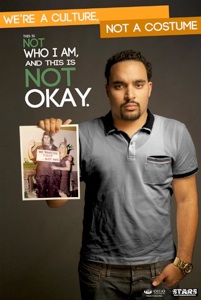
 Students Teaching About Racism in Society (STARS) at Ohio University began a poster campaign to educate folks about the hurtful nature of racist costumes with the slogan "we're a culture, not a costume." All of the costumes they depict are real, and are perennially reprised. They get big props for concisely and clearly communicating what many of us have been frustrated with for years.


So, before dressing up this year, refer to Austin C. Brown’s guide to finding culture-appropriate costumes. And if you are looking for some clever alternatives, check out Take Back Halloween, and try some new themes this year.

Sunday, October 8, 2017

Creation Myths: Christopher Columbus


What we now accept as the true history of the United States in reality is comprised of decades of creation myths. After the American revolution, having separated ourselves from the rich history of Europe (and having sneered at this continent's indigenous histories to the point of annihilation), the newly formed United States found itself without a heritage with which to construct its new civilization. We were left without a history, without heroes or cultural icons. And the void needed to be filled.

As a result, we now have a cultural reliance on several sacred stories of our foundation. We revere the country's holy texts, and ritualistically repeat the essential creeds to our children. The stories of Jamestown, the pilgrims, and Plymouth Rock can be piously recalled. Yet none of the modern tales match the actual reality of our past. James Baldwin notes, "what passes for identity in America is a series of myths about one’s heroic ancestors."

And we have made heroes out of our cruelest ancestors, not the least of which was Christopher Columbus. After first encountering the Arawaks, Columbus realized "with 50 men we could subjugate them all and make them do whatever we want." Thus was born America's true founding legacy.

To take advantage of Columbus's 'discovery', Spain declared that "with the help of God, we shall powerfully enter into your country, and shall make war against you in all ways and manners that we can, and shall subject you to the yoke and obedience of the Church and of their highnesses; we shall take you, and your wives, and your children, and shall make slaves of them, and as such shall sell and dispose of them as their highnesses may command; and we shall take away your goods, and shall do you all the mischief and damage that we can, as to vassals who do not obey, and refuse to receive their lord, and resist and contradict him; and we protest that the deaths and losses which shall accrue from this are your fault, and not that of their highnesses, or ours, nor of these cavaliers who come with us."


The crimes that followed Columbus's landing set the stage for centuries abuse and atrocity, the legacy of which continues today. Much of these works were carried out in the name of Christ. Consider that the first English ship to carry enslaved West Africans to the New World was named JesusFor hundreds of people this was the first encounter with God's Son, He that had come to 'set the captives free,'

Many of us already know that the stories we heard in grade school are myths. But white America perpetuates and clings to them anyway. Why? Perhaps we are too afraid to look straight into the face of our generational sin. White Americans continue to benefit from our ancestors' actions, and it's time we owned up to the implications.

That Columbus is lauded as a hero is shameful and embarrassing. We need to rethink what stories we tell. Begin by watching this video, and consider who and what we celebrate on Columbus Day:


Thursday, October 5, 2017

Friday Fruit (10/06/17)

Black girl in black dress and sweater with gold necklace in front of teal background with light grey text and insigniaOn Fridays, BTSF offers links to other discussions about race & Christianity. It's an opportunity for you to read other perspectives, and for me to give props to the many voices leading the way...


Weekly Round Up:

These are some of BTSF's links of interest this week. What are yours?

Feel free to contribute your own links in the comments section, or submit items you feel should be included during the week. Self-promotion is encouraged.

Monday, October 2, 2017

Appropriation of Protest

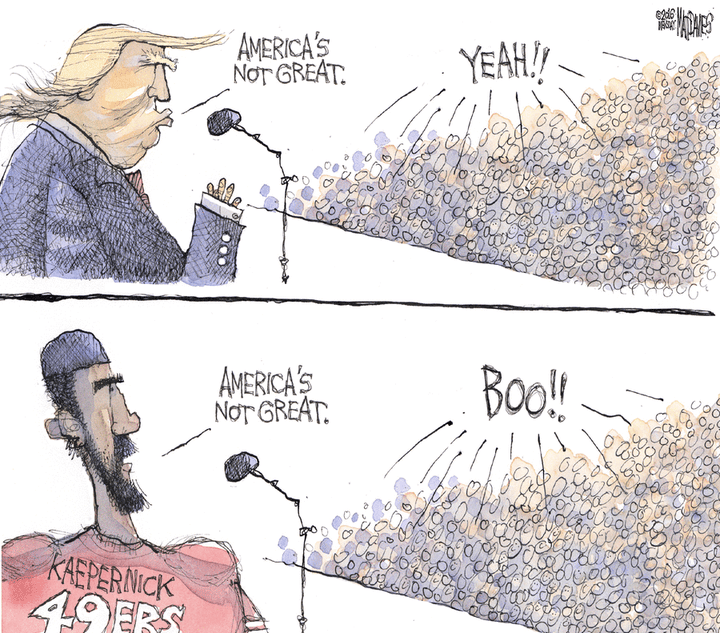
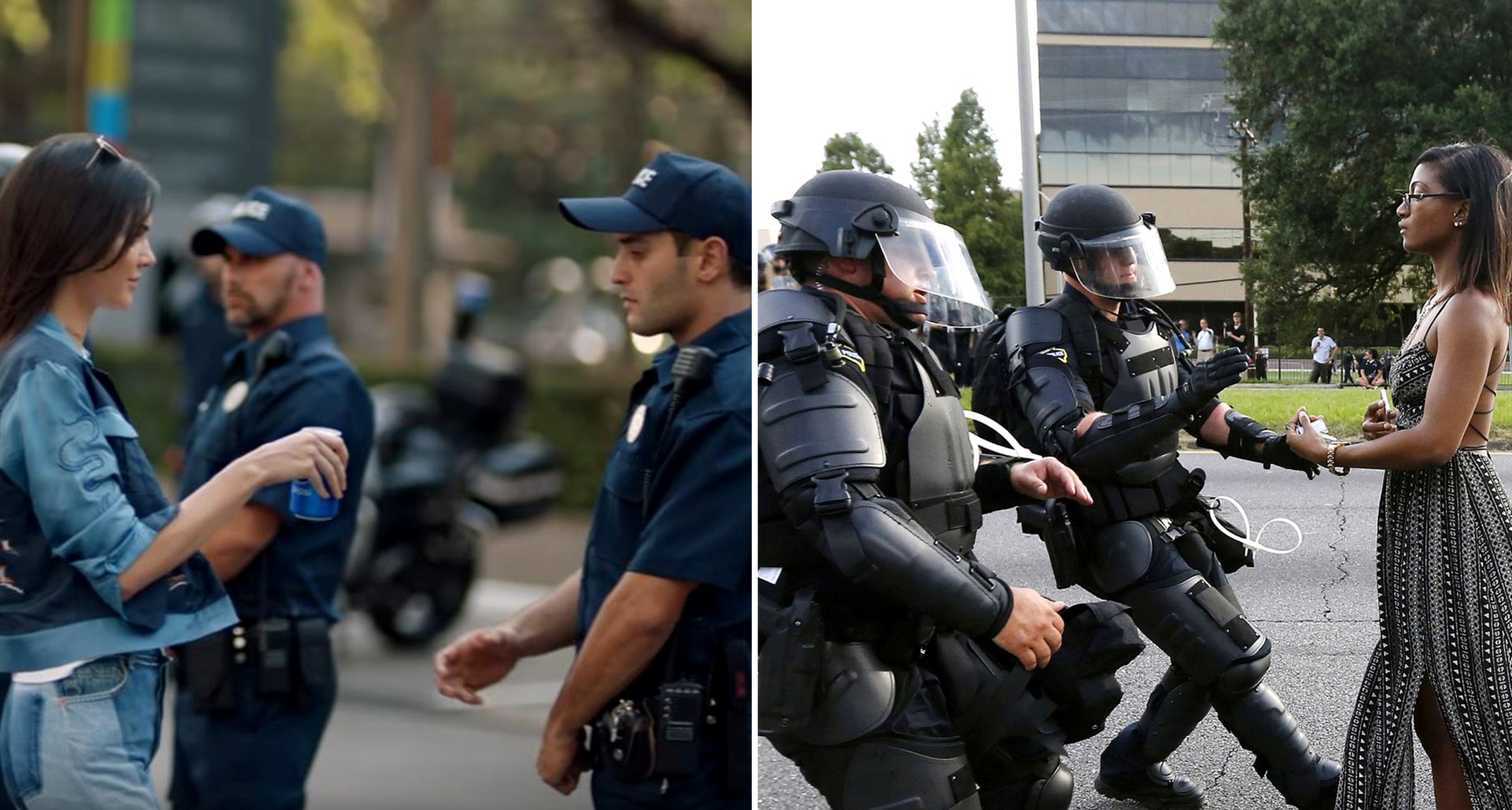
Image result for kaepernick vs trumpI first wrote about 'Taking a Knee' a year ago. That's when Colin Kaepernick began his now famous National anthem protest. He started it to challenge police brutality and racism. Not to make a point about free speech. Not in defiance of Trump.

Now, scores of players, as well as coaches and owners, are taking symbolic postures during the anthem. They're upset that Trump tweeted. They want to express their free speech. They're showing their solidarity. But Kaepernick is still out of a job.

Athletes of color have a long history of political expression, and an equally long history of receiving criticism for it. We want them to entertain us, to serve us, not to challenges us or make us even slightly uncomfortable with the system that put them there.

Abagond observes, "that making it about respect for the flag, or even free speech, draws attention away from what taking the knee is all about: protesting racial inequality and, in particular, police brutality."

Image result for jenner pepsi
And it's not the first time Black expression in the face of oppression has been co-opted by a white narrative. This is the legacy of Black blues, hip hop, fashion, and many other means of voice that were birthed out of a desire to call attention to the lived realities of life as a Black person in the United States.

There is a constant drive in white dominate culture to appropriate, and thus to tame, the expressions of oppressed groups. Indeed, the work of combating injustice itself functions this way. As months protects unfolded after the killings of Michael Brown, there were ongoing calls to “wait for the facts” from many moderate white progressives. Protesters were criticized and marches were deemed a waste of time.

These days, the controversial and “militant” phrase ‘Black Lives Matter’ is worn as a badge of honor by progressive social justice warriors that want to show they are truly ‘woke.’ Marches take place every week across the country for one cause or another. And now anyone that wants to feel like they're taking a stand...can 'take a knee.'

Image result for ironic protestToo often, people of color take the risk first, finding a new and powerful way to make their voices heard. Too often, white folks respond first with anger and skepticism, followed by dismissal, and ultimately finished by co-opting to the point of ineffectiveness or distraction.

It's not necessarily bad that more people have become aware, or have been willing to join a cause. But what if we didn't wait so long to stand up against injustice? What if, in particular, the Church were at the forefront of movements for justice, instead of limping along in the rear? What if we stood for the causes we were asked to stand for...rather than just appropriating the methods to our own ends?

Sunday, September 17, 2017

Sanctuary for Edith Espinal

Image may contain: 6 people, people standingThe Church is a place of sanctuary. This legacy goes back to the earliest days of our faith, offering refuge and shelter for those being persecuted. Will God's people offer sanctuary today? 

Edith Espinal has lived in Columbus, OH a long time. Her three children live here too, and two of them are citizens. Four years ago, she applied for asylum but was denied, as were her subsequent appeals. Immigration Customs and Enforcement (ICE) has given her final notice and she now wears an ankle monitor. On September 18, she faces deportation.

"I don’t want to leave behind my children"

Edith has no criminal record, she's never even gotten a speeding ticket. 

"I'm not a bad person. I've always tried to follow the law"

Columbus faith leaders, spearheaded by Columbus Mennonite Church, are asking ICE "to hear the plea of our neighbor, and join us in keeping her home with her family...We will continue to walk with Edith and her family in hope and prayer until she receives a stay of removal." Without this stay, Edith will be deported. 

How do we as Christians walk in accompaniment with Edith and her family? 
Theirs represents the thousands of other families in similar situations. Afraid of being taken from their home. Afraid of losing their loved ones. Afraid of what comes next.

These are real people. They have faces, they have names. 
Moreover, they are the face of Christ. Will we offer him sanctuary, or will we send him away? 


Luchamos al fin.

Sunday, September 10, 2017

Dream on Dreamer

The following is adapted from a sermon originally given in honor of  MLK Sunday by Rev. Karen Cook. Today, it is reposted as a word of encouragement to DREAMers who face uncertain futures in these times. We love you, we'll keep fighting for you. Dream on.

He was one of the youngest of Jacob’s twelve sons, Joseph the dreamer.

How many of you dream?  What will it take for us to just let go and dream?  Why do dreams puzzle us?  What make a dream a good dream or a bad dream?  

Dream on Dreamer.   

Joseph had these two dreams and he made the mistake of sharing these dreams with his brothers. He said to them, “Listen to this dream that I dreamed. There we were, binding sheaves in the field. Suddenly my sheaf rose and stood upright; then your sheaves gathered around it, and bowed down to my sheaf.” (Genesis 37:6-7)

I didn’t have brothers or sisters but I can just image with my minds eye some jealousy was rearing its ugly head. How dare Joseph have the audacity share this dream with his brothers, his half brothers at that.  Before Joseph’s brothers could recover from the shock of his first dream he told them about the second dream.  

He had another dream, and told it to his brothers, saying, “Look, I have had another dream: the sun, the moon, and eleven stars were bowing down to me.” (Gen. 37:9) Not only did the brothers react but daddy had something to say this time.  “What kind of dream is this that you have had? Shall we indeed come, I and your mother and your brothers, and bow to the ground before you?”  (Gen. 37:10) 

Dream on Dreamer.

It was on a hot Wednesday, August 28, 1963, that Rev. Dr. Martin Luther King, Jr. proclaimed for all American and all of the world to hear: 
Image result for mlk
"Let us not wallow in the valley of despair I say to you today, my friends, so even though we face the difficulties of today and tomorrow, I still have a dream. It is a dream deeply rooted in the American dream. 
I have a dream that one day this nation will rise up and live out the true meaning of its creed: "We hold these truths to be self-evident: that all men are created equal." I have a dream that one day on the red hills of Georgia the sons of former slaves and the sons of former slave owners will be able to sit down together at the table of brotherhood... 
I have a dream that one day every valley shall be exalted, every hill and mountain shall be made low, the rough places will be made plain, and the crooked places will be made straight, and the glory of the Lord shall be revealed, and all flesh shall see it together."
Dream on Dreamer.  

Joseph’s half brother Reuben said, “let’ not kill him; let’s defer him.” Other brothers said, “Let’s sell him into slavery, and file him away in that part of the memory bank labeled deferred and forgotten.  
And we will see what will become of his dreams.”

Joseph’s brothers made a big mistake.  

Joseph tells his brothers about his dreamsThey didn’t know that the Dream-Giver was using what they meant for evil would be used to bring about the fulfillment of Joseph’s dream. They didn’t know that God was using the evil to fortify Joseph and his faith for that moment when Joseph’s own brothers would come to his doorstep begging for bread.  

Because Joseph waited on God, he had been allowed to see the goodness of the Lord in the land of the living.  Because he had trusted the God who gave him this dream; that same God had taken those same dreams that people said couldn’t and wouldn’t never be; and brought them to fulfillment.  That same God had taken those same dreams that folk said he was uppity for dreaming and had no right to dream and turned them into living realities.  I can see Joseph as he looked at his brothers and said, 
“You meant it for evil, but God meant it for good.”

What happens when a dreamer is attacked and his or her dream deferred?  I’ll tell you what happens. The same God who gave the dream uses those hardships, uses the suffering, uses the pain, uses the obstacles which were meant to destroy God’s servants.  Hear this beloved, God will use it as a means to fortify and strengthen the dreamer.  Beloved, I know it may not feel like it now but hold on dreamer, hold on.

The bible says, “We are hard-pressed on every side, yet not crushed; we are perplexed, but not in despair; persecuted, but not forsaken; struck down, but not destroyed” (2 Cor. 4:8-9)

Complentative MLKHis body could be killed but neither Dr. King nor the dream itself could be destroyed because Dr. King had learned to trust the God of Abraham, Isaac, Jacob, the God of Joseph, the God of his mother and father, the God who had set his soul on fire and told him, “I have set thee a watchman on the wall” (Ezekiel 3:17)

Dr. King learned that in all things God’s grace is still sufficient and God’s strength is made perfect in weakness. (Hebrews 11:34)

Dr. King knew that no matter what people said about him or did to him he could not be discredited with God, who had put on his back the multicolored robe of mercy, redemption, salvation, love, and forgiveness which had been purchased by the blood of Jesus on Calvary’s tree.

What happens when the dreamer is attacked and his or her dream deferred?  If you trust God, he will let you see the fulfillment of your dreams.

Beloved, if God has shown you a book and it says authored by________, yet you don’t have a computer or a laptop, or an iPad, baby write that thing out long hand. 

Dream on Dreamer.

If God has put a song in your heart and a melody in your soul, yet you can’t play a lick, baby write down those words and keep humming that melody.  

Dream on Dreamer.

If you are the best cook this side of Parsons Ave. and you see yourself in your own restaurant, baby keep on cooking.  

Dream on Dreamer.

If God has called you to teach, yet you don’t have a degree don’t let that stop you, teach baby teach. Teach your children, teach your grandchildren, teach in Sunday School, teach a bible study. 

Dream on Dreamer.

There maybe one here today, your dream has been laying dormant for many years. If that is you, today starts your journey of fulfilling your dream. I need somebody to shout…I’m getting my dream back!

Dream on Dreamer!
Creative Commons License
By Their Strange Fruit by Katelin H is licensed under a Creative Commons Attribution-NonCommercial-NoDerivs 3.0 Unported License.
Permissions beyond the scope of this license may be available at @BTSFblog