BTSF in chronological order (most recent articles appear first):

Sunday, July 28, 2013

Race as a Social Construct

There is nothing biologically real about race. Nevertheless, it is very real in a social sense, with consequences for our daily lives, both good and bad. Guest contributor, Sarah Quezada at Mission Year explores what it means to navigate a world in which racial lines are biologically blurred.

Click to enlarge
One of my favorite concepts in Sociology (c’mon… you’re honestly telling me you don’t have a favorite Sociological concept??? I don’t buy it…) is the idea of race as a construct. I had to head back to my trusty 101 textbook to help explain.

First of all, I love the distinction spelled out between the words race and ethnicity:
“Whereas people use the term race to refer to supposed biological characteristics that distinguish one people from another… ethnicity and ethnic refer to people who identify with one another on the basis of common ancestry and cultural heritage. Their sense of belonging may center on nation of origin, distinctive foods, dress, language, music, religion, or family names and relationships” (from Essentials of Sociology: A Down-to-Earth Approach 6 edition by James M. Henslin, p213).
Now they share an awesome example. The writer speaks of a young girl who has one “white” and one “black” parent in the States and may be labeled as simply “black.” In more recent years, it’s also likely she would be “biracial.” If she were to visit Salvador in Brazil, however, they “have at least seven terms for what we call white and black” (p215). This child would be classified in one of “whiter” categories.

So basically, on her flight, the girl’s racial classification effectively changed. It doesn’t make a lot of sense to our understanding of race because we think race as connected to biology. But in reality, it’s not. Racial categories are used to label biological characteristics, and those groups can change depending on what culture is doing the classifying.

Here’s another great example from Hotel Rwanda, which is a powerful, yet difficult, movie on the Rwandan genocide:


Once, when I was teaching this chapter in my Sociology 101 class, I had the most perfect moment occur. A student raised his hand. He had a tanned complexion and sandy brown-blonde hair, but basically looked the same as many of the guys in this predominately white classroom. “Well,” he told the class. “My dad is Egyptian, so I guess technically I’m African American.”
Click to enlarge

It quickly poked a hole in a label we use so frequently for “race,” but it doesn’t really “work” in all situations. Because race is really trying to distinguish skin colors, and that’s just difficult to do.

That’s why I get such a kick out of discussions about my white Latino husband. He doesn’t fit into the description people actually mean when they use refer to someone as “white.” But his skin tone is white nonetheless, and in Guatemala, he is considered white. But his being Latino also confuses people because his skin tone doesn’t match what people expect from folks of that cultural heritage.

Society just keeps shifting the labels of race and ethnicity to try to accommodate all the peoples and cultures of the world.


People can be treated differently based on the race they are perceived as belonging to, regardless of their identity with that race. 
  • How might the student in the example above be treated in the United States? 
    • Will his experiences be the same as others that identify as "African-American"? 
  • If race isn’t biologically real, where does disparity between races come from? 
  • How do you see the fluidity of race play out in your context?

Sarah lives in Atlanta with her Guatemalan husband Billy, and their children Gabriella & Isaac. She blogs about cross-cultural marriage and family life, immigration, and multicultural identity at A Life with Subtitles. She is also Director of Operations at Mission Year, a Christian volunteer program. 

Friday, July 26, 2013

Friday Fruit (07/26/13)


Dorothy Counts, 1957
On Fridays, BTSF offers links to other discussions about race & Christianity. It's an opportunity for you
to read about racial justice & Christianity from other perspectives, and for me to give props to the shoulders on which I stand...

Weekly Round Up:

These are some of BTSF's links of interest this week. What are yours?

Feel free to contribute your own links in the comments section, or submit items you feel should be included during the week. Self-promotion is encouraged.

Sunday, July 21, 2013

Bearing Good Fruit

In past articles, we've explored how white Christians bear 'strange fruit' in their approach to race and racism. We've come face-to-face with some of the profound racial failings of the American Church, both modern and historic. Now, let's learn some ways that white Christians can bear good fruit in their witness to a racialized world.

If Christ’s death means restitution for our brokenness, what does that mean for the Church's racial sins? How can white Christians live into redemption for a legacy of injustice and silence? What would it look like for white Christians to ‘go and sin no more’?

Scripture
First, we can learn from scripture that tells us God is not colorblind, and that a diversity of cultures is essential to the Body of Christ. We can learn from the mistakes of the early church, and then begin to identify the effects of race in our own lives.

Education
We can continue the journey by educating ourselves about the modern racialized world in which we live, and our participation in its perpetuation. We can read books that we might have previously ignored, consume media we thought wasn't for us, learn histories that we weren't taught in school. There is must to catch up on in order to be responsible contributors to the cause.

Relationships
Empowered by a new richness of knowledge, we can also form meaningful relationships with people with a wide range of backgrounds and experiences. We can model our friendships after those Jesus chose, surrounding ourselves with a variety of perspectives, and intentionally seeking out the marginalized. Racial justice cannot occur in the academic abstract.

Submission
We can submit to the leadership of people of color: at church, in our workplaces, in our extracurriculars, in the movement. When we do so, we set aside our own agenda and follow the lead of those who best understand the changes that need to take place. White folks will then learn we are not here to save the world, but are rather participants in a greater plan. When we set aside our own need to be at the center, we take the first small step in dismantling the status-quo.

Listen
Then, we will become better equipped to be strong, supportive co-laborers for our sisters and brothers experiencing oppression and marginalization. We can pass the mic, lift to the podium, so that other voices are heard and amplified. We can listen and learn from those who hunger and thirst after righteousness."

Act
And when the time is right, we too can lift our voices to strengthen the call for justice.  We show up in solidarity when we are called upon so that the collective voices of Christ on earth ring loud against both individual incidents of racism and the ongoing system of racial disparity. When national racial tragedies occur, there should be no question as to where the collective church stands.

Thus, the world will begin to see what redemption in Christ means. They will see that white Christians recognize that life on earth isn't as God intended, and that we validate the pain and frustration of our sisters and brothers, rather than trying to silence it. They will see a picture of Christ's grace, and reconciliation lived out in our walk. The world will see that our Christian faith means we value justice and yearn for a restored world.

The world will see Jesus when we bear good fruit. 

What steps have you taken to bear good racial fruit? Find more suggestions here


Friday, July 19, 2013

Friday Fruit (07/19/13)


This week, we have a lot of links looking at the broader issues of race and legal justice. A lot here looks at facts and data, but I would also encourage you to listen to personal accounts and stories to truly begin to understand the events of this week. Christena's 'Reconciliation Replay' is a good place to start.

Weekly Round Up:
  • Precocious 'colorblind' kids react to biracial Cheerios commercial
    • I got a bunch of requests to post this one because it's 'feel good' in a week where we could definitely use it. But, to be honest, I was underwhelmed: blatant racism easy to point--even a child can do it. It takes more nuanced thinking to tackle (and own) the way modern racism has evolved.

These are some of BTSF's links of interest this week. What are yours?

Feel free to contribute your own links in the comments section, or submit items you feel should be included during the week. Self-promotion is encouraged.

Monday, July 15, 2013

The Cross and the Lynching Tree (Part 3: #Justice4Trayvon)

This is the final post of a three-part series examining James Cone's 'The Cross and the Lynching Tree.' Originally drafted before the Zimmerman verdict was announced, I now re-read it convicted anew.

The silence of the body of Christ in the face of Jim Crow violence is striking. How did they not see the injustice? What is it that white Christians are also blind to today?

The demonization that black men underwent during the era of lynching actively morphed the stereotypes against them from docile ‘Sambos,’ into violent hyper-sexualized predators. This stereotype was actively encouraged in order to justify Jim Crow violence in the name of protecting women and ‘family values.’ This legacy forms the basis for many modern prejudices about black men today.

This 'dangerous black male' stereotype is at the root of our preoccupation with the potential violence of a black victim, rather than the actions of his killer. It is why the victim might be tested for drugs, but not the aggressor. It's why the media wrings its hands about over the sensationalized potential for reactionary rioting, rather than on the reality of innocent loss of life. It is also why public opinion over racialized murder trials are almost always split by race.

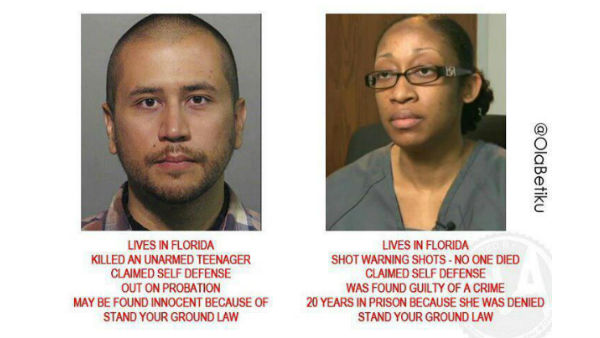
Click to Enlarge
As in the Jim Crow era, juries continue to convict and sentence black folk very differently than white folk for the same crime (See the other Florida 'Stand Your Ground' case). We continue to treat racialized trials as though race doesn't matter or that white folk are unbiased arbiters in such cases. The legacy of pathologizing people of color, while excusing the violence of whites, is now more strongly institutionalized. But it’s also more subtle, with no individual blatant acts of bigotry to raise alarms. This is how modern Jim Crow survives.

How else is the gospel of Jesus’ cross revealed today? "The lynching of black America is taking place in the criminal justice system where nearly one-third of black men between the ages of eighteen and twenty-eight are in prisons.” (163) The persistent 'dangerous black male' stereotype results in a 13x greater prison rate for black men over white men with the same charge.

This legacy is also why 90% of the people stopped and questioned by police in New York City are Black or Latino. Of the Jim Crow era, Joel Williamson notes that “their blackness alone was enough to line them up against walls, to menace them with guns, to search them roughly, beat them, and rob them of every vestige of dignity.” (6) The same could easily be said for stop and frisk policies today.

Jim Crow lynching was a regular reality within your, or certainly your parents’, lifetime. This is not a distant past with perpetrators dead and gone. We exist in a society that has come of age, and been molded by, racialized violence. This proximate legacy effects all of the interpersonal dynamics in our law enforcement, our sentencing laws, our judicial system. Indeed, white folk “still reap privileges from the society that lynching created” (137)

Cone observes that “if the lynching tree is America’s cross and if the cross is the heart of the Christian gospel, perhaps… [it] has something to teach America about Jesus’ cross.” (64) Jesus told us that whatever we have done to the ‘least of these,’ we have done to Him, and thus “every time a white mob lynched a black person, they lynched Jesus.” (158) Indeed, “when we see the crucifixion as a first-century lynching, we are confronted by the reenactment of Christ’s suffering in the blood-soaked history of African Americans. “ (161)

The cross and the lynching tree are inextricably linked in American Christianity. The reality is that “few African Americans are more than a few degrees removed from a similar narrative and the experience that it creates” (Ray). “The cross needs the lynching there to remind Americans of the reality of suffering—to keep the cross from becoming a symbol of abstract, sentimental piety. …yet the lynching tree also needs the cross, without which it becomes simply an abomination. It is the cross that points in the direction of hope…beyond the reach of the oppressor.” (161)

Niebuhr’s lack of empathy in his time reveals a cognitive dissonance not unlike our modern perspective. On the one hand we believe in the sanctity of each life in Christ. We believe in justice and equality. But we live in a country that maintains huge economic, political, and health disparities on the basis of race.

It is often the silence in the face of oppression that is most appalling. In many ways, it is the Peter's denial that is more inexcusable than the physical brutality of Roman guards.  I do not presume that I would have the insight or fortitude to go against the masses then. But let’s challenge ourselves to do better now.

We may want to otherize Jim Crow racists. But if we ask ‘where were the white Christian voices then?’ we must also ask, ‘in what ways do we remain silent now?'
Creative Commons License
By Their Strange Fruit by Katelin H is licensed under a Creative Commons Attribution-NonCommercial-NoDerivs 3.0 Unported License.
Permissions beyond the scope of this license may be available at @BTSFblog