BTSF in chronological order (most recent articles appear first):

Sunday, October 30, 2016

Halloween Costumes

'Tis the season for a reminder...

There are plenty of articles about racially inappropriate costumes, yet every year folks perpetuate appropriation, caricature, and humiliation as Halloween sport. It is annual affliction, so I guess it's worth making the point yet again...

Using a culture, race, or ethnicity as a costume is not appropriate. Ever. 

On Halloween, we get the opportunity to disguise ourselves as something 'other,'something different from normal, something bizarre. That people of color might be one of these costume options is tragic and offensive.

As Lisa Wade notes, Halloween outfits basically come in three flavors: scary, funny, or fantasy. Real cultures shouldn't fit into any of these categories. By using people's identities as costumes, we imply that they are 'not one of us,' or not even fully human, belonging instead to the realm of ghouls and goblins.

In the U.S., we spend the entire year marginalizing people of color, maintaining low visibility on TV, in movies, and in the media, but then suddenly become hyper-interested in 'appreciating culture' for one offensive night (as though dressing as a Hollywood version of what you think a culture is has anything to do with appreciating it).

When we claim that it's all 'good harmless fun,' we reveal our privilege never to have to face the consequences of such stereotypes in our own lives. We reveal the power we hold to dictate who defines 'harmless' and 'fun.' We reveal how loudly our own voices are heard, even as we silence others. We reveal our capacity to imagine fantasy worlds for real cultures, while ignoring the historical baggage that makes us feel uncomfortable.

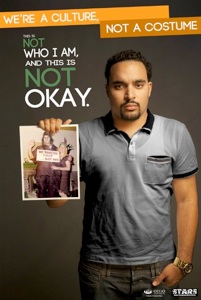
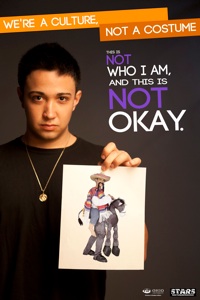
 Students Teaching About Racism in Society (STARS) at Ohio University began a poster campaign to educate folks about the hurtful nature of racist costumes with the slogan "we're a culture, not a costume." All of the costumes they depict are real, and are perennially reprised. They get big props for concisely and clearly communicating what many of us have been frustrated with for years.


So, before dressing up this year, refer to Austin C. Brown’s guide to finding culture-appropriate costumes. And if you are looking for some clever alternatives, check out Take Back Halloween, and try some new themes this year.

Thursday, October 27, 2016

Friday Fruit (10/28/16)

people holding brown and white signs with black text under dimily lit scaffolding against black skyOn Fridays, BTSF offers links to other discussions about race & Christianity. It's an opportunity for you to read other perspectives, and for me to give props to the many voices leading the way...


Weekly Round Up:

These are some of BTSF's links of interest this week. What are yours?

Feel free to contribute your own links in the comments section, or submit items you feel should be included during the week. Self-promotion is encouraged.

Sunday, October 23, 2016

Welcoming the Stranger: #AllPeoplePractices

Image result for welcome the strangerThe following was adapted from a short address given at this weekend's All People Conference in Columbus, OH. 

The Hebrew word “ger” or “stranger” appears 92 times in the Old Testament.  We see that God “defends the cause of the fatherless and the widow, and loves the stranger residing among you, giving them food and clothing” (Deut. 10:18). The bible also tells us not to “oppress the widow, the fatherless, the stranger, or the poor and let none devise evil against another in his heart." (Zechariah 7:10)

Indeed Malachi pretty strongly warns us that God "will be swift... against those who thrust aside the stranger." And in Deuteronomy 10:19 it says “So you, too, must show love to stranger, for you yourselves were once the new kid in the pew.” I may have mistranslated that last one...

But I do know that in Leviticus 19 it says “when a stranger resides with you in your land, you shall not oppress the stranger. The stranger who resides with you shall be to you as the citizen among you; you shall love the stranger as yourself.” I’ve always thought it was funny how some folks jump right over that verse when they’re in such a hurry to quote the chapters on either side of it...

Image result for flight to egypt
Throughout scripture we see that our faith has been founded on the shoulders of strangers seeking welcome in new places. As a teenager, Joseph narrowly evaded death, and was forced to leave his parents to live in a foreign country. We remember Noah, who stuffed his family onto a crowded ship, and endured the tossing waves to escape their eminent doom. We honor Moses, who also floated on a life raft in troubled waters to reach safety as a baby boy. And Jesus himself, who as a child was forced to escape state violence and oppression by crossing a border, and became a refugee in a foreign land. People of God, let us remember who we are!

What if Pharaoh’s daughter hadn't taken in a child in need? What if Joseph the Dreamer hadn't been able to find employment in a new country? What if the Egyptian immigration agents had stopped Mary and Joseph at the border? Where would the Church be today, but for those that were willing to welcome the stranger?

Indeed, the idea of welcoming the stranger is at the very heart of God’s love for God’s people. It can be seen as the distilled essence of the Gospel message itself. For it is in our sinfulness, our estrangement, our stranger-ness, that Christ welcomed us into God’s own family. How can we but do anything else for each other?

Image result for citizen of heavenWe worship a God that does not heartlessly tell us to "go away," but says instead "welcome home." We benefit from a Savior who helped us cross the border into God's land of prosperity, where we are welcomed with the full rights of Heaven’s citizenship.And while we were not natural born members of God’s heavenly Kingdom, we know that Christ has sworn us in as naturalized citizens, having been born again on God’s sovereign soil.

But if at times we are apprehensive before the throne of God, perhaps it is because we know we have barred shut the gates of our own kingdoms at home. And I don’t just mean the gates at our nation’s entrances, but the gates around our own hearts and minds as well.

If we operate out of fear, we end up creating our own famines. We cling to the way it’s always been, and wonder why things never change. We create artificial codes of entry with unwritten rules of behavior and then look around in wonder when yet another local church is laid to rest.

Sometimes our welcome sign is sending mixed messages:
We say “bring your kids, but they’d better not cry”
We say “serve the church, but only if you’re able bodied”
We say “bring your charity, but not those that need it”
We say “bring your diversity, but only if you’ll assimilate”
We neglect our neighbors in the narthex, and vet our visitors in the vestibule
We say “come as you are”…when we really mean “come as we are”
And sometimes we leave the folks outside our walls to wonder why any church would be worth the all that trouble.

We don’t seem to realize is that by building walls--around our hearts, around our churches, and around our country--we are locking ourselves in, more than keeping others out. But Church, I tell you we cannot have open hearts, open minds, open door, while we have closed borders.

Image result for welcomeIt was of course Jesus that said to those who offered love and kindness “I was a stranger and you welcomed me.”

So what does it mean to welcome the stranger?
It means wrapping our arms around those that the world has discarded
It means setting aside our own comfort and preferences for the sake those around us
It means caring for the injustice in others' lives, and working daily to right the wrongs against them
It means affirming that undocumented doesn’t not mean unloved or unworthy
And it means offering forward the same radical welcome that Christ offered to us through His life and death on the cross.

Sunday, October 16, 2016

The Rest of the Ballot

Voting deadlines are looming across the country.
Are you registered? Do you know your polling place?

In an elections season like this one, much of our attention is focused on the presidential race. But so much that affects our daily lives is actually further down on the ticket.

I've always made it a point to vote in all elections,local and national, that were available to me, just on basic stubborn principle. But recent years have emphasized to me how truly important local elections are, even as a matter of life and death.

In Ferguson, Police Chief Thomas Jackson was appointed by the elected  mayor (via city manager). The St. Louis County Chief of Police, Jon Belmar, was also appointed by elected officials (county executive and city council).  In Beavercreek, the city where John Crawford was shot, the elected city council members, city manager, and city mayor were the ones to appoint the Chief of Police Dennis Evers and the ones who determine police budgeting allocations. These are the folks overseeing the police force chains-of-command that establish protocols, that train their officers, that give the orders, that the lead internal investigations, and that buy military equipment for their departments.

And state-level elections matter too. The special prosecutor for the Crawford shooting, Mark Piepmeier, was appointed by State Attorney General Mike DeWine. Florida State Attorney Angela Corey was elected to office in 2008 before famously failing to convict George Zimmerman of murder, even while prosecuting Marissa Alexander to the fullest extent of the law. And it was Florida Governor Rick Scott who first assigned Corey to the Zimmerman case.


County executive? Attorney General? City Council? County Sheriff? State Attorney? When is the last time you paid close attention to who was elected to these offices? But these are the elected positions that had direct influence on the most prominent racial cases of recent history.

Though the narrative is sometimes convoluted, it's the local ballot elections that are at the center of most racial justice issues today. They determine who will be prosecuted under New Jim Crow laws, which legislatures might propose a new Kill-At-Will bill or a mandatory sentencing law. It's the county commissioners, governors, and state officials that determine how your local taxes are spent, whether on police militarization or on public transportation. It's the school board members that decide whether to feed the School-to-Prison Pipeline or to actively reverse systemic educational disparity. It's also these local elections that regulate housing affordability, environmental justice, and discrimination laws--all decisions made at the local level, and with immediate consequences for racial justice.
Source

But as important as local elections are, they're not always made easy. Municipal elections are often held during odd-numbered years (as is the case in Ferguson and Beavercreek), those without major national elections, and thus with lower expected voter turnout. States may enact restrictive laws that reduce voter participation (see post: The Trouble with Voter ID Laws). While Ohio, like most states, allows for early voting, the law is getting more prohibitive, the Supreme Court having recently eliminated all evening voting hours and reduced weekend voting from 24 to 16 hours.

Clearly, laws such as these disproportionately affect working-class folk who hold one or more jobs to make ends meet. Of note, it is also elected local officials, like Ohio Secretary of State Jon Husted, who regulate the elections themselves.

Shouldn't we laud an increase in voter turnout rather than trying to suppress it? Shouldn't we want more citizens to become engaged in electoral proceedings, not fewer? How does decreased participation enhance the democratic process?

Perhaps there is a fear of allowing more people to vote in a democratic society. But if a political party makes gains from voter suppression, what does it say about that party’s platform? Clearly not that it is formed with the benefit all citizens in mind.

Years of disenfranchisement leads to a foundation of legal precedent and accumulated power that perpetuate disparity and injustice. It’s no coincidence that that the Senate is still 94 percent white. As Christians, we know God says to “choose some wise, understanding and respected men from each of your tribes, and I will set them over you” (Deuteronomy 1:13), but some groups are still embarrassingly absent from our leadership.

Christians have a legacy of electing leaders, and we have a responsibility to protect this right for all of our sisters and brothers. The early church decided that it would be good for them to “choose seven men from among you who are known to be full of the Spirit and wisdom. We will turn responsibility over to them” (Acts 6:3). Indeed, we are to “select capable men from all the people — men who fear God, trustworthy men who hate dishonest gain — and appoint them as officials over thousands, hundreds, fifties and tens” (Exodus 18:21). When we exercise the right to vote, we participate in a history passed down to us from both our political and spiritual forebears.

This year, make plans to ensure that you cast your ballot for local elections. Most states allow no-excuse absentee ballot voting, which means you can vote in your pajamas from the comfort of your couch (allowing you to research each of the names and issues that appear on your ballot as you go). As mentioned above, most states also allow for early in-person voting, which means you can find a time to vote that is convenient for your schedule. No excuses this year.

So, check yourself: are you registered? Is your registered address current? Do you know the ID requirements in your state? If you're all set personally, help ensure that your friends and neighbors also understand their voting rights and the importance of local elections. Organize a trip with your church to go vote together, or volunteer to help shuttle voters to the polls on election day.


As Christian voters we have an obligation to “discern for ourselves what is right; let us learn together what is good” (Job 34:4). We tend to pay attention to the Office of the President more than any other elected official. But our voices have the most influence on our own lives, and the lives of our neighbors, when we make sure to vote locally.

Thursday, October 13, 2016

Friday Fruit (10/14/16)

Colorlines screenshot of Unicorn Riot Facebook video, taken on September 29, 2016.On Fridays, BTSF offers links to other discussions about race & Christianity. It's an opportunity for you to read other perspectives, and for me to give props to the many voices leading the way...


Weekly Round Up:

These are some of BTSF's links of interest this week. What are yours?

Feel free to contribute your own links in the comments section, or submit items you feel should be included during the week. Self-promotion is encouraged.
Creative Commons License
By Their Strange Fruit by Katelin H is licensed under a Creative Commons Attribution-NonCommercial-NoDerivs 3.0 Unported License.
Permissions beyond the scope of this license may be available at @BTSFblog