BTSF in chronological order (most recent articles appear first):

Sunday, May 29, 2016

Living Faith Award Address

Living Faith Award logo (blue and yellow flame)The following is a short address I gave last Thursday at the 25th Annual Living Faith Awards Breakfast hosted by the Spirituality Network in Columbus, OH. It is similar to one I gave to a gathering hosted by the UM General Commission on Religion and Race earlier this year: 

So, I am one of those elusive millennials that the Church is always worried about. Supposedly, I’m a part of that apathetic generation, that generation that technology has ruined and and that our parents have spoiled.

And I am also supposed to be of the colorblind generation. While many people of color learn at a very young age what race means for them, I didn’t really learn I was white until college. While I was theoretically aware of race, I had been taught to see no differences. I was taught that we were all the same. That was what was polite.

In high school I believed, we should all just get along. "Pull yourself up by your bootstraps" and pull your pants up too while you’re at it. And I knew I could ignore those tidbits of history that I learned in February, because it wouldn’t be on the final exam anyway.

But when I got to college I joined a Christian fellowship on campus that taught me that our God loves color, loves our culture, and wants us to learn from one another. I learned that we worship a Triune God, perfectly diverse and perfectly united. I learned we worship a God of the oppressed. And I learned that through my isolated dominant culture lens, I could see only dimly the true character of the God I worshiped.

And that launched a journey. I learned how race and ethnicity affected the daily lives of those around me. I learned the history that wasn’t taught to me in school. I read the books I had always passed over in the library. I found out about:
The school to prison pipeline, and stand your ground
About internment camps and exclusion acts
About broken treaties, and trails of tears,
About dreamers trying get to college and children at our border
And about the millions that were colonized and told that their own culture
        was not appropriate for worshiping our white God.
I once was colorblind, but now I see.
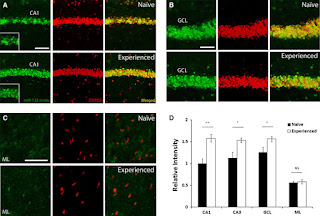
Neuroscience data
From life as a neuroscientist...
And then I moved to Columbus to start a doctorate in neuroscience, an unrelated life filled with glass beakers, petri dishes, and molecular genetics (in my case, all the stereotypes are true). It felt like the “smart choice” goodbye to so much that resonated with my soul. But I was good at it. I liked the lab, and the lab liked me.

So I turned to the digital world to continue my racial education, to serve as the professors of justice and theology that I never had. I started my own blog to hold me accountable and help me to continue to learn. It's called By Their Strange Fruit after the Billie Holiday song and the verse in Matthew that says "ye shall know them by their fruit." Because I believe it is no hyperbole to say that people are being killed in our own backyards because of the Church’s inability to bear prophetic fruit to the nations. Too often we bear 'strange fruit' instead.

It was during this time that my husband and I joined UM Church for All People, which is a multi-race, and multi class church on the South Side of Columbus. We joined out of a belief that isolating ourselves among believers of similar backgrounds only deprives our own souls of God’s majesty. We moved onto the block to be in relationship with the surrounding community. And we adopted a value of downward mobility, not as a charitable endeavor, but as one fundamental to our own souls.

However, the time came for interviews, professorships, and publications. It was time to move away.
But Jesus is a troublemaker and he would not let me go. My labmates thought I was foolish and my family had their questions. But I have never felt something so good, so right, as giving my all to the work of building the Front Porch of the Kingdom of God.
At the Living Faith Award breakfast

And it set me back on my heals. When I finally decided to leave neuroscience to work at Church
for All People full time, it was the easiest hard decision I have ever made.

Because I am of that generation that would rather do something meaningful than something marketable. That generation that would rather make a difference than make a profit. That values authenticity over apathy.

I am of that generation that has been woken up by Trayvon Martin, and Michael Brown, and Sandra Bland, and Aiyana Jones, and Tamir Rice, and Freddie Grey, and Mya Yong, and John Crawford, and Eric Garner. Won't you say their names.

I am of that generation that is tired of my sisters and brothers being used as mascots and as Halloween costumes. That knows that undocumented doesn’t mean unloved or unworthy.

We are not a colorblind generation. We know we are not all eyes, we are not all ears, we are not all hands or feet. And thank God that in all God’s wisdom that we are not!

And I am of that generation that wants my church to believe in that vision as well.

Spirituality Network logoSo that’s why I stand with you today.
Because I love Christ’s Church.
And because I love, I want us to be better.

And it's places like this community that can help us do that. Amen.

Friday, May 27, 2016

Friday Fruit (05/27/16)

Japanese American Internees Read "Letters From Camp" With Muslim KidsOn Fridays, BTSF offers links to other discussions about race & Christianity. It's an opportunity for you to read other perspectives, and for me to give props to the many voices leading the way...


Weekly Round Up:

These are some of BTSF's links of interest this week. What are yours?

Feel free to contribute your own links in the comments section, or submit items you feel should be included during the week. Self-promotion is encouraged.

Sunday, May 22, 2016

A Refuge for Women of Color: #CCDAWOC16

"Clothed with Sun" logo for CCDA WOC retreatThis year's Christian Community Development Association (CCDA) conference will once again offer a post-conference retreat for women of color (WOC). This is an critical event for the conference and its attendees to support.

I am a firm believer in the diverse and unified Body of Christ. But for those who do not belong to the dominant culture, yet must navigate and endure it daily, it is important to have time among one's own. It is imperative to set space aside for fellowship and rejuvenation for those that most intimately understand the unique journey of being a Christian woman of color.

There is the need for sanctified space for those of God's people who are oppressed, marginalized, or in the minority. All through the year women of color are under the white gaze and the male gaze simultaneously, immersed in dominant culture, navigating white and male power. This takes a great social, emotional, and spiritual toll, and it is important to have a reprieve--a time of rest-- in which to fellowship and worship with folks that share lived experiences.

Book cover for 'Too Heavy a Yoke: Black Women and the Burden of Strength'
The planners of the CCDA WOC retreat note that:
"To be a woman of color committed to racial reconciliation and social justice in the Christian church––whether evangelical or mainline––is to be a perpetual outsider. Many of us are culturally and theologically isolated in the spaces where we live, work, and minister. Our existence at the intersection of race and gender invites unique experiences, different from those of our White sisters and our brothers of all races. Sometimes those experiences include struggling to be heard and valued by the very communities and organizations that we serve."
In addition, Dr. Chanequa Walker-Barnes, author of 'Too Heavy a Yoke: Black Women and the Burden of Strength' shares:
"Many of us spend the vast majority of our days as racial-gender outliers. We are used to being one of few people of color in white-dominant circles, one of few women in male-dominant arenas. And we are almost always the first or only woman of color. We are the marginalized among the marginalized. We are used to walking on eggshells, filtering our words and behaviors so as not to make waves, having our opinions discounted even as people affirm how important it is for us to be present. Being a woman of color in evangelical social justice organizations is akin being a three-dimensional creature trying to live in a two-dimensional world."
If we, as the Body of Christ, are to come together in diverse and unified worship, it will require tremendous and disproportionate sacrifice on the part of women of color. The multicultural church comes at a great cost for the oppressed and the marginalized, much greater than for those coming from power and privilege.

Last year's WOC retreat participants
To be sure, white men and women will have to sacrifice their comfort and preference to be a part of the multicultural Body of Christ. But in contrast, women of color end up sacrificing their rest, their privacy, their autonomy, their self-care, their safety, their sanity, indeed sometimes their very humanity.

The ongoing oppression of women of color (even, and especially, in Christian spaces) is emotional,
spiritual, and physical violence acted upon them. The consequences are long lasting. The need for sanctuary is real.

Thus, the WOC post-conference retreat "is an opportunity for women of color to come together to:

  • Share the blessings and burdens of being women of color in Christian social justice ministry
  • Form strategies to sustain personal and professional wellness in the midst of cultural trauma and isolation
  • Renew our commitment to justice and reconciliation in the body of Christ
  • Enjoy fun and fellowship as sisters in Christ"
This is a vital part of of our work as the Body of Christ.

If you'd like to help make this post-conference happen, consider donating by clicking here. I'm glad I did (both this year, and now this year as well)! Indicate 'I'm donating towards a specific event.' and type "Women of Color Retreat." Just $79 can sponsor one person to attend! 

Thursday, May 19, 2016

Friday Fruit (05/20/16)

Loreal Juana Barnell-Tsingine
On Fridays, BTSF offers links to other discussions about race & Christianity. It's an opportunity for you to read other perspectives, and for me to give props to the many voices leading the way...


Weekly Round Up:

These are some of BTSF's links of interest this week. What are yours?

Feel free to contribute your own links in the comments section, or submit items you feel should be included during the week. Self-promotion is encouraged.

Sunday, May 15, 2016

Logical Fallacies: The Three Bears Effect

Cartoon Goldilocks chooses between three bowls of porridge
This post is part of an ongoing series on common logical fallacies used in conversations about race. If you have suggestions for logical fallacies that you'd like to see covered, submit your ideas here.

In many of our socialized norms and rhetoric, white people are set up as "normal" or the default against which other cultures are measured. This leads to logical fallacy commonly termed the "Three Bears Effect," in which communities of color are pitted against each other leaving white culture to be the Goldilocks in the middle that is jussst right.

Stereotypes about Asian-Americans often act as foils to those about Black folks. In whatever manner black people are characterized, Asians tend to be pegged as the exact opposite.

Readable text availible here: https://abagond.wordpress.com/2008/05/20/the-model-minority-stereotype/
Dare I mention stereotypes about penis size?
The tightly correlated dichotomy illustrates how contrived all of these stereotypes actually are. 
Check out the chart compiled by Abagond -->

Striking, isn't it?
Surely we don't believe that such descriptions just happen to perfectly parallel each other. These characterizations have been constructed by years of conditioning and prejudice. 

Polarized stereotypes allow us to suppose that if some people of color meet with success racism must not actually be a big deal, while ignoring the many struggles that those under this wide umbrella face. This dichotomy also allows us to assume that there is something wrong with those that don't succeed, and that we can feel secure in supporting the racialized status quo. 

The bowls labeled: Too hot, too cold, just right
Often termed the
 'Three Bears Effect'
Artificial polarization helps to pit people of color against each other, leading to division where we should have unity. The 'divide-and-conquer' strategy helps fuel modern racism. It also allows white folks to sit comfortably in the middle, further normalizing their culture relative to the 'extremes' around them.

By allowing such a false narrative, we belittle the fact that Asian-Americans do indeed encounter a great deal of racism. Even 'good' racial stereotype are never actually as beneficial as they may seem (see post: Model Minority). And at the same time, we vilify Black and Brown communities, rather than focusing on the system racism that is the true menace to society. 

What do you think readers? Does this model of stereotype polarization hold? 
What about other groups of color: how do they fit into this paradigm? 
Creative Commons License
By Their Strange Fruit by Katelin H is licensed under a Creative Commons Attribution-NonCommercial-NoDerivs 3.0 Unported License.
Permissions beyond the scope of this license may be available at @BTSFblog