BTSF in chronological order (most recent articles appear first):

Sunday, November 29, 2015

World AIDS Day (Part 1)

World AIDS Day logo with red ribbon of map of the globeDecember 1st is World AIDS Day. It marks "an opportunity for people worldwide to unite in the fight against HIV." While many treatment advances have been made, 35.3 million people currently live with HIV. As a result, ~2 million people die from AIDS each year, including 270,000 children.

Like so many aspects of life, AIDS diagnosis, treatment, and outcome are affected by race. In the same way that issues of infant mortality, heart disease, obesity, and mental health disproportionately affect people of color, AIDS remains a significant issue for black and brown communities.

Many factors such as income and health care access that affect the prevalence of HIV differ significantly across race. Thus, in 2010 “an estimated 7,000 (57.4%) newly infected youths were blacks/African Americans, 2,390 (19.6%) were Latinos, and 2,380 (19.5%) were whites.” Indeed, according to Colorlines, if black America were its own country, it would rank 16th in the world for the number of people with HIV.
Graph from the CDC showing highest rates of AIDS diagnosis is black populationsIn addition, American Indians are often left out of targeted treatment programs due to small population size. They also have the shortest time between HIV diagnosis and full on AIDS infection, and have worse subsequent survival rates than other races and ethnicities.

In the Asian and Pacific Islander communities, HIV testing rates are terribly low, increasing the risk of carriers unknowingly passing on the virus to others. By many measures Asian American and Pacific Islanders show the highest increases in rates of new infections in the United States. Click here for links to HIV/AIDS education materials in a variety of Asian languages.

Colorlines asserts that "HIV infection rates are an excellent measure for who societies don’t give a damn about." Hatty Lee and Kai Wright note that “globally, those who have access to social and economic capital avoid the virus or, when infected, live healthy lives with it. Elsewhere, infections and deaths continue to mount.” The necessary treatments exist, but access to them remains severely inhibited.
Click for full infographic
from Colorlines

Wright notes that “in the late 1990s, right about when taxpayer-developed lifesaving drugs hit the market and America declared victory over HIV, the epidemic split: Black diagnoses continued climbing as a share of overall diagnoses, while white diagnoses plummeted. In other words, in the part of America where people had access to care, the epidemic changed dramatically; elsewhere, it didn’t.”

The pattern is the same outside the United States. Over 95% of those living with HIV/AIDS are in developing countries. Of these, 8,000 people die per day. Countries like the United States spends ~$1500 per person each year on health care, while Guatemala is only able to spend $41 per capita per year.

While the number of AIDS-related deaths peaked in the United States in 1995, developing countries didn’t begin to see reductions for over 10 more years. The World International Intellectual Property Institute reported that “without AIDS, life expectancy in the year 2010 in Zimbabwe would be 70 years, in Botswana 66 years and in Zambia 60 years. With AIDS, these life expediencies are expected to drop to 35 years in Zimbabwe, 33 years in Botswana and 30 years in Zambia.”

Pharmaceutical companies vigorously lobby against drug access for the countries that need it most, even though sales in these same counties only accounts for 1% of their total profits. The import of generic drugs is often banned, even though they are ten times cheaper (even after 90% discounts from pharma companies).

As president of the Global Health Council, Nils Daulaire stated that “if there were a nuclear war, we wouldn't worry about whether people had their trigger mechanisms patented or not. This is, I hate to use the term, the moral equivalent of war,' he says, referring to the AIDS crisis in Africa.” Thus, the lack of drug access is often characterized as a severe violation of human rights. For more on this story, watch the compelling documentary, Fire in the Blood.

But there are reasons to hope. Is Christ’s Church one of those reasons?
Find out what the Church is doing in part 2

Sunday, November 22, 2015

Refugee Thanksgiving

Norman Rockwell's painting 'Refugee Thanksgiving' of a refugee blessing a meager mealThere is a fear. A fear that they will arrive poor, needing to be taken care of. That they'll be ignorant of our customs and culture. That they will take our jobs, or be dependent on our charity. That they'll bring disease and violence, that they intend to do us harm. That our own hard working residents will have to support them with welfare, and what is ours will be stolen. That once they cross the water, they'll never go back.

And yet, this week we give thanks for a time when hundreds of undocumented immigrants flooded to this land. They failed to assimilate. They scorned the dominant culture. They spoke their own language and refused to adopt the language of the land they had entered.

They brought disease. They brought violence. They brought terror. They were dependent on the social welfare handouts of those who had worked hard to get what they had. What wasn't freely given, they stole. They refused to go back to their own country. But we celebrate them each year on Thanksgiving day.

So which is it? Do we honor immigrants or revile them? Do we value helping those in need, or is it a sign of our weakness? Do we share what we have, or do we hoard it in barns? Do we welcome the stranger or do we send them packing?

A family escapes slavery on a horse
I suppose our answer simply depends on which side of the border we find ourselves.

A month from now, there'll be another holiday.  One that also celebrates a refugee. A Middle Eastern child whose undocumented parents smuggled him across a border to keep him safe from the slaughter that was happening in their homeland. This Holy Family fled to Egypt, where also there had once been a baby that was hidden in a makeshift boat to escape violence and oppression.

We are a Church whose history is filled with refugees who have been the pillars of our faith. Indeed, we pray to a God that does not heartlessly tell us to "go away," but says instead tells us "welcome home." We are foreigners that have been welcomed into God's Sovereign State. Will we not offer others the same?


Image result for "May your choices reflect your hopes, not your fears." -Nelson MandelaYou cannot honor the Thanksgiving story and slam the doors of the country at the same time. Are we a 'nation under God with liberty and justice for all?' Or do we imprison and abuse? Do we say “Give me your tired, your poor, your huddled masses yearning to breathe free” or do shout in the face of Christ  "Not this Man, but Barabbas."

There is a fear. A fear that if we open our arms, it will destroy who we are. But we should be more afraid of what happens if we won't.

Thursday, November 19, 2015

Friday Fruit (11/20/15)

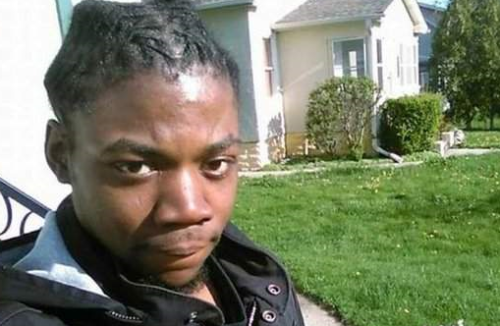
Jamar Clark
On Fridays, BTSF offers links to other discussions about race & Christianity. It's an opportunity for you to read other perspectives, and for me to give props to the many voices leading the way...


Weekly Round Up:

These are some of BTSF's links of interest this week. What are yours?

Feel free to contribute your own links in the comments section, or submit items you feel should be included during the week. Self-promotion is encouraged.

Monday, November 16, 2015

Compromised in Missouri

Israel wanders in the desert for 40 years
As Christians, we understand that history matters, that the mistakes of the past have repercussions for us today. Scripture laments that "our fathers have sinned...and we have borne their iniquities," and we read stories where God "punishes the children and their children for the sin of the parents to the third and fourth generation.”

When God's people built themselves a golden calf, the next generation bore the consequences as well. Surely the younger group said among themselves "it's not our fault that our parents were so sinful. We know better now." And yet, they continued to wander the desert.

White text on black background: "I stand with Mizzou; #IStandWithMizzou"
So when we read current events, it can be helpful to remind ourselves of the history and context out of which they've emerged. Missouri has been the center of so much of the news in this latest chapter of our racial history. The killing of Michael Brown. The militarized show of police that followed. Since then, the deaths of VonDerrit Myers and Antonio Martin. And now, the racism on the University of Missouri's campus that has highlighted the painful realities of being #BlackOnCampus across the country.  So what's the historical context that has led us to wander in this desert? 

Missouri's history is famous for the 1820 'Missouri Compromise' that allowed it to join the United States as a slave state, thus perpetuating the institution in the U.S. and indeed allow it to expand further to the southwest. While the statute did prohibit slavery in northern territories, the Kansas–Nebraska Act essentially nullified that effect in 1854.  It was mostly from Missouri that pro-slavery settlers flooded into neighboring Kansas to influence its becoming a slave state (a scandal referred to a "Bleeding Kansas," due to the subsequent violence that would foreshadow the impending national civil war). 

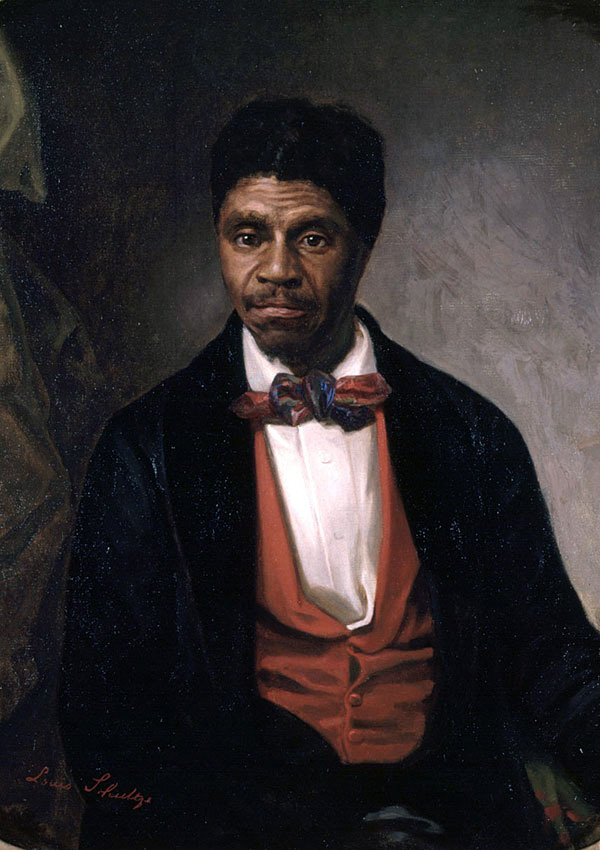
Dred Scott
In 1857, the U.S. Supreme Court ruled in Dred Scott v. Sandford that the federal government could not regulate slavery in the federal territories, officially rendering the Missouri Compromise unconstitutional. It was a case that had originated in the Missouri courts after Dred Scott filed suit for his freedom, having traveled there with his master as well as to other free states. The Supreme Court ruled that regardless of slave status, a Black person was not a citizen and therefore could not sue for freedom, or for any other purpose. This ruling had huge ramifications for all people of color in the U.S. for decades to come. 

During the U.S. Civil War, Missouri was claimed as part of both the Union and the Confederacy, with two competing state governments and was represented in both the U.S. Congress and the Confederate Congress. This situation inevitably led to more conflict and bloodshed, not the least of which at the expense of Black people living in the state. 

The NAACP has records of 81 lynching in the state of Missouri in the 27 years between 1889 and 1916. In 1901, after a white woman was found dead Pierce City, a mob armed with guns and torches cleared out an entire black neighborhood of its residents, all of whom left their property behind and never came back. 

Joplin city logo with motto "Proud of our past, shaping our future"Two years later in Joplin, Thomas Gilyard was lynched from a telephone pole and hundreds other Black residents were driven away from the area. In 1906, a mob in Springfield removed three Black men from jail to the same end. The men suspected of the murder were all quickly acquitted. There are dozens more instances just like these.

Over the span of ten years, terror tactics such of these had driven out over 30% of the area's Black residents. Today, Joplin is 90% white, the surrounding county is 92% white. The motto of the city of Joplin is "Proud of Our Past, Shaping Our Future." I have no doubt. 

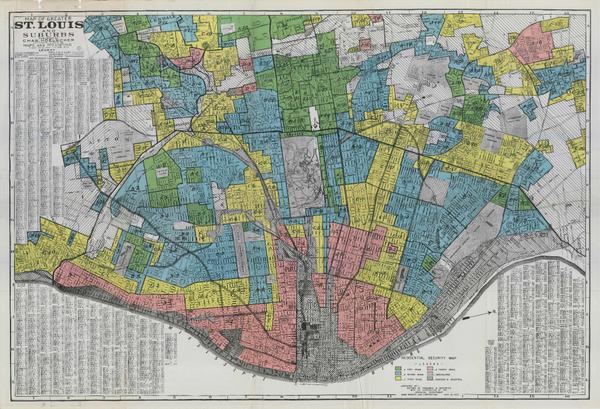
Like other states, Missouri was significantly affected by redlining, the War on Drugs, and other 21st policies that created a direct lineage to the strange fruit it bears today (more about Missouri's racial history can be found here and here ). This history brings context to the dehumanization of Black people that leads to their murder in our communities, to their treatment as second-class citizens in the courtroom, to the scare tactics they face on campuses, to the shows of force that make Black residents fear for their lives and property.

But the point is not to single-out Missouri itself. Indeed, every state has its own racial history that has significant consequences today. Take some time to look into the racial history of your own state, your own city, even your own block.

Redlining map of St. Louis.
Ferguson is clearly visible in the top right.
Was your neighborhood redlined at any point, or was it is a green-lined part of town? Was there white flight to or from your area? Was your city a sundown town that forced all people of color to leave by sundown or face lethal repercussions? What sorts of local and federal sentencing laws enforced the War on Drugs in your city?

Look at the property records for your home and for your church. Is there a Racial Restrictive Covenant in the history of the property where you live? Was your church's land bought using proceeds from the sale of slaves or their property?

This history is important. It puts our current events into a context that informs our interpretation of what we are seeing all around us. Just like our biblical forebearers, we inherit the consequences of generations past. The question is whether we will take definitive steps to break the cycle today. 

Friday, November 13, 2015

Friday Fruit (11/13/15)

On Fridays, BTSF offers links to other discussions about race & Christianity. It's an opportunity for you to read other perspectives, and for me to give props to the many voices leading the way...


Weekly Round Up:

These are some of BTSF's links of interest this week. What are yours?

Feel free to contribute your own links in the comments section, or submit items you feel should be included during the week. Self-promotion is encouraged.
Creative Commons License
By Their Strange Fruit by Katelin H is licensed under a Creative Commons Attribution-NonCommercial-NoDerivs 3.0 Unported License.
Permissions beyond the scope of this license may be available at @BTSFblog