BTSF in chronological order (most recent articles appear first):

Thursday, October 31, 2013

Friday Fruit (11/01/13)

On Fridays, BTSF offers links to other discussions about race & Christianity. It's an opportunity for you to read about racial justice & Christianity from other perspectives, and for me to give props to the shoulders on which I stand...

For those in central Ohio, join us at OSU next Friday, November 8th for:

Weekly Round Up:

    These are some of BTSF's links of interest this week. What are yours?

    Feel free to contribute your own links in the comments section, or submit items you feel should be included during the week. Self-promotion is encouraged.

    Sunday, October 27, 2013

    Halloween Costumes

    There are plenty of articles about racially inappropriate costumes, yet every year folks perpetuate appropriation, caricature, and humiliation as Halloween sport. It is annual affliction, so I guess it's worth making the point yet again...

    Using a culture, race, or ethnicity as a costume is not appropriate. Ever. 

    On Halloween, we get the opportunity to disguise ourselves as something 'other,'something different from normal, something bizarre. That people of color might be one of these costume options is tragic and offensive.

    As Lisa Wade notes, Halloween outfits basically come in three flavors: scary, funny, or fantasy. Real cultures shouldn't fit into any of these categories. By using people's identities as costumes, we imply that they are 'not one of us,' or not even  fully human, belonging instead to the realm of ghouls and goblins.

    In the U.S., we spend the entire year marginalizing POCs, maintaining low visibility on TV, in movies, and in the media, but then suddenly become hyper-interested in 'appreciating culture' for one offensive night (as though dressing as a Hollywood version of what you think a culture is has anything to do with appreciating it).

    When we claim that it's all 'good harmless fun,' we reveal our privilege never to have to face the consequences of such stereotypes in our own lives. We reveal the power we hold to dictate who defines 'harmless' and 'fun.' We reveal how loudly our own voices are heard, even as we silence others. We reveal our capacity to imagine fantasy worlds for real cultures, while ignoring the historical baggage that makes us feel uncomfortable.

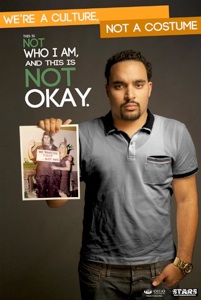
     Students Teaching About Racism in Society (STARS) at Ohio University began a poster campaign to educate folks about the hurtful nature of racist costumes with the slogan "we're a culture, not a costume." All of the costumes they depict are real, and are perennially reprised. They get big props for concisely and clearly communicating what many of us have been frustrated with for years.

    So, before dressing up this year, be sure to check out refer to Austin C. Brown’s guide to finding culture-appropriate costumes. And if you are looking for some clever alternatives, check out Take Back Halloween, and try some new themes this year.

    Friday, October 25, 2013

    Friday Fruit (10/24/13)

    Photo by Queenie Liao
    On Fridays, BTSF offers links to other discussions about race & Christianity. It's an opportunity for you to read about racial justice & Christianity from other perspectives, and for me to give props to the shoulders on which I stand...

    Weekly Round Up:

      These are some of BTSF's links of interest this week. What are yours?

      Feel free to contribute your own links in the comments section, or submit items you feel should be included during the week. Self-promotion is encouraged.

      Sunday, October 20, 2013

      10 Ways Privileged People Can Work for Justice

      Christena and Louisa
      Please welcome guest writer Louisa Davis, by way of Christena Cleveland's blog. A former UCC minister and professor of religious studies, Louisa now co-leads antiracism efforts in Washington, DC.  

      Louisa offers some practical actions steps we can take to combat systemic injustice. Christena notes that  "Louisa’s list is not a checklist or litmus test designed to engender shame. Rather, I hope it will inspire those of us who are privileged to think about the practical things we can do in our respective communities."

      Redeeming Privilege: 
      How privileged people can work for justice

      1. Allow people of color, women or members other oppressed groups to teach and especially lead you (since they usually have more crucial things to do than teach others) even when you think you might have “better” ideas.  Of course, when you think you are really sure of something speak up. But listen for an alternative paradigm, often based more on relationship building and less on Western standards of “efficiency” in my experience. Additionally, read widely to supplement what you learn from personal interactions.

      2. Tithe/donate to social service, religious or political organizations that support oppressed communities an amount based on your family’s/life’s benefits or inheritances from the work of slaves or cheap labor, like maids, farm-workers, and construction workers. I tithed 10% of the profits on the sale of a home in early 2000 since so much of my white family’s small “wealth” has come through home ownership and real estate appreciation in a system that has advantaged white G.I. Bill buyers, colonists, homesteaders, etc.

      3. Join and commit your time (and even commute) to attend regular meetings, volunteer/ministry projects and “extra” social gatherings of Black/Latino/Native/Asian-led organizations where real friendships can be developed across cultural differences.

      4. Look hard at your extra, unused material possessions and imagine how you/they can furnish the closets or whole homes of homeless or poor families (who are likely to be of color especially in our cities.)  Pass on accordingly, simplifying and “opening up” your lifestyle.

      5. Make a spare bedroom in your home available to poor sojourners or activists–not necessarily strangers, but perhaps people in transition who you have come to know through your intentional commitments to community across race, gender and class differences.

      6. Show up at marches or other public witnesses for immigrant rights, voters rights, living wages, budget priorities for the poor, etc—wherever leaders of color point. Put your privileged body where it can be seen and counted by the news-making press–even when not so convenient.

      7. Support restorative justice/non-punitive practices in your schools and communities that hear the pain and needs of both victims and so-called perpetrators. Resist blaming and further damaging the poor and marginalized for their anger and desperation.

      8. Speak up when you hear racism, classism or sexism trivialized as in the recent Paula Deen scandal or even in great films like '42' that focus on racism as name-calling and not its more diabolic and systematic economic and social marginalization of people. Calling someone “nigger” is hardly what is sending hundreds of thousands of poor black children of color to substandard schools and then to prisons.

      9. Speak up (this could be a whole list of its own–-when and how to speak up) when friends make comments about which neighborhoods are “good” or “safe.” It’s not wrong to want to live in as safe a neighborhood as possible but I’ve noticed a lot of privileged people assume communities oppressed people are “unsafe” when in fact they can have systems of neighborly care and support much thicker than most so called good neighborhoods. Besides, we can create strategies for safety wherever we are.

      10. If you choose to integrate traditional or recent communities of oppressed people as a “gentrifier” mitigate the displacement of the poor by employing “good urban manners” (e.g., an awareness of the costs others pay for your privilege): like not calling police/inspectors on more or less harmless “unruly” behavior or possible building infractions that poorer homeowners can’t afford to fix up. Hey, maybe you can donate some skills, labor or money to improvements!

      Let’s grow this list folks–starting where you are.

      And please don’t be intimidated by this personal list which has been hard-won and imperfectly executed after thirty years of trying to “make new mistakes” as a privileged ally.

      Thursday, October 17, 2013

      Friday Fruit (10/18/13)

      From Connie Zhou
      On Fridays, BTSF offers links to other discussions about race &
      Christianity. It's an opportunity for you to read about racial justice & Christianity from other perspectives, and for me to give props to the shoulders on which I stand...

      Weekly Round Up:

        These are some of BTSF's links of interest this week. What are yours?

        Feel free to contribute your own links in the comments section, or submit items you feel should be included during the week. Self-promotion is encouraged.
        Creative Commons License
        By Their Strange Fruit by Katelin H is licensed under a Creative Commons Attribution-NonCommercial-NoDerivs 3.0 Unported License.
        Permissions beyond the scope of this license may be available at @BTSFblog