BTSF in chronological order (most recent articles appear first):

Monday, April 29, 2013

The Cost of Being Poor (part 1)

This is the first of a two-part series on the high cost of being poor in the United States. 

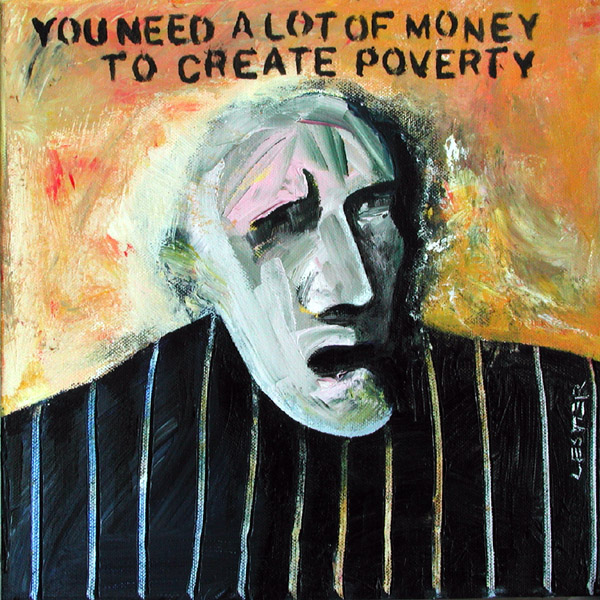
It's expensive to be poor.
"The poorer you are, the more things cost. More in money, time, hassle, exhaustion, menace" says the Washington Post. Most of us wouldn't be able to afford it.

In most states, minimum wage is well below the living wage (there is a big difference in those terms; see post Whose Bad Economy?)  Minimum wage is rarely enough to cover housing costs . One can work full time and still not earn an income that is above the poverty line. Families are forced to make tough choices to stay afloat, living paycheck to paycheck with no opportunity to save. All this in a world where everything is more expensive when you're poor.

The cost of food is higher. Don't even try to buy healthy foods (if fresh fruits and veggies are available at all). Without a car, or money for gas to drive to the suburbs, grocery shopping must be done at small convenience stores that often charge significantly more for basic groceries:
"A local convenience store recently sold Campbell’s Chunky chicken noodle soup for $3.69; Hellmann’s mayonnaise for $4.39; and Jif peanut butter for $3.79. Two-and-a-half miles away, a supermarket sold the same brand of soup for $1.99; mayonnaise for $3.29; and peanut butter for $3.29. If Jif was too expensive, Peter Pan was $2.69. The difference: As much as $3.90 for three items. Fill up a shopping cart and you will quickly see how the poor pay more for food."

A packet of koolaid will always be cheaper than milk, and it is certainly a lighter load if you have to carry it home. Maybe you do have a car to drive to cheaper locations, but if you're below a certain income level, you'll pay more for insurance: "In New York, Baltimore and Hartford, they pay an average $400 more a year to insure the exact same car and driver risk than wealthier drivers." Indeed, "Among the working poor, 13% of income is spent on commuting if public transportation is used, 21% if a private vehicle is used. Workers who earn $45,000 or more spend 2% of their income on commuting.

The Cost of Being Poor
Click to enlarge
this infographic
Housing is another issue. In the midwest, the mortgage on a four-bedroom house is ~$600/month (and interest is tax deductible). But without good credit, or money for a downpayment you end up spending over $1000/month to rent a fraction of that space (with no tax deduction). And even renting requires at least the first month's payment up front, along with a security deposit. Without that kind of cash, your choices are to pay per night at a motel (~1500/month), or live on the street.

Even using money itself is expensive. Checking accounts often charge monthly fees unless one maintains a minimum balance or direct deposit. Without a checking account, it can cost significant fees to cash a paycheck. Without checks, one is also often charged a fee to pay utility bills. And sometimes the money's just not there to pay for food and for the electricity, so you put off the electricity bill, even though you know you'll incur a late fee. And saving money for the future? Worry instead about surviving today.

So without access to banking services, many must turn to predatory payday lenders. You can borrow $300 for a $47 fee. That's only if you pay it back within a week (806% APR). But now at least your rent is covered. Credit card interest rates also vary by income. Making standard minimum payments, it will take 13 years to pay off a $4000 credit card balance carrying the typical 11.5% APR. Bear in mind that the majority of uninsured folks carry over $2000 in medical debt alone.

Continue to the next installment on the high cost of being poor... 

Friday, April 26, 2013

Friday Fruit (04/26/13)

On Fridays, BTSF offers links to other discussions about race & Christianity. It's an opportunity for you
to read about racial justice & Christianity from other perspectives, and for me to give props to the shoulders on which I stand...

Weekly Round Up:

These are some of BTSF's links of interest this week. What are yours?

Feel free to contribute your own links in the comments section, or submit items you feel should be included during the week. Self-promotion is encouraged.

Monday, April 22, 2013

Earth Day and Environmental Racism

Like so many other things, pollution and environmental destruction disproportionately affect both people
of color and the economically disadvantaged. This phenomenon is often referred to as environmental injustice and ties together the concepts of racial/economic privilege with unequal burden of the effects of environmental abuse.

Environmental racism is "the process whereby environmental decisions, actions, and policies result in racial discrimination or the creation of racial advantages." It is characterized by:
  1. Increased likelihood of being exposed to environmental hazards,
  2. Disproportionate negative impacts of environmental processes,
  3. Disproportionate negative impacts of environmental policies, for example, the differential rate of cleanup of environmental contaminants in communities composed of different racial groups,
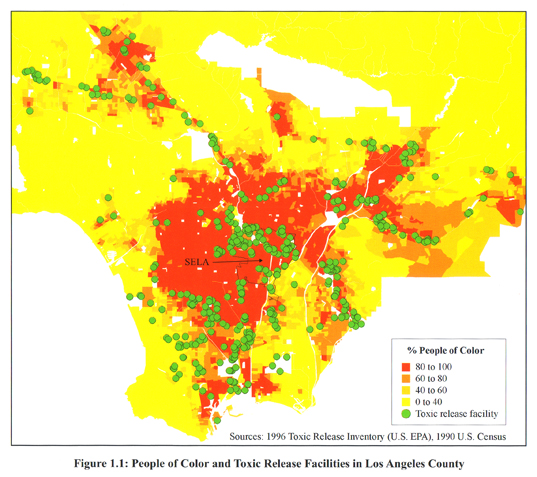
  4. Targeting and siting of noxious facilities in particular communities,
  5. Environmental blackmail that arises when workers are coerced or forced to choose between hazardous jobs and environmental standards,
  6. Segregation of ethnic minority workers in dangerous and dirty jobs,
  7. Lack of access to or inadequate maintenance of environmental amenities such as parks and playgrounds and...
  8. Inequality in environmental services such as garbage removal and transportation.
A double standard exists when it comes to environmental conditions/practices and what is considered acceptable in a given community. Both low-income neighborhoods and communities of color suffer more health risks due to environmental pollution than their more privileged counterparts. Children of color are 60% more likely to suffer from asthma, and twice as likely to experience lead poisoning. Families of color also live closer to landfills and hazardous waste treatment facilities.

It is an unfortunate fact that 53% of white children breathe air that doesn't meet EPA standards. But the rates increase to 63% for Black children, 72% for Asian American children, and 74% for Latino children. Adults face environmental racial disparity as well. Workers of color in many industries are disproportionately exposed to toxins and chemicals. The large majority of hired farm workers that handle pesticides and herbicides are people of color. Van Jones talks about the economic injustice of plastics (great video!), and even more examples can be found here.

In addition, marginalized communities often have less power to alter their environmental circumstances. It was Bullard's foundational report that first described the futile attempt of an affluent Black community in Houston, Texas to block the siting of a hazardous waste landfill in their community. His research demonstrated that race, not just income status, was a factor environmental justice issues. In addition, Sidney Howe, Director of the Human Environment Center, observed that those creating the most pollution live in the least polluted places.

This disparity is reflected all over the world. In Indonesia, American-based Freeport-McMoRan (the world's largest. lowest-cost copper producer) operates a mine that has been dumping 130,000 tons of waste rock per day into local rivers as a means of disposal. They have also been implicated in numerous human rights violations against the folks that used to live on that land.

In Nigeria, a country producing over two million barrels of oil per day (ranked 10th in the world, and 4th of suppliers to the USA), more oil spills every single year than in in the entire famous 2010 BP Gulf spill. The death and destruction is outrageous, but so is the selective media attention. Many more examples of international environmental justice can be found here. Time and again, communities, countries, and individuals in power impose environmental destruction on those who can least afford it.


In researched this post, I was disheartened to find far more articles detailing the tension between Christianity and environmentalism than those lifting up their natural intersections. What can be done? Pastor Marty Troyer offers other examples of disparity, but also some first steps for change in our own lives (see post: Reverb). We live in a broken worlds, and part of the consequences is the daily damage we do to the Earth and our neighbors here.  Sisters and brothers, we can do better.

But ask the animals, and they will teach you; or birds of the air and they will tell you; or speak to the earth and it will teach you; or let the fish of the sea inform you (Job 12:7-8). 

What do you have to learn from the teachers referenced in Job above? Which of Pastor Troyer's suggestions can you commit to in this coming year? Check out Majora Carter's TED talk and what she's doing to combat issues of environmental racism:

Thursday, April 18, 2013

Friday Fruit (4/19/13)

Aamira Fetuga
On Fridays, BTSF offers links to other discussions about race & Christianity. It's an opportunity for you
to read about racial justice & Christianity from other perspectives, and for me to give props to the shoulders on which I stand...

Weekly Round Up:

These are some of BTSF's links of interest this week. What are yours?

Feel free to contribute your own links in the comments section, or submit items you feel should be included during the week. Self-promotion is encouraged.

Monday, April 15, 2013

Accidental Racist

Welcome! Follow more conversations about racial justice and Christianity through email or RSS feed.

In his latest song, Brad Paisley says he's an 'Accidental Racist.' It's actually a fairly accurate description of how white people see themselves in a 'post-racial,' colorblind society today.

While people of color have little choice but to learn white culture in order to navigate in society, white folk can go their entire lives without ever having to understand other perspectives. We learn white history in school, we live in mostly white neighborhoods, we read white books, and watch white movies. We 'don't see race' and we definitely don't talk about it. 

So it's not surprising that white people unwittingly say and do some pretty hurtful things. They make ignorant comment about hair, wear people's identities as halloween costumes, and use human beings as mascots. Then, because of their own ignorance, they become indignant when someone takes offence: "I'm not racist. I'm just appreciating your culture."

Folks think their behavior is ok because they haven't taken the time to understand the racialized context within which we interact today. That ignorance is, in itself, hurtful. It emphasizes the disparate nature of a social hierarchy in which white folk can get by knowing very little about the cultures around them. Their racism feels like an accident, because they didn't intend to hurt anybody (see post: Does Intent Matter?).

But it's not an accident that there is so much racial ignorance in white culture today. One of the problems with 'letting bygones be bygones' is that our modern racial issues aren't just about slavery, and it's not 'all in the past'. It is an ongoing, calculated marginalization that continuously evolves to evade eradication. It's pervasive nature allows it to adapt to new social norms and 'political correctness' so that it can thrive. Let's not ever forget about slavery, but let's also remember the continued persecution that occurs on a daily basis in today's world

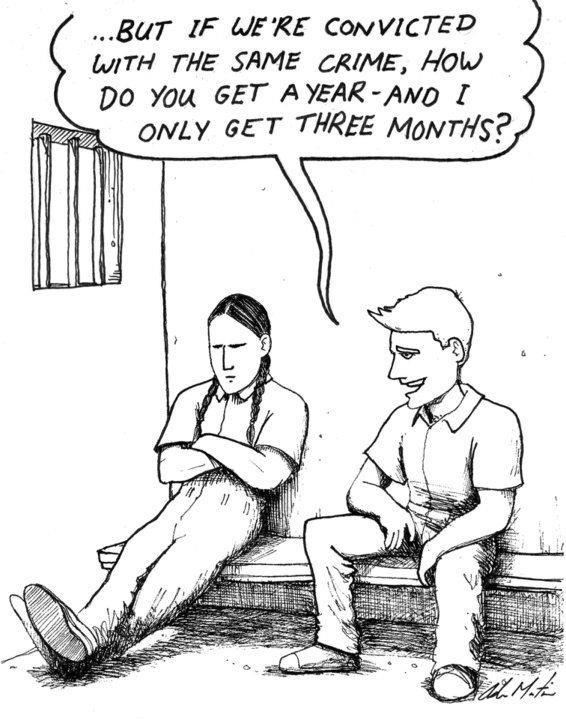
Modern racism is systemic. It's endemic to our education system, our legal structure, and everyday life. Decades of oppression have established an unbalanced system that is no accident. Ignorant complacency simply allows one to benefit from that racialized system without having to own up to the responsibility of its existence. It is no accident that white folk are unaware of painful truths of continuing racism. We don't want to be. 

Without intentionally forming relationships and engaging with others in their daily experiences, we avoid coming face to face with our racial sinfulness. Without an understanding of others' history and culture, we are indeed in danger of being 'accidentally racist.' But if we disengage and ignore reality, isn't that more intentional than accidental?

I haven't even addressed the actual content of Paisley's song. Or LL Cool J's contribution to it. Frankly, there is more foolishness in there than I have space to dig into in this post, and others have done the analysis more eloquently than than I could, so be sure to check them out as well.

Follow more conversations about racial justice and Christianity through email or RSS feed.
Creative Commons License
By Their Strange Fruit by Katelin H is licensed under a Creative Commons Attribution-NonCommercial-NoDerivs 3.0 Unported License.
Permissions beyond the scope of this license may be available at @BTSFblog