BTSF in chronological order (most recent articles appear first):

Sunday, February 23, 2014

Too Busy? Rushing to Judgement

Please welcome back guest writer, Ryan Hansen, a graduate student in clinical psychology who often explores the psychology of racism here at BTSF. 

When we think we are being 'colorblind,' we actually obscure the reality of default prejudice and discrimination in way we think and act (both individually and as a society). It is much easier to ignore our problems than it is to fix them, particularly because fixing them requires active and perpetual attention.

Previously on BTSF, I have discussed a famous study by Gilbert and Hixon (1991). They found that individuals unconsciously used stereotype-related words on a completion task when the experimenter was an Asian-American.  This study, and many more like it, highlight the fact that using stereotypes is the default way in which we think.

That same study also indicated that inhibiting these stereotype-based responses is an active process that requires cognitive resources.  Gilbert and Hixon found that when participants were first given a task requiring a lot of attention, their responses relied even more heavily on the use of stereotypes.

This mental taxation is often called “cognitive load,” and it is a condition in which we frequently find ourselves within our high-speed, multi-tasking modern lives.  The busier we are, the more we will find ourselves contributing to the racial smog within our society. In our high-paced modern lives, we have all the more reason to actively acknowledge and combat our automatic responses based on racial bias.

Looking to Jesus’s examples within his ministry, there are many instances of the Gospel spreading after racial, gender, and ethnic stereotypes are acknowledged and intentionally worked through.  When Jesus met the Samaritan women at the well (John 4: 4-42), they actively talked about the significant ethic, gender, and religious differences between them.  The passage ends with an entire village coming to Christ.

Similarly, when Jesus heals the servant of the Centurion (Matthew 8: 5-13), he actively calls attention ethnic and national identities when he says that “Truly I tell you, I have not found anyone in Israel with such great faith. I say to you that many will come from the east and the west, and will take their places at the feast with Abraham, Isaac and Jacob in the kingdom of heaven.”

Finally, there is the example of the Good Samaritan (Luke 10: 25-37).  The whole reason that this story would have been remarkable in its day is that the Samaritan actively inhibited his fear and stereotypes to help the man attacked by robbers.  As demonstrated by the priest and the Levite, our default behavior, particularly if we are rushed or preoccupied, is to pass by those we should be helping.

How might the pace of your life affect your capacity to be an effective racial reconciler? What steps can you take to consciously combat the shortcuts our brains take when we are busy and stressed? 

Friday, February 21, 2014

Friday Fruit (2/21/14)

On Fridays, BTSF offers links to other discussions about race & Christianity. It's an opportunity for you to read about racial justice & Christianity from other perspectives, and for me to give props to the shoulders on which I stand...


Weekly Round Up:
    These are some of BTSF's links of interest this week. What are yours?

    Feel free to contribute your own links in the comments section, or submit items you feel should be included during the week. Self-promotion is encouraged.

    Sunday, February 16, 2014

    Jordan Davis (1995-2012)

    How long, LORD, must I call for help, but you do not listen? 
    Or cry out to you, "Violence!" but you do not save?

    February 16th, 2014 would have been Jordan Davis's 19th birthday. Instead of celebrating, his family mourned his death and grappled with the news that his killer would not be convicted of first-degree murder. 

    Two years ago, Davis (17 years old, at that time) and his three friends drove to a gas station. Their music was loud, and Michael Dunn objected. He demanded they turn down the volume. They refused. He yelled, they taunted back. Then Dunn pulled a gun and fired ten rounds into their car, killing Jordan Davis. The boys never got out of their vehicle, and no weapon whatsoever was found inside.

    Who gets to decide the difference between an obnoxious teenager and a dangerous criminal? Kill-At-Will laws (aka Stand-Your-Ground), and those like them, encourage citizens to shoot first, and ask questions later. In a world where black boys are stereotyped as violent criminals, race makes all the difference. 

    Dunn initiated a violent encounter. He could have simply walked away and ignored the car's stereo. When the boys refused his request to lower the volume, he again could have simply walked away. Dunn chose a different option. 

    It is worth asking why Davis's music so enraged Michael Dunn. Why did Dunn feel so put upon? Did he feel disrespected? Did he feel the need to put 'uppity' black boys in their place? 

    Why is one scene funny & ironic...
    while the other is deadly?
    (watch TV ad)
    Dunn objected to what he termed Davis's "thug music."  When some words become un-PC, they are often  simply replaced with new racialized dog-whistles. When is the last time a white person was called a thug? We need to understand what is really being said. Imagine the scene if the rowdy boys in the car had been a different race. Or what if music had been a different genre (see video: Retta Rolls on Conan)?  Would Dunn have been just as incensed? Maybe, maybe not. But the racial coding underlying the interaction is unmistakable. 

    Jesse Williams notes that there “is a tradition in this country when people are able to go ahead and kill Black people because they got sassed, because we were inconvenienced, and we become a victim of a fantasy.” He went on to assert that "feeling threatened is not the same thing as being threatened”--and racial bias is key.

    Davis's mother notes, "Jordan had no guns. He had no drugs. There was no alcohol. They were coming from the mall. They were being kids." He had a mother and a father who loved him, but a nation that feared him. Davis did not survive his encounter with Michael Dunn. And no amount of 'family values' or moral upbringing could save him.

    So what about the rest of us? No, we probably would not have pulled a gun. But might we have turned up our nose and those boys in the car? Or maybe shot a bitter glare in their direction? Might we have clutched a purse? Or simply noted them as suspicious?

    Read some of the statements that Dunn made in his letters from jail while he awaited trial. Then pray for all those like him who are fearful--who fear the youth who are the promise of our nation's future. Let us pray for ourselves that God may bind up our own fears and prejudice. And pray for our families and children that they may be shielded by God's protective arms as we go about our lives.

    If a white man wants to lynch me, that’s his problem. If he’s got the power to lynch me, that’s my problem. Racism is not a question of attitude; it’s a question of power. 

    Friday, February 14, 2014

    Friday Fruit (02/14/13)

    Happy Valentines Day!
    Much love to the entire BTSF family!
    On Fridays, BTSF offers links to other discussions about race & Christianity. It's an opportunity for you to read about racial justice & Christianity from other perspectives, and for me to give props to the shoulders on which I stand...


    Weekly Round Up:
      These are some of BTSF's links of interest this week. What are yours?

      Feel free to contribute your own links in the comments section, or submit items you feel should be included during the week. Self-promotion is encouraged.

      Sunday, February 9, 2014

      White History Month

      "Why isn't there a white history month?! 
                 That's reverse racism!"
      Because we already have white history year (decade, centuries...)!

      In the United States, white history is the default, assumed perspective. It's what's taught in the classrooms, portrayed in the media, and informs policy making. We don't need a special month to teach it. It is taught ALL the time.

      Unfortunately, some people think Black History Month is just for black folk. The truth is, we are all missing large chunks of historical knowledge, which hinders us as we move forward today.

      History textbook cover:
      Columbus, but no Native Americans,
       Kitty Hawk, but no Tuskegee Airmen,
      the transcontinental railway,
       but no Chinese immigrant workgangs.
       Just a group of anonymous slaves. 
      A lot of the issues begin early in our education system: textbooks that don't give the full picture, teachers glossing over hard truths. To read my 10th grade history textbook, you'd think black folks didn't exist in the United States until they suddenly become emancipated from slavery, then they disappeared for a while until angry mobs took to the streets demanding civil rights.

      There were maybe two famous African-Americans that were ever taught, Martin Luther King Jr. and Frederick Douglass, but they were portrayed as 'exceptional Negroes' that stood above the rest. My textbook had a small sectioned acknowledging "white resistance to civil rights," followed shortly thereafter by a section on the Civil Rights Acts entitled "The Great Society and the Triumph of Liberalism." Good thing we had a group of white liberal saviors take care of injustice once and for all!

      The same principles apply to many aspects of our history: Native American achievements and contributions, the USA's paternalist relationship with the Philippines, Japanese internment camps, on and on (see Howard Zinn and James Loewen for more). Some of it is mentioned in schools, but too often it's as a footnote or an afterthought.

      How do we hope for reconciliation if we know so terribly little about those to whom we wish to be reunited?How incredibly disingenuous to say "I stand with you" and then have to ask basic questions about the history of our divide.

      White folks' ignorance is the basis for a lot of pain in the reconciliation process. Without a foundational knowledge of Al Jolson and minstrel shows, it might be hard to understand why blackface at a party is never ok. If we learned about our history of appropriation and objectification, we'd better understand why human being shouldn't be sports mascots. White folks are often surprised when marginalized folks get angry over supposedly 'trivial things,' but if we understood our history a bit better, we would probably get angry too. 


      It's important to make a concerted effort to rectify our educational short comings, and setting aside a devoted month to do so can help. Unfortunately, cordoning off four weeks to put MLK's picture up everywhere isn't going to cut it. It is a hollow act of token recognition that just allows us to pat ourselves on the backs for our inclusiveness and then move on with our lives for the rest of the year. 

      Put better by Renee at Womanist Musings:
      "By presenting this as a celebration of 'look how far we have come', we fail to focus on the ways in which race still continues to play a pivotal role in who has access to power in this society. White women are still clutching their purses in the presence of black men, we are still largely portrayed as prostitutes and criminals in the media..."

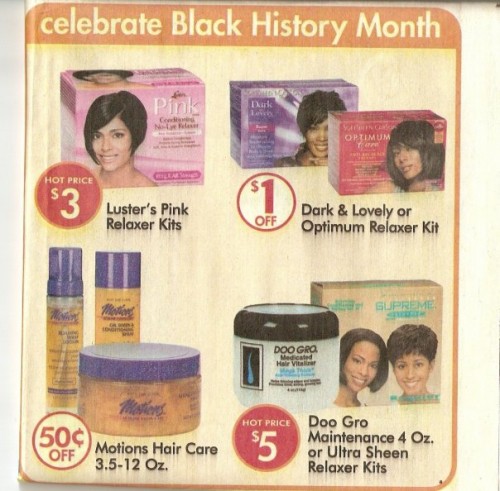
      Ah, yes....the media. Another main culprit, alongside our education system. For one month out of the year, advertisers and big companies use February as an excuse to market to black folks (often very awkwardly), then go back to their true colors on March 1. 

      So in the name of educating ourselves a bit, let's begin with the history of Black History Month itself:

      Carter G. Woodson initiated Negro History Week in 1926 in February to coincide with the birthdays of Frederick Douglass and Abraham Lincoln. The idea was to bring black history to the attention of the broader American public. Then, in 1976 the black history was given an entire month--albeit the shortest month of the year.

      Continuing our history lesson, how about some identification tasks:
      Can you name the 14 people pictured here?
      I'll get you started: MLK, Rosa Parks, Harriet Tubman...

      Name five black figures of
      historical significance....not so hard.
      Now name ten more...

      Do you know who Cathay Williams is? Marian Anderson? Crispus Attucks?  Matthew Henson? Ida B. Wells? Richard Wright? Marcus Garvey? Who are some significant white allies during the civil rights movement? These shouldn't be obscure names to us, but too often they are.

      Can you name the inventor of the light bulb? No problem. What about the carbon filament essential to it? Or the traffic light? hmmm. Telephone? Easy. The blood bank? Not so much. Eyeglasses? yep. Person to patent laser cataract removal? First brain surgeon to perform a hemispherectomy and the first to successfully separate twins conjoined at the head!?!?! Many of us would have starved as children without peanut butter, but have no idea who to thank for it.

      Ok UMC sisters and brothers...
      how about this one? 
      This isn't simply Black history. It's women's history, it's LGBT history, it's military history, it's literary history, it's science history, it's religious history. It's American history.

      Asian-American, Native American, and Latino-American histories are also constantly marginalized and ignored (and now they're even criminalized). If these narratives were given as much weight as white history in the classroom, they wouldn't need their own time set aside.

      Today, I remain profoundly embarrassed that the names of major figures in history are still often unknown to me. I find myself having scramble to catch up, to make up for lost time--cramming names and events that should have been taught to me years ago.  It might not be my fault that my high school let me graduate without this knowledge, but now it's on me to rectify it. I need a black history month...I just need to celebrate it year 'round to begin to catch up.

      If you don't know some of these most famous of examples I cite here (and I really just graze the surface), do yourself a favor and spend the next 30 minutes looking at the links and educating yourself.  Thirty minutes is a small amount of time to a devote to a subject so neglected--but it's a start. You owe it to yourself. 
      Creative Commons License
      By Their Strange Fruit by Katelin H is licensed under a Creative Commons Attribution-NonCommercial-NoDerivs 3.0 Unported License.
      Permissions beyond the scope of this license may be available at @BTSFblog