BTSF in chronological order (most recent articles appear first):

Sunday, November 17, 2013

Why Being “Colorblind” Is Impossible

Please welcome back Ryan Hansen, a graduate student in clinical psychology. Here, he demonstrates why being colorblind just isn't possible:

What do you know about the individual in this picture?


Objectively, you know nothing other than the fact that someone posed for the picture. But take a second to notice what is going on in your head as you look at this picture. The picture is essentially a blank slate, and if you slow down and pay attention you will probably notice that your mind is frantically working to project meaning on onto it. Our brains are built to categorize information and make assumptions, and one of the primary ways that we do this is with social information relies heavily on the use of stereotypes.

Stereotypes, in and of themselves, are not necessarily bad. Living in large groups, it is virtually impossible to treat each individual that you meet as the entirely unique individual that they actually are. You have to find differences in appearance and behavior that allow you to make inferences and assumptions. 

That is not always a bad thing: it keeps you from approaching a kindergartener for help with your calculus or asking someone’s great grandmother for help moving your furniture. It is such a useful ability that it seems to be fundamentally baked into the way that we perceive other people. 

Take a second to take conscious control of this process. First, notice the individual’s age. What inferences does your brain naturally want to make based upon this information? What traits do you assume this individual has? Your brain is activating its age-related stereotypes, and it is probably trying to get you to assume that this individual will be patient, caring, and wise. You might find yourself wanting to assume that this individual wakes up early, or does not use Facebook regularly.

Now take a second, and focus on the individual’s gender. Notice how your perceptions shift. Your brain may try to get you to assume that this individual is nurturing, empathic, and warm. You might find yourself making the assumption that she knows how to cook, and that she may not know how to change the oil in her car.
Finally, take a look at the picture and focus on the individual’s race. You might feel yourself assuming that she is conscientious, emotionally reserved, and intelligent. You might assume that she knows Tai-Chi, and that she may not be the best driver.

Notice that all of this is what you are projecting onto the photograph based upon your stereotypes. You have never met the individual in this photograph, and you have little to no empirical data to support any of the assumptions listed above. Rather, you are basing these assumptions on either a limited set of personal experiences, or on the biased portrayal of social categories in the media you consume. Furthermore, most of the time these assumptions are made without your realizing that you have done so.

A famous study highlights the fact that stereotypes constantly, automatically, and unintentionally influence our thinking in social interactions. In it, participants were asked to do a simple word completion task. You can do it right now- try filling in the blanks: Ri_e, s_y. They found that when the experimenter administering the task was Asian, significantly more individuals gave the answers “rice” and “shy”. When the experimenter was not Asian, significantly more individuals gave neutral answers such as “ride” or “say”. 

The important thing to note is that the people in this study were not consciously paying attention to the experimenter’s race, and they were wholly unaware that they were letting it influence their results. Rather, the simple act of seeing an Asian individual automatically caused these stereotypes to be activated in their minds, and it made stereotypical words slightly more accessible when the participants were searching through their memory banks. If you ask the individuals who participated in this study, they would probably say that the experimenter’s race had no impact on them whatsoever. They probably thought they were “colorblind” throughout the entire procedure.

In this example, the stereotypes were rather harmless, and the impact of these stereotypes was trivial. But it is easy to see how the impact of negative stereotypes across millions of people and billions of interactions could be a lot more problematic. Assuming that you are “color/gender/age blind” because you don’t use vulgar words or actively discriminate when making hiring decisions does not mean that the negative stereotypes that abound in our society have stopped influencing your thinking or behavior. 

These stereotypes are the default basis for the judgments and decisions that we make. We need to consciously see things like gender, race, and age. Noticing our reactions and assumptions, and then correcting for them, will actually help us see individuals as the unique children of God that they actually are.

Thursday, November 14, 2013

Friday Fruit (11/15/13)

Photo credit: Naima Lowe
On Fridays, BTSF offers links to other discussions about race & Christianity. It's an opportunity for you to read about racial justice & Christianity from other perspectives, and for me to give props to the shoulders on which I stand...


Weekly Round Up:

    These are some of BTSF's links of interest this week. What are yours?

    Feel free to contribute your own links in the comments section, or submit items you feel should be included during the week. Self-promotion is encouraged.

    Monday, November 11, 2013

    Cultural Exchange in the Multicultural Church


    Please welcome guest blogger, John Farmer who is on staff with InterVarsity Christian Fellowship at Guilford College. He, his wife, and daughter live in Greensboro, NC. You can follow him here.

    What is the line between cultural exchange and cultural appropriation? I’ve felt that tension many times when trying to explain my love for Mexican or Thai food. Am I truly appreciating those cultures? Am I borrowing from those cultures ethically? Or am I appropriating their cultures for my own enjoyment in a white context?

    A few weeks ago, I shared an article for Friday Fruit that brought up these good questions in my mind and heart, most of which I don't have answers to. But it also didn't address one particular complexity, simply because it was written from a secular perspective: how should cultural exchange happen in the Church?

    The Church is, by the good will and intentionality of God, multicultural. For the thousands of years between the call of Abram and the birth of Jesus, the narrative of Yahweh seemed to be monocultural – taking place in a specifically Jewish context. But we can’t miss the moments where Gentiles were critical participants in God’s movement. 

    It all begins with God’spromise to Abram, Israel’s patriarch: “…in you all the families of the earth shall be blessed.” We must think of Rahab and Ruth, two non-Israelite women who would eventually show up in the genealogy of Jesus. We can’t overlook the widow of Zarephath and Naaman the Syrian from the days of Elijah and Elisha, respectively. Jesus used these two examples in his hometown to show God’s heart for those outside the Israel community, and was promptly driven to a cliff so they could throw him off it.

    Jesus began to undo the misguided thinking that had arisen in Israel that God’s heart was solely for them, teaching in John 10: “And I have other sheep that are not of this fold. I must bring them also, and they will listen to my voice. So there will be one flock, one shepherd.” However much Jesus’ contemporaries missed the not-so-subtleties in these teachings, Pentecost made this reality boldly apparent: God cannot be contained within one cultural reality – God is multicultural. And so the Church, the Body of Christ, is multicultural.

    We have struggled mightily to live into that vision in American churches. So on Sunday mornings, and throughout the week as well, most of us go off into our ethnically divided faith communities. We are the body of Christ, and yet all the eyes, the noses, the hands, and the feet worship separately with those who look just like them.

    Our primary goal as Christians is to move towards Jesus, to become joined together with him, the Head of the Body. Our goal is to be joined together in his vision for the world, his mission to reconcile all people and all things to himself. That means we are mandated as Christians to move towards reconciliation, one with another – one flock, one Shepherd. 

    Cultural exchange is a way we move towards knowing our brothers and sisters. And cultural exchange is a way that we move towards knowing our God, whose image can only be represented by a mosaic of many different cultures.

    Cultural appropriation has shown up in churches because of selfishness. I’ve experienced way too many dramatic representations of kung fu movies, hip hop culture, and other cultural goods in the mostly white churches or ministries I have been a part of over the years. I have participated in them. I have acted them. Because we like to be entertained. 

    But Jesus has called us not to self-entertainment at the cost of our neighbors but to laying down ourselves for the good of our neighbors. If we are ever to know how to do that well to those outside the Christian community, we had better learn how to do it with our brothers and sisters who share faith in Christ.

    To love our brothers and sisters means to build trust in humility. It means to show an interest in the things they enjoy as part of their culture, allowing others to share as much as the trust we have built warrants. And it means being willing to share our own cultural goods in the context of that trusting community.

    We must do this because of the vision of Revelation 7, where the multitude from nation, tribe, and language does not merely tolerate each other or get along. They do not merely say, “Those people do those things, and we will do these things.” They share their cultural diversity, saying one thing in many languages: “Salvation belongs to our God who sits on the throne, and to the Lamb!”

    Friday, November 8, 2013

    Friday Fruit (11/08/13)

    On Fridays, BTSF offers links to other discussions about race & Christianity. It's an opportunity for you to read about racial justice & Christianity from other perspectives, and for me to give props to the shoulders on which I stand...


    Weekly Round Up:

      These are some of BTSF's links of interest this week. What are yours?

      Feel free to contribute your own links in the comments section, or submit items you feel should be included during the week. Self-promotion is encouraged.

      Sunday, November 3, 2013

      War on Drugs

      Fighting drug abuse and crime ought to be a good thing. But sometimes good intentions cause serious harm.

      Through the 1960's and 1970's drugs evolved with production technology and availability. The social stigma of drug use ebbed and flowed with social movements. Some drugs became a symbol of anti-establishment, social rebellion, gaining popularity predominantly among the young, white, American middle class.

      For years, those that could afford to do so turned to powdered cocaine use. But when crack cocaine was developed in 1984, it was sold at much lower price and became available in urban and low-income areas. In cities that were already segregated across racial/economic lines, this meant that a disparity in drug choice began to emerge.

      When the political momentum led to a legislative crackdown on drug use, the sentencing differences for these drugs were stark. The Anti-Drug Abuse Act of 1986 mandated that possession of 5,000 grams of powdered cocaine carried the same sentence as possession of only 50 grams of crack, a 1:100 disparity.

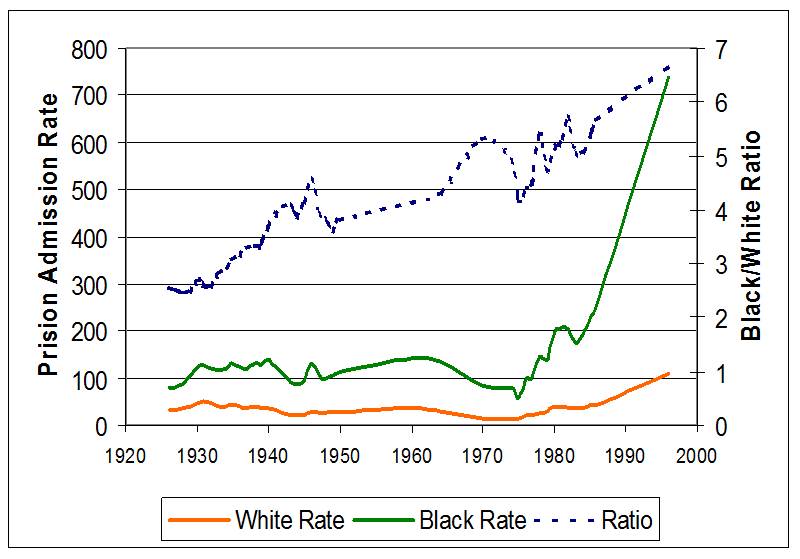
      Mandatory sentencing itself restricted judicial discretion on the bench, and tended to prioritize crimes of possession over, those of trafficking or dealing (Listen to This American Life episode, 'Sentencing'). On top of legalized sentencing disparities, profound racial differences in arrest rates and convictions has lead to decades of extra accumulated prison time for people of color.

      Though black folk represent only 13% of drug users (paralleling national racial demographics), they account for 35% of drug arrests, 55% of convictions, and 74% of those sent to prison on drug possession charges. Indeed, even though 72% of drug users are white, black men are 13 times more likely to be sent to prison for a drug offence than white men (see post: New Jim Crow).

      Click to enlarge
      In 1995, the U.S. Sentencing Commission released a report delineating the racial disparities in sentencing that resulted from 'War on Drugs' laws, and suggested a equalization of the discrepancy. But for the first time in history, Congress chose to go against the commission's recommendations. Fifteen years later, Congress finally passed the Fair Sentencing Act, but while it reduced some of the disparity, penalties still remain almost 20x greater for crack than for powder cocaine.

      In the meantime, millions of individuals have been convicted under biased laws over the years. The prison systems have swelled and profited, while lives are destroyed:
      "Convicted felons need to find a place to sleep, but can’t get access to public housing because of their felony conviction. If their families live in public housing, the families can get evicted from their homes for housing a felon. They need to find a job, but employers can legally discriminate against them. They need to eat, but felons can be denied food stamps for the rest of their lives."
      With no job, no house, no food, and no allies it's no wonder that there is a 70% recidivism rate.

      Bring back memories?
      I grew up on the legacy of the 'Just Say No' campaign that was in grade schools everywhere. It seemed like a good thing, but in reality reducing complex social issues of race, poverty, healthcare, and unemployment to a catch phrase solves nothing. In fact, these good intentions can often make matters worse by pathologizing and criminalizing the very folks you think you are helping.

      This is all not-so-ancient history. I'd love to hear commentary from folks that were reading the headlines as these policies were being made. Leave your thoughts in the comments section.
      Creative Commons License
      By Their Strange Fruit by Katelin H is licensed under a Creative Commons Attribution-NonCommercial-NoDerivs 3.0 Unported License.
      Permissions beyond the scope of this license may be available at @BTSFblog