BTSF in chronological order (most recent articles appear first):

Monday, September 16, 2013

When Churches are Bombed

Denise McNair. Cynthia Wesley. Addie Mae Collins. Carole Robertson. 

Less than three weeks after King's 'I Have a Dream' speech, 4 little girls were murdered while attending Sunday school at their church.

These children assumed they were safe as they learned to love and follow the Prince of Peace. They assumed that a house of worship was sacred ground. They assumed Christ's ministry of love would yield a world unified by His grace. They were mistaken.

The bombing at 16th Street Baptist Church took place the Sunday after the first racial integration of classrooms had occurred in Birmingham. In addition to the four girls killed, dozens of others were badly injured. In the aftermath, two other young black boys were killed, one of whom was shot by a white teenager--an eagle scout. Both before and after the bombing, Birmingham was a racially divided town. On which side did white Christians stand?

The shattered face of white Jesus in
the bombed stain glass window
"The deaths…in a sense are on the hands of each of us," noted a Milwaukee editorial the day after the bombing. "Who threw that bomb?" asked a Birmingham lawyer, "The answer should be, we all did it." But for white folks, "The overwhelming reaction was one of distancing and denial."

But as with so many recent incidents, the perpetrators were written off as lunatics, rather than as the products of a racialized society for which we are all responsible. The Christians that Jesus had charged with caring for the 'least of these' had failed to protect and defend these Sunday school children from hatred and violence. They had not taken seriously the cries for justice from their black sisters and brothers.

The scripture scheduled
for that Sunday: Luke 23:34
Peniel Joseph notes that "the murder of four black girls in Birmingham reflected the value the larger society placed on black lives." This undervaluing continues today. Joseph goes on to assert that "the circumstances that lead to the injury and killing of black children have changed, but the outcomes remain debilitating and, in certain instances, deadly" and "racism's pernicious effects on the hopes and dreams of African-American children remain." What cries for justice do we dismiss and invalidate today?

Black children continue to be "viewed by myriad institutions in society -- school, courts, police -- as potential predators and prisoners rather than future leaders." White Christians continue to look the other way when it comes to issues like the school-to-prison pipeline, the war on drugs, and stop-and-frisk. They continue to be perplexed by black folks' reactions to incidents like the murders of Trayvon Martin and Oscar Grant.

Does your church remember 4 little girls? Are their names and stories mentioned from the pulpit? Chances are, the answer depends on the race of your church (and of your pastor).

Was the recent shooting at Oak Creek Temple addressed in your church? Did your community actively speak out or take action against it? How do we continue to downplay the laments of the oppressed today?

Friday, September 13, 2013

Friday Fruit (09/13/13)

On Fridays, BTSF offers links to other discussions about race & Christianity. It's an opportunity for you to read about racial justice & Christianity from other perspectives, and for me to give props to the shoulders on which I stand...

Weekly Round Up:
  • On the 50th Anniversary of the Birmingham Church Bombing:

These are some of BTSF's links of interest this week. What are yours?

Feel free to contribute your own links in the comments section, or submit items you feel should be included during the week. Self-promotion is encouraged.

Monday, September 9, 2013

Disparity By The Numbers (Part 1)

Click to watch video:
Racial Discrimination in Everyday Life
In a 'colorblind' world, it is often tempting to believe we live in a 'post-racial' society. We want to believe that race doesn't matter anymore when it comes to shaping someone's chances at succeeding in life.

So what do the data say about having reached racial equality?
Let's take a look at some of the numbers:

Income and Employment 
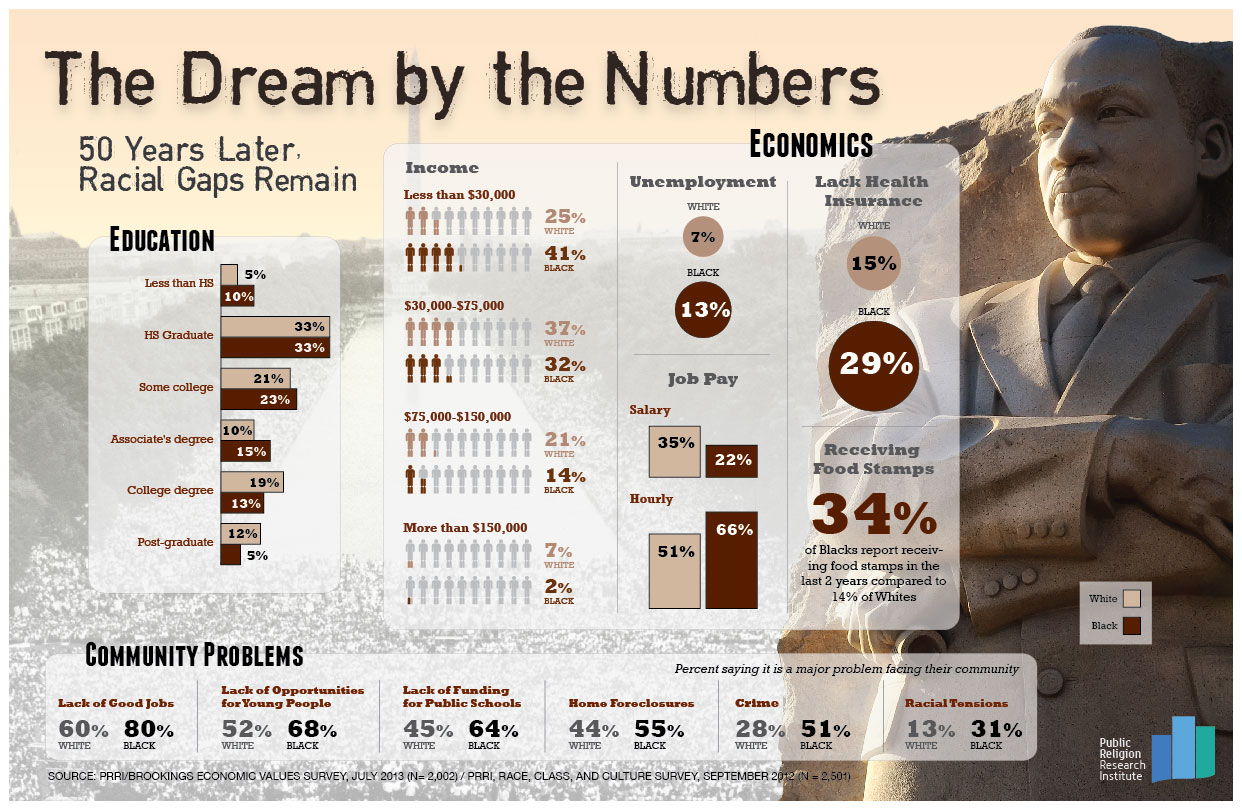
Unemployment rates for Black folk have been double that of white Americans for decades. The statistics that Martin Luther King Jr. quoted during his marches are almost exactly the same today. Black men working full time earn 72% of what white men make at the same job (the disparity grows for black women). The Latino unemployment rate has increased two times faster than whites’ since 2000. People of color are less likely to be interviewed, hired, and promoted than white workers with comparable resumes.

Black children are three times more likely to live in poverty than white children. American Indian and Latino families are more likely to live in poverty. And there hasn't been much improvement over the years. While Latino households made about 76% as much as white households in 1980, it had further decreased to 72% by 2005. The median income for white households was $50,622 in that year,  but was $30,939 for Black households, and $36,278 for Latino households.

Income by Race:
Click to enlarge
The poverty rate was reported at 8.3% for white Americans, but was 24.9% for Black folk, 21.8% for Latinos and 11.1% for Asian Americans. Though it is popular to state that the median family income for Asian Americans is the highest of any race, this statistic is carefully constructed to obscure the true disparity. Per capita, Asian Americans make 20% less than White Americans, and the statistic further crumbles when broken down by nationality.

Indeed,  "Asian Americans top whites in family income only because Asian families have on average more people working per household." Change “family income” to “personal income, and you get a very different story. Given that Asian American poverty is rarely represented on TV and in the news, the pressing needs of many in the community remain invisible and unassisted (See post: Model Minority).

Education 
Black and Latino students are more likely to attend high-poverty schools than white students. Latino, Black and American Indian students also have the highest dropout rates. Economic disparity means more students of color must maintain jobs while attending school in order to contribute to family income. And the pervasive school-to-prison pipeline disproportionately shuttles students of color into the judicial system. Students of color are also less likely to be offered gifted programs, AP courses, or college counseling

Click to Enlarge
Here again, the 'model minority' myth works against Asian American students. An individual's misfortune is more likely to be seen as an anomaly of personal failing than as a consequence of a broken system. This perception leads to under-funding of assistance programs/scholarships for a large chunk of Asian Americans that do not fit the stereotype. Teachers are less likely to offer special help, or even to check in on their Asian American student, leaving them to fend for themselves. But Asian Americans, like Black students, have to stay in school longer to get paid the same as a white person.

How should Christians respond to these statistics? 
What can the Church do to combat systemic racial disadvantage?

Continue to part two to look at housing, incarceration, and health disparities...

Thursday, September 5, 2013

Friday Fruit (09/06/13)

Learn more
Like what you read on BTSF and want to learn more?

Join us at 'Embracing Diversity 2013' hosted by UM Church for All People in Columbus, OH October 26-28.
Mention 'BTSF' at registration and get a $25 discount!


Weekly Round Up:

These are some of BTSF's links of interest this week. What are yours?

Feel free to contribute your own links in the comments section, or submit items you feel should be included during the week. Self-promotion is encouraged.

Sunday, September 1, 2013

Labor Day

Once per year the USA celebrates Labor Day, a national holiday originating from 1800's celebrations of trade workers and the social/economic benefits they bring to our society. So, is this holiday only an antiquated excuse for an extra time to sleep in?

Let's use the day to examine the serious economic and labor struggles that still plague our country.

It is increasingly difficult for the average worker to support a family. In most states, minimum wage is well below the living wage (there is a big difference between the two). Ironically, thousands of folks will go to work on Labor Day because they need the money and can't afford a day of rest.

When folks are desperate for work, they will endure any number of abuses or indignities. They may work in dangerous environments, or be paid less than promised. Workers may be given insufficient training, leading to injury or embarrassment when they don't perform to standards.

Employees may be held at work long after their shift is over, if that is what the boss deems necessary. Maybe they need to pick the kids up from school, but they don't dare leave and risk losing their jobs. Workers may be required to maintain an open schedule to be placed in shifts as is convenient for the company, but may not be told their schedule until the last minute, and so cannot line up child care or other jobs.

Folks may spend an hour on the bus to get to a job, only to arrive and find out they aren't needed that day. Or they work for two hours and then get sent home. "Try again tomorrow." And if they don't show up for that chance, they know they loose the opportunity for later.

There are serious consequences of this labor disparity. Workers skip meals so that their children may eat. Folks turn to loan sharks to make ends meet, entrenching themselves in a spiral of debt. Families make tough choices to cut out "non-essentials" like medicine (see post: healthcare reform), clothing, and nutritious food.

And as the nation bemoans the 7% unemployment rate, unemployment in communities of color remains at 13%. Indeed, while analysis fret about about the housing market, there continue to be huge disparities in homeownership across race.

Take a close look at the words of Jeremiah 22:13-16. Woe to we that profit from injustice and gain economic security at the expense of others! We "who make our neighbor serve us for nothing and do not give them their wages." Jesus himself urges that "the workers deserve their wages." And yet, as more states put an end to collective bargaining, the wealthy receive a smaller tax burden now than they have in the last 80 years.

Part of our problem is that we have a very warped perspective of economic reality. Particularly since housing in the United States is largely segregated by economic standing, people look around themselves and feel that, on the whole, there is equal opportunity and prosperity for everyone.

PBS News Hour recently conducted an informal survey, asking people identify the sort of economy that exist in the USA. Their findings are telling. Also, Jon Stewart points out the huge economic disparities that most folks gloss over. Both of these videos are embedded below.

Take time this week to give thanks for your own economic security, no matter what level it is at.
For more insight into the issue mention above, read Barbara Ehrenreich's 'Nickel and Dimed' or play this excellent interactive game to see what choices you would make given some stark realities.


Creative Commons License
By Their Strange Fruit by Katelin H is licensed under a Creative Commons Attribution-NonCommercial-NoDerivs 3.0 Unported License.
Permissions beyond the scope of this license may be available at @BTSFblog