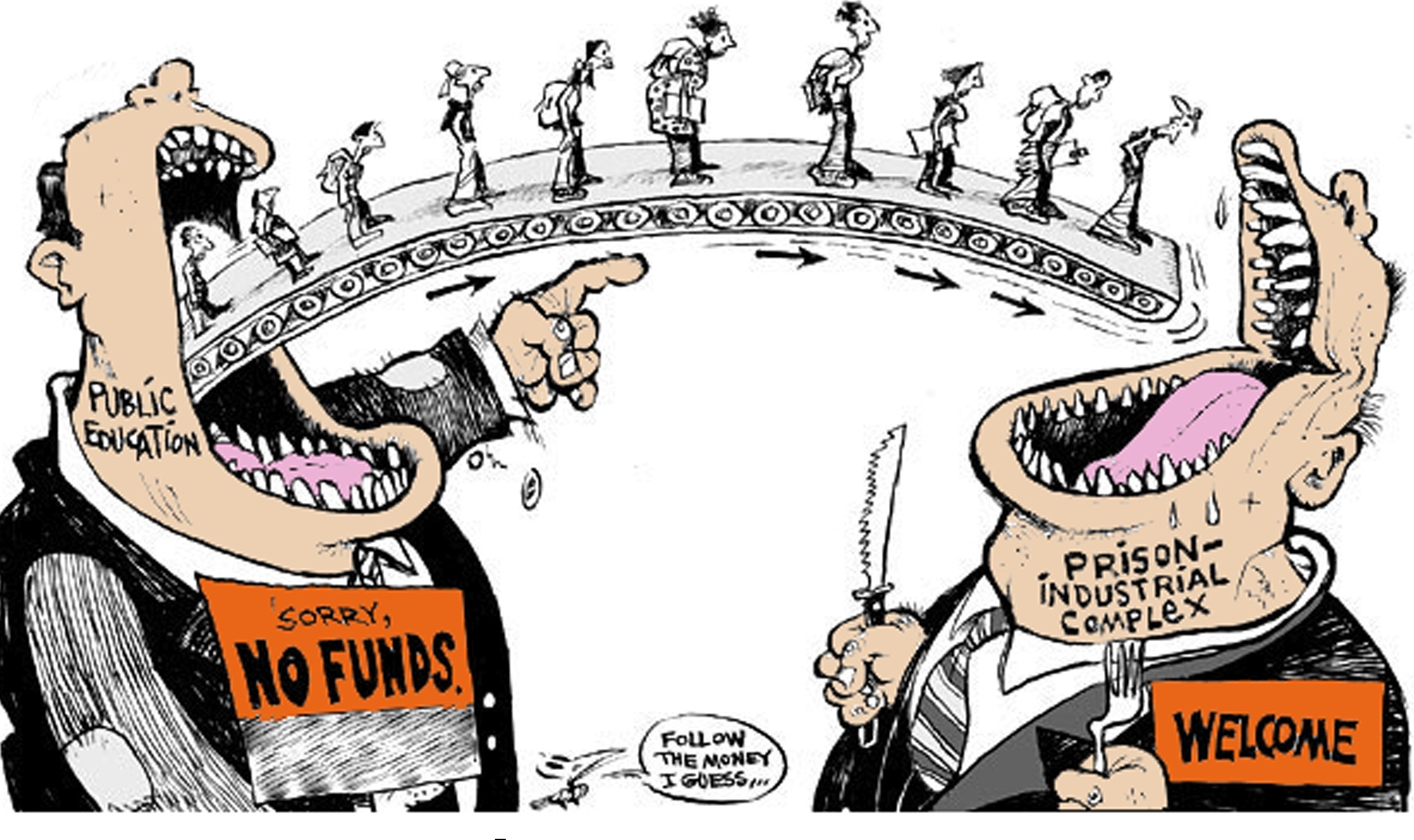
What creates a school environment that criminalizes its students?

 A school's curriculum can also play a part in fueling the school-to-prison pipeline. With No Child Left Behind, and other testing-based regulations, classroom focus has shifted to 'teaching to the test'. Because of the high stakes involved with student performance, these practices incentivise the 'weeding out' of troublesome students.
Common Dreams reports that "schools in Florida gave low-scoring students longer suspensions than high-scoring students for similar infractions, while in Ohio students with disabilities were twice as likely to be suspended out of school than their peers."
Furthermore, when course materials often ignore or disparage students' heritage, children begin to learn that their lives are not important (see post: White History Month). This lesson is reinforced school authorities objectify and harass students as they travel the hallways.
The school-to-prison pipeline carries with it life-long consequences for our children. Students are entangled in the justice system at a early age, prematurely initiating a vicious cycle of criminalization.
Even when law enforcement isn't involved, increased suspension rates result in alienation from the education system and accumulated days of missed school. Students don't view the classroom as a place where they belong and relinquish any belief in a right to education. After even a couple of forced absences, students loose the chance to attend college, to earn living wage, and to pass on accumulated wealth to future generations.
It's true that the Bible says "do not withhold discipline from a child" (Proverbs 23:13), but it is also clear that our youth "are a heritage from the LORD, children a reward from Him" (Psalm 127:3). Do we really believe that only certain kinds of children are precious? Thus, we are also instructed "do not provoke your children to anger" (Ephesians 6:4) and "do not provoke your children, lest they become discouraged" (Colossians 3:21)
Play this interactive game to learn how easy it is to get caught up in the school-to-prison pipeline and then find out what you can do to ensure that schools are a safe and nurturing environment for all students.
From the ACLU: How can we ensure safe public schools while respecting all students’ right to education? If you had a million dollars to spend on education in your community, what would you do with it?
As mentioned in the previous post, a push for increased school security has led to schools' hiring full-time police officers as “school resource officers,” to maintain law and order in their hallways. But cops are trained to chase criminals, not to nurture troubled kids. So they "approach youth as they would adult “perps” on the street, rather than children at school."
What might have once been an opportunity to learn from mistakes, now escalates into repeated conflict with law enforcement. In the midst of steep funding cuts and budget crises, these officers are a burdensome expense that in many cases actually impede students' educational opportunity. Alan Singer reports that "at an unannounced scanning at Murray Bergtraum High School in Manhattan in December 2010, police confiscated a reported 500 cell phones, but no dangerous weapons." Thus, students are provided with criminal records instead of school supplies and textbooks.

In addition to an increased presence of law enforcement in schools, increasingly prevalent zero-tolerance policies impose a one-size-fits-all model of educational discipline, mandating that automatic consequences be doled out for certain kinds of offences, regardless of context.
For example, a straight-A student was given a mandatory suspension after holding the door open for a familiar adult because it violated a zero-tolerance policy that required a machine-based identity confirmation security system. According to the ACLU, "under these policies, children have been expelled for giving Midol to a classmate, bringing household goods (including a kitchen knife) to school to donate to Goodwill, and bringing scissors to class for an art project."
Zero-tolerance policies prohibit discretion for cases such as these where full expulsion may not be the most appropriate recourse. Classroom behavioral issues that may have been resolved though mediation or counseling are pushed onto an already-overwhelmed legal system.

Common Dreams reports that "schools in Florida gave low-scoring students longer suspensions than high-scoring students for similar infractions, while in Ohio students with disabilities were twice as likely to be suspended out of school than their peers."
Furthermore, when course materials often ignore or disparage students' heritage, children begin to learn that their lives are not important (see post: White History Month). This lesson is reinforced school authorities objectify and harass students as they travel the hallways.
 |
| Click to view Alexa's journey on the school-to-prison pipeline |
Matt Kelley notes that “Whether or not they realize it, the punishments school officials hand out can literally determine — and derail — the path of a student’s life. Which makes it even more critical that when schools make these decisions, they hand out discipline that’s fair.” Essentially, these policies "push students out of school and into the criminal justice system."
Increasingly, children gain early exposure to prison environments and internalized the idea that they are expected to be criminals. Indeed, "the overuse of suspensions and expulsions may actually increase the likelihood of later criminal misconduct."

We are teaching our children that delinquency is normal and expected of them and their peers. Students learn to distrust teachers, adult mentors, law enforcement, and the judicial system. They learn that jail is an inevitable destination, regardless of their behavior.
George Galvis describes his first experience with police at his school this way: “I was 11. There was a fight and I got called to the office. The cop punched me in the face. I looked at my principal and he was just standing there, not saying anything. That totally broke my trust in school as a place that was safe for me.”
Children are supposed to learn from their mistakes within a supportive environment, but instead they can be haunted by their transgressions. Past arrests affect the severity with which future infractions are punished, and so bad behavior compounds itself. Singer notes that "children on probation are routinely arrested and incarcerated for allegedly violating their probation by committing minor school infractions, such as dress code violations."
 |
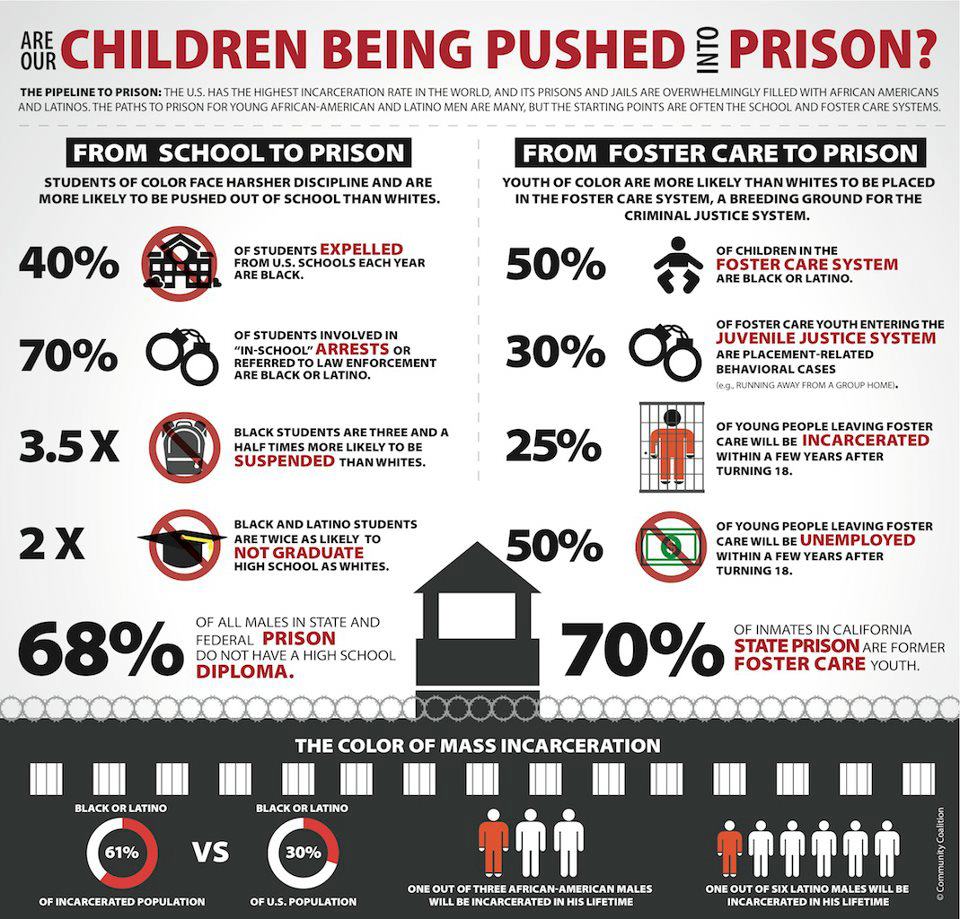
| Click to enlarge infographic |
It's true that the Bible says "do not withhold discipline from a child" (Proverbs 23:13), but it is also clear that our youth "are a heritage from the LORD, children a reward from Him" (Psalm 127:3). Do we really believe that only certain kinds of children are precious? Thus, we are also instructed "do not provoke your children to anger" (Ephesians 6:4) and "do not provoke your children, lest they become discouraged" (Colossians 3:21)
Play this interactive game to learn how easy it is to get caught up in the school-to-prison pipeline and then find out what you can do to ensure that schools are a safe and nurturing environment for all students.
From the ACLU: How can we ensure safe public schools while respecting all students’ right to education? If you had a million dollars to spend on education in your community, what would you do with it?