On Fridays, BTSF offers links to other discussions about race & Christianity. It's an opportunity for you to read about racial justice & Christianity from other folks, and for me to give props to the shoulders on which I stand...
These are some of BTSF's links of interest this week. What are yours?
Feel free to contribute your own links in the comments section, or submit items you feel should be included during the week. Self-promotion is encouraged.
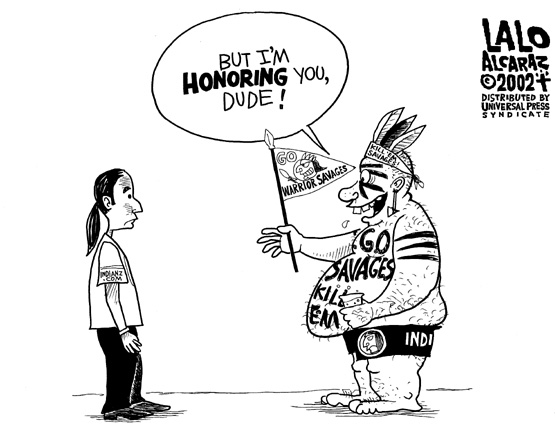
The Washington R****ns name and mascot* (and the many like it) rely upon caricatured stereotypes of those who have been historically subordinated. These negative images are promoted for the entertainment and profit of the dominant culture. Though there are, of course, varying perspectives within the many diverse native communities, this practicehaslongbeendecriedasinappropriate.
The consequences are real. In 2005, the American Psychological Association released its 'Resolution Recommending Retirement of American Indian Mascots,' which cited the many "harmful effects of racial stereotyping and inaccurate racial portrayals, including the particularly harmful effects of American Indian sports mascots on the social identity development and self-esteem of American Indian young people."
Given that most such mascots are associated with schools, we should be particularly vigilant. But as of 2006, over 2,500 elementary and high schools use American Indian mascots. Thus, at an early age we promote the idea that stereotyping marginalized groups is acceptable.
Sports fans routinely claim they are 'honoring' Native American cultures by painting their faces red and sticking plastic feathers in their hair. But perhaps if we truly wanted to honor indigenous cultures, we would begin by honoring their repeated requests to cease and desist with such mockeries. If we really wanted to honor, perhaps we would take the time to learn the true histories, cultures, and stories, rather than promoting monolithic and inaccurate images. If we honestly wanted to honor, we might show interest beyond the moments in which we are simply interested in appropriating for our own gain.
Of the most common sports mascots, most are animals (Eagles, Bears, Falcons, Lions) or objects (Rockets, Jets, Sox, Rockies). What does it say when we add to this list teams like the Chiefs, Braves, and Indians? Even when other human beings are used as mascots, it is as a profession, not as a race or ethnicity itself (Packers, Steelers, Cowboys).
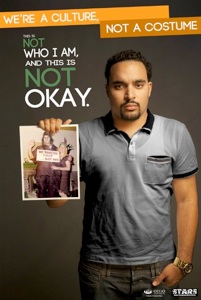
People of color are often otherized to the point of being not fully human. We see the manifestations of this tendency is the use of people as propsinadvertisements (links NSFW), and as Halloween costumes. When we lose our compassion for each other as fellow human beings, objectification and dehumanization facilitate violence and the devaluation of life.
Some of the ease with which we employ such objectification speaks to the invisibility of native cultures within our daily lives. Would you paint your face black, wear an afro wig and prance around the football field trying to imitate your perceptions of black people? Would you lead a pep rally including a fake communion ceremony and selling plastic toy crucifixes as souvenirs?
Given the history of white culture's relationship with American Indian populations, continued profit through the use of caricatured imagery seems particularly heinous. Yet it is all too commonplace. It ushers an environment where it is appropriate for opposing teams to shout things like "hey, Cowboys, finish off those R*****ns" or "Kill the Indians!”
And yet, as a nation, we continue to cling to our mascots like graven idols. We cite years of tradition, argue that offense wasn't intended and so it shouldn't be taken. But ultimately, majority culture shouldn't get a say. It's not about pleasing the crowd's desire to be entertained. We have been repeatedly asked to cease our behavior and yet we have patently refused. Indeed, “when someone says you are hurting them by your action, if you persist – then the harm becomes intentional.”
What does that say about our heart for our neighbor? This neighbor from whom we've stolen land and maligned for generations. The issue of sports mascots is one small piece of a much larger network of injustices against American Indian nations. Most of these issues continue to be ignored or ridiculed.
We need to consider seriously what is at stake when we prioritize our own team pride over the humanity and respect of our sisters and brothers. Are we really more loyal to a mascot than to the reconciled body of Christ?
Have you attended a school that uses imagery of American Indian stereotypes as a mascot? How would your community react to calls for change? What would be your witness? Take a look at this great video that drives the point home (but check out this commentary as well):
*Due to its use as a racialslur, BTSF andotherschoose not to employ the official name, out of respect for those traditionally targeted by the term.
On Fridays, BTSF offers links to other discussions about race & Christianity. It's an opportunity for you to read about racial justice & Christianity from other folks, and for me to give props to the shoulders on which I stand...
These are some of BTSF's links of interest this week. What are yours?
Feel free to contribute your own links in the comments section, or submit items you feel should be included during the week. Self-promotion is encouraged.
The story ofLes Misérables follows Jean Valjean who, having spent 19 years in prison for stealing a loaf of bread, is released on parole. Meeting with severe discrimination as a convict, Valjean breaks his parole and begins a new life under an assumed name.
After a life-altering encounter with a priest, Valjean gives his life to God. He becomes a gentle and respected man, eventually running a business and becoming a town mayor. He offers kindness and aid to those around him because he remembers what it was like to be hungry But his legalistic prison guard Javert is always in close pursuit, threatening to destroy everything Valjean has worked so hard for.
Jean Valjean
It is easy for we in the audience to champion and sympathize with Jean Valjean as we watch the most recent film adaptation of this old story. But what about when we leave the theater?
Both Javert and Valjean are Christian men, acting in the name of God. But as Morgan Guyton notes, they represent two different Christianities and "Javert's Christianity is winning big time in today's America."
"Convicted felons need to find a place to sleep, but can’t get access to public housing because of their felony conviction. If their families live in public housing, the families can get evicted from their homes for housing a felon. They need to find a job, but employers can legally discriminate against them. They need to eat, but felons can be denied food stamps for the rest of their lives."
With no job, no house, no food, and no allies it's no wonder that there is a 70% recidivism rate. Valjean too would have returned to jail but for a grace that is too often denied in our modern world.
But hear what Isaiah 61:1 says: "The Spirit of the Lord God is upon Me, Because the Lord has anointed Me to preach good tidings to the poor; He has sent Me to heal the brokenhearted, To proclaim liberty to the captives, And the opening of the prison to those who are bound." Do we take that scripture seriously?
Fantine
Audiences also sympathize with Fantine, the working girl whose life we watch crumble, eventually leading to her prostitution and death. But if we knew she was turning tricks on our own street corners would we in reality treat her with the same scorn as Javert does?
Fantine is a teen mom who, having refused the sexual advances of her employer, is fired and is unable to get a new job. Her cries for help are unheeded and she struggles to make ends meet, bit-by-bit selling everything she has to stay current on her child-support payments. Having played the role in the the recent film, Ann Hathaway notes that Fantine is "living in New York City right now; she’s probably less than a block away.”
When we see someone digging through a trash dump, or sleeping on the park bench, we're not humming "Do you hear the people sing?" Instead, we're averting our eyes and clutching our purses.
"Javert speaks for all self-made men who believe in the infallibility of the economic order and of the law that sanctifies it. Who know they deserve their fortune, who are quick to judge, who are suspicious of mercy, who enforce the arrangements that keep people in their proper place."
In Javert's world, it is "more unjust to steal bread to feed a starving child [than] to starve children with an economic system that makes bread unaffordable to their mothers, even if it's perfectly legal. " Likewise in our world, "default and amnesty are the twin unforgivable sins of modern capitalism and the penal court."
Guyton poses an interesting question that I will rephrase: if the police were to pick up a kid (with sagging jeans and an attitude) who had stolen your car, would you pretend you had actually given it to him, and remind him he forgot to take your MacBook?
Christ's death lavished God's grace upon us to a magnitude that we can hardly comprehend. Yet we are so stingy with it in return. We cling to our own accomplishments as though we could take credit for even a single breath we draw (see post: Saved from Meritocracy). We dismiss our won shortcomings as innocent mistakes, and scorn the downfall of others. Praise God for His mercy on Javert and Valjean.
Have no fear of robbers or murderers. They are external dangers, petty dangers.
We should fear ourselves. Prejudices are the real robbers; vices the real murderers.
On Fridays, BTSF offers links to other discussions about race & Christianity. It's an opportunity for you to read about racial justice & Christianity from other folks, and for me to give props to the shoulders on which I stand...
These are some of BTSF's links of interest this week. What are yours?
Feel free to contribute your own links in the comments section, or submit items you feel should be included during the week. Self-promotion is encouraged.