BTSF in chronological order (most recent articles appear first):

Sunday, September 11, 2011

What is a post-9/11 American?

Despite declarations of national solidarity, reconciliation across lines of race and religion took a severe beating after September 11, 2001. We proclaimed ourselves part of a unified nation, but it seems there was a limit to our goodwill toward each other.

Diversity, but only to a point
More than ever, the United States is hostile to those perceived to be foreigners. Regardless of actual citizenship, people of color are routinely targeted as 'others,' not truly rightful members of our society. Particularly, harassment and discrimination against Arabic, South Asian, and Latino citizens has escalated over the past 10 years (both by law enforcement and by individuals).

We say we are 'proud to be an American,' but what do we mean by that? Who do we include with ourselves in that statement? Are we proud to include turban-covered heads in our company's TV ad?  Or proud to include Spanish on our voicemail systems?

When we proclaim in memorial services that 'all our lives were forever changed by the events of 9/11,' do we consider the lives that now fear daily unjust retribution for those events?

Take a look at some of the videos posted at Racialicous that give testimony to these fears. People speak of the unity that complete strangers had with one another after the towers came down, but as Shawn Singh notes, it was "only after 9/11 did I feel less of a camaraderie with my peers." We hear in the media about Muslim women being pressured to wear the hijab, but Rabia Said recalls her friend's parents begging their child not to wear it for fear of violence against her.

Seeks Blacks and Latinos,
 but not Sikhs
Many of us can take our characterization as 'American' for granted, but millions (including the President) must defend and prove it everyday.

Too many well-intentioned commentators will remind us that 'both Americans and Muslims lost lives on 9/11,' as though these are necessarily two separate entities. We perpetually entwine the term 'Muslim' with 'foreigner', otherizing and alienating our allies.

As we reflect on consequences of 9/11, allow me to leave you with the following verse for your meditation:

"There is no fear in love. But perfect love drives out fear, because fear has to do with punishment. The one who fears is not made perfect in love. We love because He first loved us. Whoever claims to love God yet hates a sister or brother is a liar. For whoever does not love their sister and brother, whom they have seen, cannot love God, whom they have not seen. And he has given us this command: Anyone who loves God must also love their sister and brother." 1 John 4:18-21
What does 1 John 4:18-21 mean to you? What practical effect does it have on how you conduct yourself in your interactions with others?

Monday, September 5, 2011

Labor Day

Cartoon: Executive hanging a 'happy labor day' sign while standing on the back of a laborerOnce per year the USA celebrates Labor Day, a national holiday originating from 1800's celebrations of trade workers and the social/economic benefits they bring to our society. So, is this holiday only an antiquated excuse for an extra time to sleep in?

Let's use the day to examine the serious economic and labor struggles that still plague our country.

It is increasingly difficult for the average worker to support a family. In most states, minimum wage is well below the living wage (there is a big difference between the two). Ironically, thousands of folks will go to work on Labor Day because they need the money and can't afford a day of rest.

When folks are desperate for work, they will endure any number of abuses or indignities. They may work in dangerous environments, or be paid less than promised. Workers may be given insufficient training, leading to injury or embarrassment when they don't perform to standards.

A cartoon shark dressed as a loan shark
Employees may be held at work long after their shift is over, if that is what the boss deems necessary. Maybe they need to pick the kids up from school, but they don't dare leave and risk losing their jobs. Workers may be required to maintain an open schedule to be placed in shifts as is convenient for the company, but may not be told their schedule until the last minute, and so cannot line up child care or other jobs.

Folks may spend an hour on the bus to get to a job, only to arrive and find out they aren't needed that day. Or they work for two hours and then get sent home. "Try again tomorrow." And if they don't show up for that chance, they know they loose the opportunity for later.

There are serious consequences of this labor disparity. Workers skip meals so that their children may eat. Folks turn to loan sharks to make ends meet, entrenching themselves in a spiral of debt (see post: The Cost of Being Poor). Families make tough choices to cut out "non-essentials" like medicine (see post: Healthcare Reform), clothing, and nutritious food.

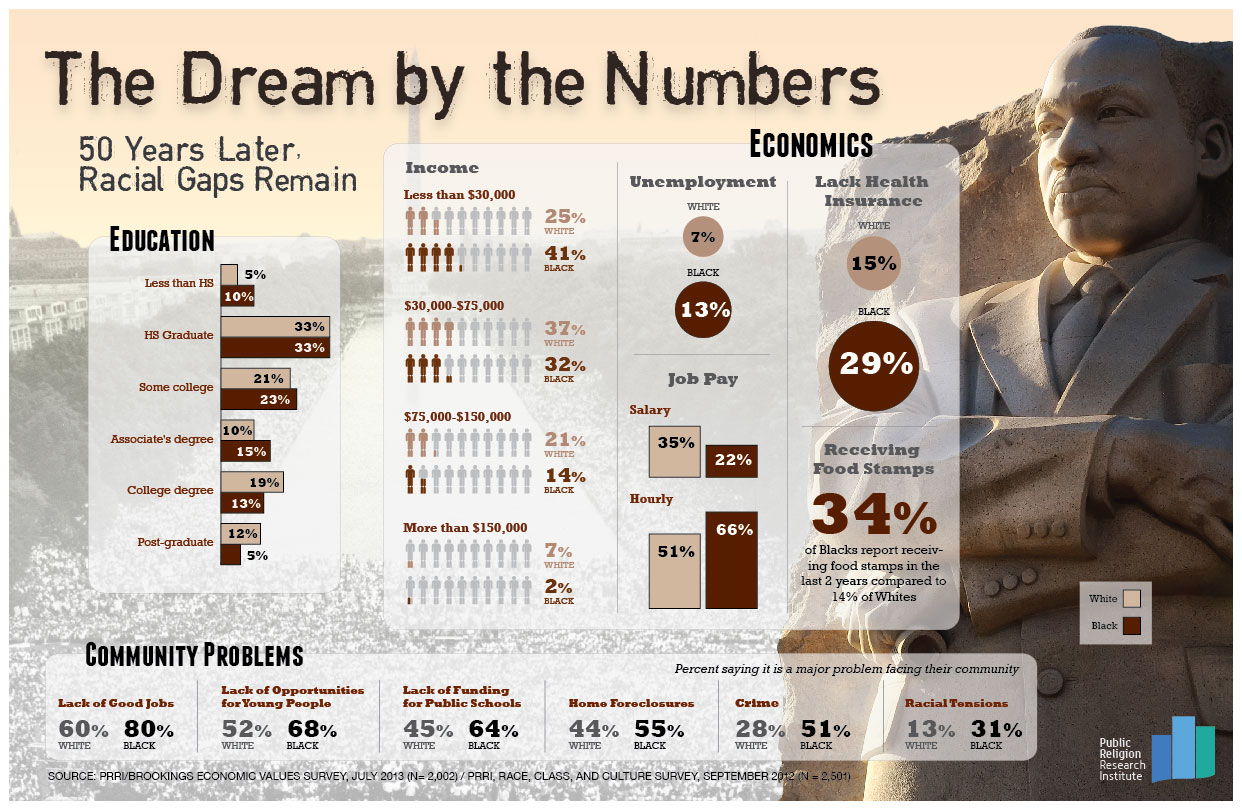
And as the nation bemoans the 7% unemployment rate, unemployment in communities of color remains at 13%--the same racialized wage disparity ratio that Dr. King bemoaned in 1967. Indeed, while analysts fret about about the housing market, there continue to be huge disparities in homeownership across race.

Book cover: Nickel and Dimed
Take a close look at the words of Jeremiah 22:13-16. Woe to we that profit from injustice and gain economic security at the expense of others! We "who make our neighbor serve us for nothing and do not give them their wages." Jesus himself urges that "the workers deserve their wages." And yet, as more states put an end to collective bargaining, the wealthy receive a smaller tax burden now than they have in the last 80 years.

Part of our problem is that we have a very warped perspective of economic reality. Particularly since housing in the United States is largely segregated by economic standing, people look around themselves and feel that, on the whole, there is equal opportunity and prosperity for everyone.

PBS News Hour recently conducted an informal survey, asking people identify the sort of economy that exist in the USA. Their findings are telling. Also, Jon Stewart points out the huge economic disparities that most folks gloss over. Both of these videos are embedded below.

Take time this week to give thanks for your own economic security, no matter what level it is at.
For more insight into the issues mentioned above, read Barbara Ehrenreich's 'Nickel and Dimed' or play this excellent interactive game to see what choices you would make given some stark realities.


Sunday, August 28, 2011

Pointing the Blame

Please welcome guest blogger, Brittany L. Browne! A recent graduate of Ohio Dominican University, she is a freelance writer with Columbus Messenger, and a Racial Justice Coordinator with the YWCA Columbus AmeriCorps program. Connect with her via Linkedin or follow her on Twitter @britbrowne.

Just when you thought Sunday was getting better at being more inclusive, it’s still the most segregated hour of the week in America. The claim in Christianity is that all churches seek to be inclusive just as Christ was inclusive. While this sounds uplifting and righteous, the reality is we are not doing a very good job at it, nor are we trying hard enough. Well, because we don’t want to.

“It’s not our responsibility;” these are the ultimate words that speak volumes to the reasoning behind lack of inclusiveness in our churches. To the credit of those churches who are inclusive and who strive to be more inclusive for the sake of the Kingdom of heaven on earth-- kudos!

But, to those who are not as inclusive and would rather make an excuse than an action plan, it is no longer enough as a follower of Jesus Christ to sit in the pulpit on Sunday and exclude yourself from the other Christians in the world who live by the scripture of Ephesians 4:2-5.  It is not enough to cry “woe is me” any longer. It is well overdue for a new movement or new excuses at the very least.
                                                           
The majority of racial issues and lack of inclusiveness as it relates to the church always seem to rely back on the views of one another. We live in such a blame society, where nothing no longer is our own fault. We feel as if we don’t want to be the guilty one.

Yet who is to blame is not the question, or the answer for that matter. We really need to re-evaluate ourselves as Christians, saying that we are open-minded, all-loving etc. Essentially, this will bring us to a foundational state that allows us to be broken in the Holy Spirit. Through this brokenness we can recognize our own shortcomings in seeking first the kingdom of heaven and really being our “brother’s keeper.” 

According to a recent Anniston Star article:

“It’s been 53 years since Martin Luther King Jr. wrote in “Strides Toward Freedom: The Montgomery Story” that the most segregated hour in Christian America is 11 o’clock on Sunday morning, the same hour when so many are standing to sing, ‘In Christ there is no East nor West.’ Equally appalling is the fact that the most segregated school of the week is Sunday school. How often the church has had a high blood count of creeds and anemia of deeds.”

King’s indictment still rings true. According to a recent study conducted at Baylor University, nine out of 10 congregations have a single racial group that accounts for more than 80 percent of their membership.
 
So, we see it is imperative to not only talk about these things but to place feet on our prayers.

From the African American perspective, I too often hear “We were the ones who have been oppressed for so long; it should be [their] responsibility to approach us for inclusive collaborative efforts.” Counter to this the Caucasian community says, “We’ve tried our best, there is nothing else we can do. [They] are more than welcome to join us.” (Of course, that means under certain circumstances like limited roles in leadership etc.)

One hurtful example of Christianity’s bondage of racism would be the United Methodist denomination. Now, being mindful that I attend a United Methodist congregation, it is certainly different than the average United Methodist Church (UMC). If that is questionable, one is more than welcome to attend this dynamic multi-cultural, multi-economical, multi-class environment on any day—open 24hours for your convenience!

Nevertheless, the African Methodist Episcopal Church rose out of the United Methodist Church due to the encounter of racism over 200+ years ago and they have not till this day been re-united with one another. More history on AME can be found here.

In the book titled, One Body, One Spirit, by George Yancy, he says:

“But, this notion of “colorblindness” discounts the degree of racial alienation we have in our society. We simply can not treat skin color like we treat hair or eye color.”

The reality is that regardless of race, regardless of the oppressor or the oppressed, as believers and specifically followers of Jesus Christ, we need to stop pointing fingers. We have to take off our old self and be created new creatures in Christ. We should also have the heart of new creatures, which in return molds our thinking, and our actions that should follow. The excuses are cumbersome and a false representation of the full life Christ is asking us to lead.

As Don Williams Jr. once said, “On an altar of prejudice we crucify our own, yet the blood of all children is the color of God.”

See Also:

Monday, August 22, 2011

The Social Gospel Saved my Soul

Man speaking like a dove, but actually with the tongue of a snakeThere seems to be a belief that 'loving thy neighbor' is something to do in the Church's spare time, after it has 'sealed the deal' for the state of the soul in the afterlife.

Personal salvation is central to the Gospel, but it goes hand-in-hand with addressing the brokenness of the world in which we live. The fact that the Church often sidelines issues of justice is at the root of much of the public distrust of Christianity. It's what so often brands us as 'hypocrites.' The world hears us say "who cares what the rest of your life is like...just say you'll join our club!"

Cover of Wakabayashi's book 'Kingdom Come': the Earth inside a walnut shell
In scripture, we constantly see Jesus forming his ministry around the pairing of service and salvation. We follow a Christ that was very concerned with personal salvation, but did not trivialize the suffering he encountered on earth. When addressing the earthly needs of those around us, we demonstrate God's grace in a tangible way (Servant evangelism being largely based on this philosophy).

Perhaps if we took more of a stand for justice, the world would understand that God really does care about His creation, and therefore is invested in individuals, not just a religious institution.

These concepts have been eloquently fleshed out in Allen Mitsuo Wakabayashi's book, 'Kingdom Come.' Wakabayashi describes God's heart for the Kingdom, and the deep need for redemption that includes both personal salvation and a transformed world.

Wakabayashi declares that Evangelism/personal salvation is not at odds with social justice. They go hand in hand! He asks, "how much more effective would our evangelism be if all Christians and churches were characterized by a commitment to dealing with social issues that trouble our world?"

Stone church with sign in front: 'church closed'
He notes that we are constantly battling against a stereotype that Christians are uncaring and uninvolved, but that "the world needs to see that our faith really does make a difference for life, especially as we deal with some of the most vexing social struggles, like race, gender, and class suppression." Wakabayashi mentions several important questions: "If your church were to leave the community you're in, what impact would that have? Would they miss you? Would they weep?"

Specifically about racial justice, Wakabayashi  observes "when it comes to the racial problems in our nation, white evangelicals have tended to deal with the problems by encouraging each other to make friendships across the racial barrier and to treat people kindly. While this is commendable, the same people do little to change the laws and policies that perpetuate so many of the racial problems."

Thick ink: "If you want peace, work for justice. Paul 6"
Christians are a prominent demographic in the political world, but too often we occupy a narrowly defined role in that sphere, focusing only one or two high-profile issues. But we remain largely silent when it comes to "advocat[ing] peace, justice, and compassion." How can this be?? Weep, Church, for we have forgotten our call.

We cannot 'preach Good News to the lost' and then retreat to the safety of the familiar, expecting that our words will be taken with sincerity. In reality, that behavior becomes a barrier to forming the relationships that facilitate a personal relationship with Jesus.

Perhaps, if we were better at loving our neighbor, and fully invested in our neighborhood, people would better understand us as agents of God's Good News. True, we are "not of this world," but God gives us a lot of time here before calling us Home. Surely God intends for us to invest that time in the world that God created.


Consider and comment: 

"When was the last time you heard your pastor encourage you to get involved in the policies of the city in order to effect kingdom change?" 

How do personal salvation and social justice intersect/interact in your life? How can we better integrate them going forward? 
Creative Commons License
By Their Strange Fruit by Katelin H is licensed under a Creative Commons Attribution-NonCommercial-NoDerivs 3.0 Unported License.
Permissions beyond the scope of this license may be available at @BTSFblog