BTSF in chronological order (most recent articles appear first):

Sunday, February 27, 2011

Racism in Academic Admissions

Image result for gi billTaking race into account for academic admission is a heated topic. But objectors rarely examine the challenges that minority students face in accessing higher education. Rarely is there ever a recognition of the history of advantages that white students have that put them ahead from the get-go. It's true that a given white student might have disadvantages to overcome, but white folks have a long history of attending college, and that success begets itself:

If your grandparents served in WWII, they could take advantage of the GI bill and go to college (unless they were black and most colleges wouldn't accept them). They could build economic security by buying a home though that same GI bill, maybe with a little help with the down payment from their parents (unless they are just staying afloat themselves). They could become part of the growing middle class of the 1950s and 60s (unless they got redlined into a declining neighborhood).
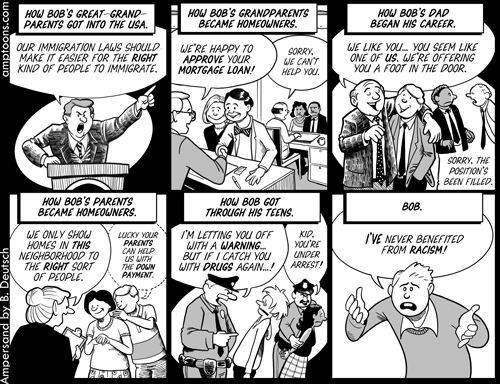
These same white ancestors could also earn better wages through union negotiations (unless the union wouldn't accept them because of race, or they couldn't get a job at all because of biased hiring practices). Then they could make sure their kids went to a good high school (unless the redlined houses didn't have high enough property values to produce
the tax revenue needed for successful public schools). And since they had been to college, they could encourage their children to attend as well (and perhaps benefit from legacy-based admission policies),  provide their children with guidance through the admissions process, and perhaps financial support to fund their higher education. Then their children could graduate from college, get a higher paying job, in a good neighborhood, with successful schools, and start the cycle over again with lucky little you!

Contrast this history with the oppression faced by other groups for generations: [Video] Slavery By Another Name.

Kaplan charges up to $3,600 for SAT prep
Folks will sometimes cite low Black and Hispanic graduation rates to suggest that these policies are actually not good for anybody. They may imply that universities are lowering their standards to admit minority students that never had what it takes to do well in college anyway. But, the truth is that many highly qualified POC never get the opportunity to even think about applying to college and those that make it face all sorts of barriers and prejudices that members of the majority never have to worry about as they go through their studies.

Opponents love to mention disparities in standardized test scores, but again rarely discuss from where those disparities come. First of all, tests like the SATs say very little about a person's intelligence, but are simply a measure of one's ability to perform on said test. So if you come from a school that coaches test taking, or if you have the time and financial resources to take multiple practice tests, buy College Board books, and take Kaplan classes, you are likely to do pretty well. 

If we were truly living in a meritocracy, a race-blind system of admissions would work pretty well (see post: Saved from Meritocracy). But we live a country that routinely and systematically stacks the odds against people of color. From early on, children of color can expect less nurturing attention from the teacher, more frequent and severe disciplinary action, and lower expectations for their long term academic performance. How well would anyone fair in these conditions? 

In addition, if one happens to be poor or has a disrupted home life, the challenges can become insurmountable. Who can keep a high GPA, have all the necessary extracurricular involvement, and hold a part-time job that helps put food on the table

On a final note, diversity in admissions needs to be accomplished, as much for the benefit of the majority population, as for students of color. In the same way that diversity in church is essential for spiritual development, diversity in schools is crucial for academic development. If I were trying to learn perspectives I already know, I could stay at home and save the $20 grand/year! It is the university's responsibility to provide its students with the environment of broad and deep education that they are paying for!


Follow more conversations about racial justice and Christianity through email or RSS feed.

Friday, February 25, 2011

Repost: UMC Black History Month

Diane brought an article from the UMC website to my attention the other day: Black History Month urges welcome for all by Rev. Hilly Hicks.

I wonder how often our black sisters and brothers in Christ choose to drive away from white churches to go somewhere that might be more welcoming? There are deep consequences to our history and corporate racial sin. Rev. Hicks had the courage to go back to Antioch UMC, but we are not always so fortunate. See the links below to learn more about Christianity's role in racial reconciliation and why we would should be doing more.


See also:

Wednesday, February 23, 2011

Reposts from Resist Racism and Racialicious

Earlier this month, there were two posts on prominent blogs about race that I think are salient here:
Confessions from a Christian and Power for Good.  Check them out!

Pay attention to the tension that enters the conversation with the topics of religion and race come up. Notice some of the pain in the comments. We can do better, Church. But these post also offer hope that there are some great allies of faith out there.

Also, a friend and dear mentor of mine recently shared some good thoughts for you to check out on her own blog. Her's is one of several guiding voices that helped in my early racial education. Her's is also the blog that got me on the idea of blogging because I had enjoyed hers so much.

Context:
Racialicious: "is a blog about the intersection of race and pop culture."
Resist Racism: is about...well....resisting racism!

See Also:
Racialicious: Interracial Relationships and the Church
Stuff Church People Do
Why it is Important

Sunday, February 20, 2011

White History Month

"Why isn't there a white history month?! 
           That's reverse racism!"
Because we already have white history year (decade, centuries...)!

In the United States, white history is the default, assumed perspective. It's what's taught in the classrooms, portrayed in the media, and informs policy making. We don't need a special month to teach it. It is taught ALL the time.

Unfortunately, some people think Black History Month is just for black folk. The truth is, we are all missing large chunks of historical knowledge, which hinders us as we move forward today.

History textbook cover:
Columbus, but no Native Americans,
 Kitty Hawk, but no Tuskegee Airmen,
the transcontinental railway,
 but no Chinese immigrant workgangs.
 Just a group of anonymous slaves. 
A lot of the issues begin early in our education system: textbooks that don't give the full picture, teachers glossing over hard truths. To read my 10th grade history textbook, you'd think black folks didn't exist in the United States until they suddenly become emancipated from slavery, then they disappeared for a while until angry mobs took to the streets demanding civil rights.

There were maybe two famous African-Americans that were ever taught, Martin Luther King Jr. and Frederick Douglass, but they were portrayed as 'exceptional Negroes' that stood above the rest. My high school textbook had a small sectioned acknowledging "white resistance to civil rights," followed shortly thereafter by a section on the Civil Rights Acts entitled "The Great Society and the Triumph of Liberalism." Good thing we had a group of white liberal saviors take care of injustice once and for all!

The same principles apply to many aspects of our history: Native American achievements and contributions, the USA's paternalist relationship with the Philippines, Japanese internment camps, on and on (see Howard Zinn and James Loewen for more). Some of it is mentioned in schools, but too often it's as a footnote or an afterthought.

How do we hope for reconciliation if we know so terribly little about those to whom we wish to be reunited?How incredibly disingenuous to say "I stand with you" and then have to ask basic questions about the history of our divide.

White folks' ignorance is the basis for a lot of pain and misunderstanding in the reconciliation process. Without a foundational knowledge of Al Jolson and minstrel shows, it might be hard to understand why blackface at a party is never ok. If we learned about our history of appropriation and objectification, we'd better understand why human being shouldn't be sports mascots. White folks are often surprised when marginalized folks get angry over supposedly 'trivial things,' but if we understood our history a bit better, we would probably get angry too. 


It's important to make a concerted effort to rectify our educational short comings, and setting aside a devoted month to do so can help. Unfortunately, cordoning off four weeks to put MLK's picture up everywhere isn't going to cut it. It is a hollow act of token recognition that just allows us to pat ourselves on the backs for our inclusiveness and then move on with our lives for the rest of the year. 

Put better by Renee at Womanist Musings:
"By presenting this as a celebration of 'look how far we have come', we fail to focus on the ways in which race still continues to play a pivotal role in who has access to power in this society. White women are still clutching their purses in the presence of black men, we are still largely portrayed as prostitutes and criminals in the media..."

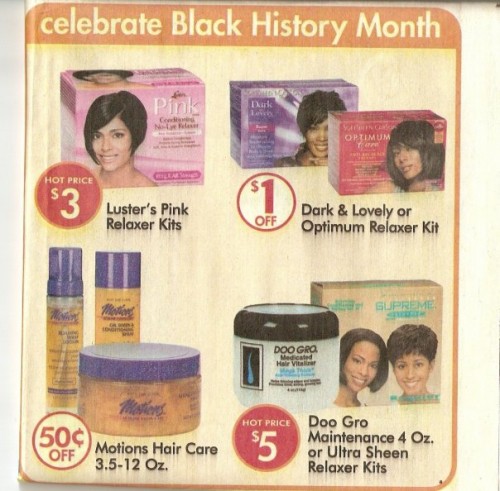
Ah, yes....the media. Another main culprit, alongside our education system. For one month out of the year, advertisers and big companies use February as an excuse to market to black folks (often very awkwardly), then go back to their true colors on March 1. 

So in the name of educating ourselves a bit, let's begin with the history of Black History Month itself:

Carter G. Woodson initiated Negro History Week in 1926 in February to coincide with the birthdays of Frederick Douglass and Abraham Lincoln. The idea was to bring black history to the attention of the broader American public. Then, in 1976 the black history was given an entire month--albeit the shortest month of the year.

Continuing our history lesson, how about some identification tasks:
Can you name the 14 people pictured here?
I'll get you started: MLK, Rosa Parks, Harriet Tubman...

Name five black figures of
historical significance....not so hard.
Now name ten more...

Do you know who Cathay Williams is? Marian AndersonCrispus Attucks?  Matthew Henson? Ida B. WellsRichard Wright? Marcus Garvey? Who are some significant white allies during the civil rights movement? These shouldn't be obscure names to us, but too often they are.

Can you name the inventor of the light bulb? No problem. What about the carbon filament essential to it? Or the traffic light? hmmm. Telephone? Easy. The blood bank? Not so much. Eyeglasses? yep. Person to patent laser cataract removal? First brain surgeon to perform a hemispherectomy and the first to successfully separate twins conjoined at the head!?!?! Many of us would have starved as children without peanut butter, but have no idea who to thank for it.


This isn't simply black history, it's women's history, it's LGBT history, it's military history, it's literary history, it's science history, it's religious history. It's American history.

Asian-American, Native American, and Latino-American histories are also constantly marginalized and ignored (and now they're even criminalized). If these narratives were given as much weight as white history in the classroom, they wouldn't need their own time set aside.

Today, I remain profoundly embarrassed that the names of major figures in history are still often unknown to me. I find myself having scramble to catch up, to make up for lost time--cramming names and events that should have been taught to me years ago.  It might not be my fault that my high school let me graduate without this knowledge, but now it's on me to rectify it. I need a black history month...I just need to celebrate it year 'round to begin to catch up.

If you don't know some of these most famous of examples I cite here (and I really just graze the surface), do yourself a favor and spend the next 30 minutes looking at the links and educating yourself.  Thirty minutes is a small amount of time to a devote to a subject so neglected--but it's a start. You owe it to yourself. 

Follow more conversations about racial justice and Christianity through email or RSS feed.

Friday, February 18, 2011

Appropriation vs. Appreciation

This Saturday is C4AP's  Black History Month Celebration, which will be themed 'Back to Africa.' To me, I feel like that might be an awkward theme (kinda hearkens 'go back to Africa' epithets,  plus not all black folk in the USA are from Africa, not all black folk identify as African, not all black folk can even trace their roots more than a couple generations in the US, let alone to a different continent....UPDATE: see Sherie's important comment below), but people smarter than I chose it and so I'll roll with it.

I direct the church's gospel choir and we were asked so sing 'Lift Every Voice and Sing' and a song of our (read: director's) choice: Ahuna ya Tswanang Le Yesu. It was always a favorite at worship in college, so I am pumped to bring it to C4AP. It is in Sotho, a Bantu language most prominent in South Africa. This is the choir's first time singing in a language other than English and they have mastered it with grace and style (yeah, I know we had doubters...what now?!).

A lot of folk are saying they will wear African garb to the event. I am not really sure what that means. It's a really big continent, with lots of different styles. I have a lovely outfit given to me by my close friend, who brought it back from a trip visiting her family in Ghana. I thought I might wear it Saturday for the event, but I am always wary of awkwardly appropriating other cultures. Too often white folk are guilty of picking and choosing when they 'appreciate' others people's cultures, which can result in caricature, disrespectful behavior, and hurt feelings.  A lot of it depends on my motivations and attitude--but a stranger across the room isn't going to know either. Plus the song we are singing is South African, which is totally different from Ghana.

Thoughts readers? Appropriate or appropriation?


UPDATE (02/19/11):
1) see Sherie's comment below--good points to remember
2) the choir was AWESOME
3) Wore the outfit
4):


See Also:
Creative Commons License
By Their Strange Fruit by Katelin H is licensed under a Creative Commons Attribution-NonCommercial-NoDerivs 3.0 Unported License.
Permissions beyond the scope of this license may be available at @BTSFblog