BTSF in chronological order (most recent articles appear first):

Showing posts with label Christianity. Show all posts

Sunday, November 29, 2015

World AIDS Day (Part 1)

World AIDS Day logo with red ribbon of map of the globeDecember 1st is World AIDS Day. It marks "an opportunity for people worldwide to unite in the fight against HIV." While many treatment advances have been made, 35.3 million people currently live with HIV. As a result, ~2 million people die from AIDS each year, including 270,000 children.

Like so many aspects of life, AIDS diagnosis, treatment, and outcome are affected by race. In the same way that issues of infant mortality, heart disease, obesity, and mental health disproportionately affect people of color, AIDS remains a significant issue for black and brown communities.

Many factors such as income and health care access that affect the prevalence of HIV differ significantly across race. Thus, in 2010 “an estimated 7,000 (57.4%) newly infected youths were blacks/African Americans, 2,390 (19.6%) were Latinos, and 2,380 (19.5%) were whites.” Indeed, according to Colorlines, if black America were its own country, it would rank 16th in the world for the number of people with HIV.
Graph from the CDC showing highest rates of AIDS diagnosis is black populationsIn addition, American Indians are often left out of targeted treatment programs due to small population size. They also have the shortest time between HIV diagnosis and full on AIDS infection, and have worse subsequent survival rates than other races and ethnicities.

In the Asian and Pacific Islander communities, HIV testing rates are terribly low, increasing the risk of carriers unknowingly passing on the virus to others. By many measures Asian American and Pacific Islanders show the highest increases in rates of new infections in the United States. Click here for links to HIV/AIDS education materials in a variety of Asian languages.

Colorlines asserts that "HIV infection rates are an excellent measure for who societies don’t give a damn about." Hatty Lee and Kai Wright note that “globally, those who have access to social and economic capital avoid the virus or, when infected, live healthy lives with it. Elsewhere, infections and deaths continue to mount.” The necessary treatments exist, but access to them remains severely inhibited.
Click for full infographic
from Colorlines

Wright notes that “in the late 1990s, right about when taxpayer-developed lifesaving drugs hit the market and America declared victory over HIV, the epidemic split: Black diagnoses continued climbing as a share of overall diagnoses, while white diagnoses plummeted. In other words, in the part of America where people had access to care, the epidemic changed dramatically; elsewhere, it didn’t.”

The pattern is the same outside the United States. Over 95% of those living with HIV/AIDS are in developing countries. Of these, 8,000 people die per day. Countries like the United States spends ~$1500 per person each year on health care, while Guatemala is only able to spend $41 per capita per year.

While the number of AIDS-related deaths peaked in the United States in 1995, developing countries didn’t begin to see reductions for over 10 more years. The World International Intellectual Property Institute reported that “without AIDS, life expectancy in the year 2010 in Zimbabwe would be 70 years, in Botswana 66 years and in Zambia 60 years. With AIDS, these life expediencies are expected to drop to 35 years in Zimbabwe, 33 years in Botswana and 30 years in Zambia.”

Pharmaceutical companies vigorously lobby against drug access for the countries that need it most, even though sales in these same counties only accounts for 1% of their total profits. The import of generic drugs is often banned, even though they are ten times cheaper (even after 90% discounts from pharma companies).

As president of the Global Health Council, Nils Daulaire stated that “if there were a nuclear war, we wouldn't worry about whether people had their trigger mechanisms patented or not. This is, I hate to use the term, the moral equivalent of war,' he says, referring to the AIDS crisis in Africa.” Thus, the lack of drug access is often characterized as a severe violation of human rights. For more on this story, watch the compelling documentary, Fire in the Blood.

But there are reasons to hope. Is Christ’s Church one of those reasons?
Find out what the Church is doing in part 2

Sunday, December 7, 2014

#StayWokeAdvent: The Gift of the Angels

Last Sunday at UM Church for All People, Rev. Karen Cook opened an Advent sermon series on God's gifts. But Micheal Brown, Eric Garner, Tamir Davis, John Crawford & others weighed heavily on our minds that morning.

In her sermon, Rev. Cook eloquently brought all of these themes together. She weaves in elements from Micky ScottBey Jones's 'It’s Advent. #StayWoke' and speaks to the power of God's gifts to us in these times:

For Christians, Advent is the season when we’re preoccupied with anticipation.  It’s a time when we celebrate God’s ability to give “beyond all we can ask or imagine.”  In Christ, God gave us the most unexpected gift: Himself.  We can see God, know God, and experience the benefits of God’s presence.  In Christ, God demonstrated His great love for us and brought to earth blessings that even those who have “everything” long for—peace, contentment, grace, forgiveness, hope, purpose and joy!

Advent invites us to stand together as people with our brothers and sisters in Ferguson as we all struggle to and wrestle with the decision to move forward with so many unanswered questions, in Chicago as we weep with decisions made and so many unanswered questions, in Cleveland as we weep with decisions made with so many unanswered questions, as we wait anew for hope:
"Have you ever been stuck in a dark place with only a sliver of light or no light at all? You know those times waiting for news that could bring just as much struggle as it brings resolution? Remember the times of waiting and waiting, not knowing when the answers will come? Times of anticipation, of unknowing, of darkness before more light, are not always joyful, peaceful, or even largely hopeful. These are times of struggle, times of wrestling, doubting, mourning, crying, yearning, times of staying alert to the signs that light may be coming, that things are changing.
This is the time, the time of Advent, to stay alert…to “stay woke”…to your senses, your mind, your body, your feelings, your spirit to where to Spirit is stirring and leaning. Stay woke….to the impact your life has on others…Stay woke…to the injustice that we either contribute to or diminish…Stay woke….to the groanings of the world…Stay woke…to the humble, radical, empire-upsetting ways of Jesus…Stay woke…to the darkness…Stay woke…to the light…and to the sacred and profane in both."
-'It’s Advent. #StayWoke'
We have to stay awake because this message of Advent regardless of what is going on around us is Good News, it is news that is worth waiting for, it is news that is worth sharing. And this same news became gift to the shepherds:


The angels belong to another world, but the shepherds belong to the lowest social class in this world. The angels are bright and glorious with heavenly light, but the shepherds are dirty and carry the stench of sheep. The angels knew what it was like to exist in the presence of God, but the shepherds were excluded from the very temple they provided sheep for sacrifice. The angels explode onto the scene with loud, dynamic shouts of praise and worship, but the poor shepherds are stunned and frightened into silence.

The angel of the Lord stood before the outcasts of society.  And gave this amazing gift to these shepherds, “Do not be afraid; for see—I am bringing you good news of great joy for all the people…

...Today a Savior has been born to you.”

Beloved, the shepherds needed this gift, but we need this gift too, just to deal with the anxieties of life.

Let me ask you, are you worried? Are you anxious? It seems that our lives are so hectic, especially this time of year, and there are so many different worries bearing down on us from every angle. All these worries can weigh us down and depress us.

But it’s not just the worries of life that can get us down, it’s also the realities of life. Realities which are painful vivid reminders that we live in a fallen world. There are many in our community who are alone, there many in our community who are grieving, there are many in our community who are looking for safe affordable housing, there are many in our community who struggle daily with additions.

The world can be such a depressing place and that‘s from just this season alone. But the gift of the angel said, “I bring you good news of great joy for all people; to you is born this day in the city of David a Savior.” Into this dark depressing world was born He who is the light of the world. What good news! What great joy!

Glory to God in the highest heaven, and on earth peace among those whom he favors!

It is a threefold message wrapped up in one gift:

First, "Glory to God in the highest heaven"
God had kept His promise to destroy the works of the enemy through the person and work of Jesus Christ. I love the scripture in Psalm 24:8 it sounds like a battle cry:
"Who is the King of glory? The Lord strong and mighty, the Lord mighty in battle" 
This is the God whom the angels glorified: God who won the victory for us over the powers of darkness through the incarnation of the Lord Jesus Christ. That is the first great gift of the angels.

"And On Earth, Peace"
We must understand the nature of this peace. This is not a peace treaty between nations that will soon be broken. This is not the empty peace that men seek in false religions, or in material possessions, or in worldly philosophies, or in psychology, or in many other things of this earth.

Jesus said in John 14:27, "My peace I give unto you; not as the world gives do I give to you.  Beloved, This is a peace that comes by way of the Holy Spirit who has been sent by the Father and the Son into the heart of every everyone of us. That’s the second great gift of the angels

"Among those whom he favors!"
Those who are favored of God know that God is with them.  They have His ear as they walk through dark valleys and they know that their struggle to remain true to God will not go unrewarded.  God’s favor can be felt in the spirit. When we have the favor of the Lord, we rest in quiet confidence that we are forgiven and that God is not finished with us yet.

Romans 5:1 tells us that "therefore, having been justified by faith, we have peace with God through our Lord Jesus Christ, through whom also we have access by faith into this grace in which we stand, and rejoice in hope of the glory of God."

And so, not only during this season of Advent but on every day of our life on earth, we can share the angels gift of joy with everyone we encounter: "Do not be afraid; for see—I am bringing you good news of great joy for all the people; to you is born this day in the city of David a Savior, who is the messiah the Lord"


This gift should be able to get you through what every you are going through
This gift should help you kick whatever habit is holding you back
This gift can hold you in the midnight hour,
This gift can dry your weeping eyes
This gift…

Glory to God in the highest heaven, and on earth peace among those whom he favors!

"Now to Him who is able to keep you from stumbling, and to present you faultless before the presence of His glory with exceeding joy, to God our Savior, Who alone is wise, be glory and majesty, dominion and power, both now and forever. Amen." (Jude 1:24-25)

Monday, December 1, 2014

#StayWokeAdvent: Waiting for Justice

"Come, Lord Jesus. Come." 

It is the cry of our hearts when we have no other answers. When the darkness seems too deep, the winter seems too long. When the world is silent, and the night is lonely.

Where is the victorious King that we have been promised? Where is our God's mighty reign?  We cry out to God in our pain and our brokenness.
And in reply, we are told to wait.

To wait? How can this be? Is this not the constant platitude of the self-righteous? Of the scholars of the Law who tell us to let the process to run its course, to wait for the system to do its work? Dr. King replied to such as these "for years now I have heard the word 'Wait!' It rings in the ear of every Negro with piercing familiarity. This 'Wait' has almost always meant 'Never.'"

But we do not serve a God of the 'never.' And even as our hearts break, our God of the 'not yet' hears our cries: “Wait for the LORD; be strong, and let your heart take courage.” We hear the promise that "those who wait for the LORD shall renew their strength, they shall mount up with wings like eagles, they shall run and not be weary, they shall walk and not be faint."


For our waiting is not one of earthly aspiration. We do not wait for laws or officials to fulfill that which they should never have promised.  We do not wait for systems to be dismantlement and rebuilt as slightly different versions of themselves.  We do not wait for more idle talk and wringing of hands.
We do not wait for empty solutions like these.

We wait on the Lord.

And ours is not a passive, feeble waiting. One that lies listless and anemic in the face of present trials. Ours is the alert anticipation of a poised runner at the starting line. Ours is the energy of a coiled spring, bent but not broken, strengthened by the tension, and prepared to be released in the moment of God's anointing.

We are ready. Christ is coming.

We wait with a hunger that compels us to live out our hope for justice in this world, and brings us strength even as we stumble. Like the shepherds, we stay awake to what God is doing, ready to act upon the proclamation of Good News. Like the Magi, we leave our comfort and familiarity, giving of our resources in response to scripture's promise.

God commands: "prepare your minds for action; discipline yourselves; set all your hope on the grace that Jesus Christ will bring you when he is revealed." We are to live "lives of holiness and Godliness, waiting for and hastening the coming of the day of God." We do the work here, knowing that we participate in the ultimate fulfillment of God's justice in the New Kingdom. We do the work now, assured that the justice we begin today will one day be completed.

In this time, "we neither ignore the brokenness in us and around us, nor do we ignore the transformative power of Christ." We hold to the promises of God with all of the preparedness and expectation of a Church that truly believes in His coming.

~~~~~~~~~~~~~

During Advent, we remember an exiled Israel, longing for restoration. An Israel that for centuries waited, hoped, and prayed knowing that the same God that delivered them from Egypt would bring forth a Messiah for their ultimate Salvation. Today, Advent calls us to remember that first coming of the Christ, even as we anticipate the His second. So too, in our work today is grounded in our history, our pain, our journey even as we labor with longing toward our future.

The sober purples and blues remind us of our yearning, our need to repent, We lament a world without resolution. We hope, yes, but we also look deep into our broken reality and long for the way our souls sense it should be, hope it can be, know it will be.

The waiting in this way is uncomfortable. It’s messy. We long to rush to resolution. We feel the need to rationalize our pain, our confusion. We are lost, and so we cling to any direction we can find. We simplify and we minimize. We reduce the complexities of a fallen world into catch phrases and 'teachable moments.'

But even as we anticipate Christ's coming, we know that God is already here, whispering to us in this Advent season: "Fear not, for I am with you, do not be afraid, for I am your God; I will strengthen you, I will help you, I will uphold you with my victorious right hand."

"I consider that the sufferings of this present time are not worth comparing with the glory about to be revealed to us. For the creation waits with eager longing for the revealing of the children of God; for the creation was subjected to futility, not of its own will but by the will of the one who subjected it, in hope that the creation itself will be set free from its bondage to decay and will obtain the freedom of the glory of the children of God. We know that the whole creation has been groaning in labor pains until now; and not only the creation, but we ourselves, who have the first fruits of the Spirit, groan inwardly while we wait for adoption, the redemption of our bodies. For in hope we were saved. Now hope that is seen is not hope. For who hopes for what is seen? But if we hope for what we do not see, we wait for it with patience."
-Romans 8:18-25


Monday, April 15, 2013

Accidental Racist

Welcome! Follow more conversations about racial justice and Christianity through email or RSS feed.

In his latest song, Brad Paisley says he's an 'Accidental Racist.' It's actually a fairly accurate description of how white people see themselves in a 'post-racial,' colorblind society today.

While people of color have little choice but to learn white culture in order to navigate in society, white folk can go their entire lives without ever having to understand other perspectives. We learn white history in school, we live in mostly white neighborhoods, we read white books, and watch white movies. We 'don't see race' and we definitely don't talk about it. 

So it's not surprising that white people unwittingly say and do some pretty hurtful things. They make ignorant comment about hair, wear people's identities as halloween costumes, and use human beings as mascots. Then, because of their own ignorance, they become indignant when someone takes offence: "I'm not racist. I'm just appreciating your culture."

Folks think their behavior is ok because they haven't taken the time to understand the racialized context within which we interact today. That ignorance is, in itself, hurtful. It emphasizes the disparate nature of a social hierarchy in which white folk can get by knowing very little about the cultures around them. Their racism feels like an accident, because they didn't intend to hurt anybody (see post: Does Intent Matter?).

But it's not an accident that there is so much racial ignorance in white culture today. One of the problems with 'letting bygones be bygones' is that our modern racial issues aren't just about slavery, and it's not 'all in the past'. It is an ongoing, calculated marginalization that continuously evolves to evade eradication. It's pervasive nature allows it to adapt to new social norms and 'political correctness' so that it can thrive. Let's not ever forget about slavery, but let's also remember the continued persecution that occurs on a daily basis in today's world

Modern racism is systemic. It's endemic to our education system, our legal structure, and everyday life. Decades of oppression have established an unbalanced system that is no accident. Ignorant complacency simply allows one to benefit from that racialized system without having to own up to the responsibility of its existence. It is no accident that white folk are unaware of painful truths of continuing racism. We don't want to be. 

Without intentionally forming relationships and engaging with others in their daily experiences, we avoid coming face to face with our racial sinfulness. Without an understanding of others' history and culture, we are indeed in danger of being 'accidentally racist.' But if we disengage and ignore reality, isn't that more intentional than accidental?

I haven't even addressed the actual content of Paisley's song. Or LL Cool J's contribution to it. Frankly, there is more foolishness in there than I have space to dig into in this post, and others have done the analysis more eloquently than than I could, so be sure to check them out as well.

Follow more conversations about racial justice and Christianity through email or RSS feed.

Thursday, April 11, 2013

Friday Fruit (04/12/13)

Voting Day
On Fridays, BTSF offers links to other discussions about race & Christianity. It's an opportunity for you to read about racial justice & Christianity from other perspectives, and for me to give props to the shoulders on which I stand...

Weekly Round Up:

These are some of BTSF's links of interest this week. What are yours?

Feel free to contribute your own links in the comments section, or submit items you feel should be included during the week. Self-promotion is encouraged.

Sunday, April 7, 2013

Recent History

Americans have a peculiar sense of time.
Many other countries can trace their history for millennia, if not as nations, then as cultures and societies: China, England, Egypt, Japan, Ethiopia. The United States has really only existed for a blip in time (having actively divorced itself from the society that occupied the land before it).

Perhaps because our country is relatively young, the scale on which we measure our history has been shortened. The majority of our historic sites are at most 300 years old, and we think a 50-year-old building is ancient.

This mindset makes it easy to believe that our past is far behind us. But in reality, every aspect of our history has occurred within just a few generations. Eliza Moore, the last known legal enslaved person, died in 1948. That means your parents (or certainly grandparents) had the opportunity to hear first-hand accounts from those who experienced American slavery. The 13th Amendment was passed less than 150 years ago, less than twice our current lifespan.

Anyone currently over the age of 50 lived in a time when police dogs and firehoses were unleashed on school children* and people of different races couldn't even be in swimming pools together. It is within a single generation of us that people of color were regularly denied the right to vote.** For centuries, officials were elected, laws were written, and a racialized society was legally maintained. And we think that all that has been washed away after just a few short decades?

How can we claim we are colorblind when this is the environment in which we have come of age? State-sanctioned, legally-mandated racism was in place less than a generation ago. How can we think we are free from the prejudice that was so recently the law of the land?

The idea that we are 'post-racial' is laughable. To assert that we should 'move on' or 'just get over it' is ludicrous given the accumulated injustice and disparity that has birthed our modern racialized society. The consequences of a not-so-distant past reverberate loudly today in our segregated cities, our education systems, in police behavior, and in the justice system.

Imagine if Germany had a society in which Jewish citizens were imprisoned twice as frequently and then disproportionately executed. The world would be up in arms! Yet with the USA's own brutal track record with people of color, our current practices remain unchecked.

If we are allowed to distance ourselves from a recent past, we may come to believe that we are inherently better people than those that came before. We forget that they read the bible, attended church, loved their children, and gave to charity, just like we do. Hiding behind the idea of 'ancient history' allows us to live unexamined lives in the present.


*Update: That sentence was written before Michael Brown was shot. Turns out this history is even more recent that initially stated. In fact, it's not even history.
**Similarly, see The Trouble with Voter ID Laws

Thursday, April 4, 2013

Friday Fruit (04/05/13)


Laura Mvula
On Fridays, BTSF offers links to other discussions about race & Christianity. It's an opportunity for you
to read about racial justice & Christianity from other perspectives, and for me to give props to the shoulders on which I stand...


Weekly Round Up:
These are some of BTSF's links of interest this week. What are yours?

Feel free to contribute your own links in the comments section, or submit items you feel should be included during the week. Self-promotion is encouraged.

Monday, April 1, 2013

Better than Jim Crow

Look how far we've come. 
So many of the racial issues that plagued our history are no longer with us. Slavery, Jim Crow, legalized segregation: all largely things of the past. Progress is good and we celebrate the heroes that have brought us this far. 

But if we rest in the satisfaction that we are no longer as we were a generation ago, we become complacent in our own battles with injustice today. Indeed, comparing ourselves with Jim Crow or KKK racism is setting a fairly low bar

Since the Civil Rights Era, the blatant ugliness of Jim Crow- racism has given way to a new, more subtle form of colorblind racism. Prejudice is no longer quite as overt or violent as it was in the 1960's, but the systemiccultural  and generational manifestations of racism are still very much in place (see post: Defining Racism). 

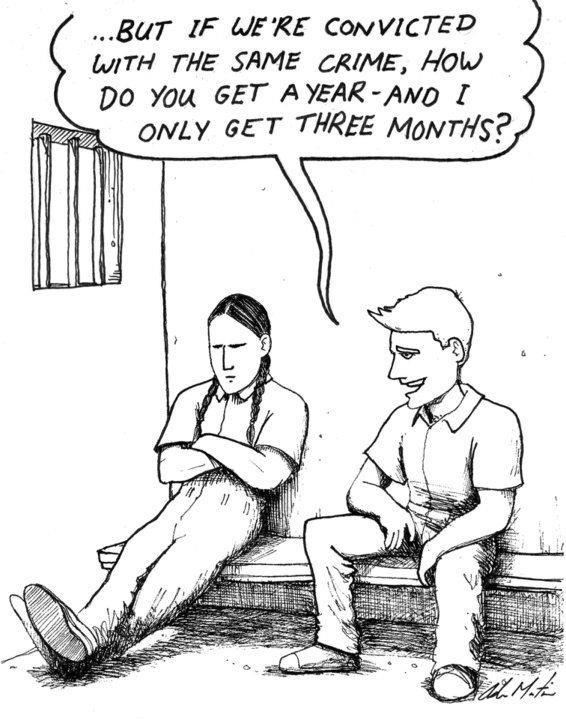
Click to enlarge cartoon
While most of us believe that everyone should have a fair shot at getting ahead, many white folk are still actively against the sorts of policies that would make this sort of ideal world possible (eg. prison reform, affirmative action,  health care reform, racial profiling, voting access).

And so significant racial disparities remain, while we end up blaming the victim for the inequality. We still tout broad racial stereotypes or 'cultural pathology,' to avoid any personal culpability

So we are left with a country in which we no longer burn crosses, but where lives are still daily destroyed by racial prejudice (see post: New Jim Crow). The consequences of racism are still just as real, only without the same 'cause and effect' immediacy that there once was. 

In some ways, the subversive and insidious nature of modern racism can make it even more difficult to combat. It's harder to pin down, to prove, or to call out. We end up trivializing the testimony and experiences of our sisters and brothers of color, who tell us they experience the effects of racism everyday. When white folk  believe racism is no longer an issue, their own racial biases and privilege go unexamined and unchecked.


So how far have we really come? 
In 1967, Martin Luther King Jr. observed, "When we view the negative experiences of life, the Negro has a double share. There are twice as many unemployed. The rate of infant mortality among Negroes is double that of whites…"

Reflecting on this quote, Abagond responds "Forty-something years later little has changed: the black unemployment rate is 1.96 times the white one (2011) while black babies die at 2.36 times the rate of white babies (2005)."

In many ways, we're actually no better than Jim Crow at all. 

Thursday, March 28, 2013

Friday Fruit (03/29/13)

On Fridays, BTSF offers links to other discussions about race & Christianity. It's an opportunity for you to read about racial justice & Christianity from other perspectives, and for me to give props to the shoulders on which I stand...


Weekly Round Up:

These are some of BTSF's links of interest this week. What are yours?

Feel free to contribute your own links in the comments section, or submit items you feel should be included during the week. Self-promotion is encouraged.

Sunday, March 24, 2013

Resurrection and Reconciliation

As Easter approaches, let us reflect on the miracle of Christ's resurrection--a resurrection that reconciled us to God the Father in a way that we could never have done for ourselves.

You see, I know I have messed up in my life. I may not have killed anybody or committed grand theft auto, but I know I have hurt people, both intentionally and unintentionally. Sure, I am 'basically a good person' when I am well rested and not pressed for time, but I have lied when cornered, and wished ill for someone when I wanted to get ahead. I have thought I was better than so-and-so at such-and-such. I have had thoughts in my heart that I wouldn't want to share with my closest friends, let alone a holy powerful God, in any sort of intimate way.

And I know God loves me profoundly, but He also loves the people I have been disrespectful to, or have been scornful of. And He kinda wishes I hadn't done those hurtful things to His children and He would like it if I would make it right with them.

If only there were a way that I could apologize for all of those things, or pay some sort of compensation, so that when I saw God in heaven, I wouldn't be so embarrassed. Some way that when He reflects on the times I have been cruel to my siblings on earth, I could say "yeah, but I did X hours of community service to make up for it!"

But how many hours would be enough? And what happens when, as soon as I finish them, I have another angry outburst at my husband, or become jealous of my next door neighbor. And so I have to compensate for those new hurts too...Ad nauseum. There are simply not enough hours in a day, or days in a lifetime to keep covering my tracks.

Enter scene: Jesus. A guy with all the love of the Father, but all the personal experience of the struggles here on earth. He lived His life without accumulating a list of errors and oops that we all collect, which meant that by the time He died, He had no apologies to make, no compensation He needed to pay for His wrong-doings. He could stand before God, totally unhindered and unembarrassed.

Yet when the time came, He reflected on my failed attempts to apologize for myself, and said to God "blame me for the things she has done. Treat her as though she had lived her life perfectly, and let me spend the rest of eternity writing her apology notes, and repaying the hurts she caused. Let us trade places in Your eyes so that she need not feel the weight of her mistakes, but instead can enjoy her time with You, totally guilt free."


And so that is what they did: Jesus took the blame, and I got the promise that, if I want to, I can spend the rest of my existence enjoying an uninhibited relationship with the One who knows me, and loves me, the best.

Reconciliation: With one hand,
He holds to the Father,
and with the other, he holds to us
as we make the journey
Jesus, in the mean time, is a lot stronger, faster, and more powerful than I am. He managed to take the blame for my issues, and deal with all of the consequences of my mistakes, yet sill make it home in time for Easter dinner. Not only mine, but everyone elses's as well.

Without any mistakes of His own, and having the power and wisdom of the Father, He was ideally suited to take care of business. So much so, that having accomplished it, He too can now stand before God, unhindered and unembarrassed. It was His resurrection that demonstrated this ability, this power, to accomplish what I could not do on my own.

It is this miracle that we celebrate on Easter. It is this trading-places that makes me eternally grateful. It is why I follow Him, and try to take His advice on how to live my life. It was on the first Easter that Jesus reconciled us to God, so that we need not feel shame, regret, or humiliation, only bathe in God's love and caring:

 "But now He has reconciled you by Christ's physical body through death to present you holy in His sight, without blemish and free from accusation" (Colossians 1:22) 

"All this is from God, who reconciled us to himself through Christ and gave us the ministry of reconciliation: that God was reconciling the world to himself in Christ, not counting men's sins against them. And he has committed to us the message of reconciliation." (2 Corinthians 5:18-19)


Sisters and brothers, now that we have vertical reconciliation with God, let us work for horizontal reconciliation with each other: "Thy will be done, on earth as it is in heaven." We must continue to Stand in the tragic gap, between what is and what could be. We must remember how Jesus forgave even as He was on the Cross, and learn to forgive one another, be reconciled to one another.

Thursday, March 21, 2013

Friday Fruit (3/22/13)

On Fridays, BTSF offers links to other discussions about race & Christianity. It's an opportunity for you to read about racial justice & Christianity from other perspectives, and for me to give props to the shoulders on which I stand...


Weekly Round Up:

These are some of BTSF's links of interest this week. What are yours?

Feel free to contribute your own links in the comments section, or submit items you feel should be included during the week. Self-promotion is encouraged.

Sunday, March 17, 2013

Kiss me! I’m an Immigrant

Please welcome back Rev. Marty Troyer, pastor of Houston Mennonite Church, on whose site the original version this post was published. In honor of St. Patrick's Day, he takes us through some reflections on how 'minority status' has changed over the past 200 years in the United States: 


We’ve come a long way, haven’t we?

Every year, St. Patrick’s Day parades all across the country kick-off revelry surrounding all things Irish. The day began as a religious holiday for Christians to celebrate the life of one of our saints, Patrick. But now everyone’s going green: leprechauns, pinching, luck, Guinness, kissing, wearing green. But it certainly hasn’t always been this way.

In the 1800’s Irish immigrants weren’t celebrated, though their hard working hands did the manual labor “we” were unwilling to do. Rather, they were derided, threatened, opposed and run out of town in every state in the union. Unwelcome in America because of their religion, non-whiteness (yes, the racial category of “white” was much narrower at the time) and slowness in assimilation (the previously mentioned St. Patrick’s Day celebrations empowered Irish immigrants to survive in a hostile culture), the Irish were the target of a nativist, xenophobic movement known as the Know Nothings, or, ironically “The Native American Party.”

Perhaps we haven’t come so far after all. Arizona’s SB 1070 (and copycat laws in other states) has been made into law. Congress is has had hearings on terrorism by American Muslims thanks to Peter King from New York. The message is clear: you are unwelcome in America because of your religion and slowness to assimilate. They follow Prime Ministers Angela Merkel of Germany and David Cameron of the UK, who said in recent years that the multicultural experiment has utterly failed.

This anti-immigrant fervor advocates for a “melting pot” approach where racial/ethnic/religious minorities must assimilate into the dominate culture mythically referred to as “we.” But who is this “we” anyway? And why are “we” so sure “they” aren’t part of “us”? And since when does Representative King get to decide who “we” are?

The 'Know Nothing' party’s
 
nativist “ideal
 
Jesus ran into this same exclusivist attitude many times. In fact, Luke says his first public sermon nearly got him killed just for mentioning God’s acceptance of the “outsider.” The “they” in Jesus culture, more than anyone, were an ethnic-religious minority group known as the Samaritans. And when Jesus was once asked who our neighbors are that we’re supposed to love, he answered with a story. The story unmasks two insiders who have no regard for human suffering or rights even for another insider; but it highlights an outsider Samaritan who embodies what it means to be a good neighbor. Where once animosity and hatred separated the “we” from the “they,” the essence of Jesus’ mission and ours is to break barriers and form friendships.

The Bible we Christians read is clear on this point, we are to love the stranger among us because we were once strangers. And who among us, except of course the true Native Americans, wasn’t once a stranger in this new world?

So I’ve got a couple invitations for you this week. Let’s see St. Patrick’s Day as a reminder of our collective ability to turn from exclusion to embrace. Let’s celebrate that the “they” who were once “they” are now part of our “we.” And this week, I invite you to tune out the anti-Muslim, anti-immigrant, anti-neighbor rhetoric and listen instead to a familiar voice of reconciliation and welcome: Saint Patrick’s.

When he was fourteen, Patrick was victim of the unthinkable tragedy of being kidnapped from his home and stolen away to Ireland. He later escaped his captors and returned home. Within several years he responded to Christ’s call on his life and returned to Ireland not to seek revenge but for reconciliation with his captors. He lived the rest of his days sharing Christ’s love for all people in Ireland.


To all the Christian readers in this amazing country of beautiful multicultural diversity: “Go and do likewise.” Perhaps our political leaders don’t believe in diversity of cultures, but our God does. Wouldn’t it be great if we Christians were known not for our exclusivity, but for our ability to “love the stranger as you love yourself”?


To all my Muslim and Latino/a (and Irish!) readers I say welcome home! This land is your land, this land is my land. Forgive us for our sins, we don’t know what we’re doing. I so deeply regret that you have been shaken by being “vilified, questioned and even legislated against” by people who claim to worship the prince of peace. But stay strong in your faith, and together we’ll get it right. This Christian pastor is glad you’re here.

Note: I’m actually not Irish, I’m Swiss/German through and through. As a Mennonite with Germanic roots, this story could just as easily be told through the lens of our own stories of immigration.

Thursday, March 14, 2013

Friday Fruit (3/15/13)

Bishop Minerva Carcaño
On Fridays, BTSF offers links to other discussions about race & Christianity. It's an opportunity for you to read about racial justice & Christianity from other perspectives, and for me to give props to the shoulders on which I stand...


Weekly Round Up:

These are some of BTSF's links of interest this week. What are yours?

Feel free to contribute your own links in the comments section, or submit items you feel should be included during the week. Self-promotion is encouraged.

Monday, March 11, 2013

Is Justice New?

There is a tremendous wave of white Christians newly on fire for justice, growing in passion and energy. Some of us once felt justice work competed with the message of the Gospel, but are now understanding that they go hand-in-hand (see post: The Social Gospel Saved My Soul). We are proclaiming God's heart for justice and bringing resources of time, money, and voice to many issues of injustice in our time.

But let us be cautions in labeling the Christian justice moment as 'new.' It may be new for young Christians. It may be new for some Christian denominations. It may be new for Christians of privilege (particularly white Christians). But Christian justice is not new.

Those whom we marginalize in our societies have always been central to the heart of God. King David declared that "the LORD secures justice for the poor and upholds the cause of the needy" (Psalm 140:12) and John the Baptist insisted that "anyone who has two shirts should share with the one who has none, and anyone who has food should do the same” (Luke 3:11).

Indeed, the very beginning of Jesus's ministry was marked with the words "He has anointed me to bring Good News to the poor. He has sent me to proclaim that captives will be released, that the blind will see, that the oppressed will be set free" (Luke 4:8).

St. John Chrysostom
Since then, generations of bold Christians that loved Jesus have paved the way for the work justice on earth. Clement of Rome (c. 96 AD) testified that Christians were selling themselves into slavery to raise money to feed the poor. In the 4th Century, St. John Chrysostom asserted: “not to enable the poor to share in our goods is to steal from them and to deprive them of life. The goods we possess are not ours but theirs...That which is due in justice is not to be offered as a gift of charity."

More recently, representatives of the the Church have continued the tradition of Christ-driven justice in the modern world. John Wesley, the founder of the Methodist movement, was a prominent advocate for prison reform and abolitionist movements in the 18th-century and it was a Christian that coined the term 'social justice' in the 1840s.

Others, like John RyanDorothy Day, Geoffrey Griffin, Toyohiko Kagawa, and Óscar Arnulfo Romero y Galdámez, stewarded Christianity's justice advocacy in the 20th century. The Chicago Declaration of Evangelical Social Concern was written in 1973, with the formation of Evangelicals for Social Action that same year.

Prathia Hall
Many clergy and churches were at the forefront of civil rights movement, though they often had to compensate for the silence of other Christians at the time. Besides the obvious, the compelling stories of Ralph AbernathyPrathia Hall, Howard ThurmanCecil Williams, John Perkins (and many others) offer inspiration and guidance for our work today.

All this to say, there are many shoulders on which contemporary Christian justice advocates stand. Christ's people have a long history of leaders who have combated injustice. White Christians in particular need to honor them and learn from them as we go about our work today. Listen to their concerns and advice. Study their movements and strategies. Avail yourself of the richness of the saints that have gone before.

It is important that we acknowledge these seasoned leaders (particularly role models of color), because failing to do so undermines the very message of solidarity the we attempt to claim (see post: White Savior Complex).  Let's celebrate, and not forget them. Christians have made grave mistakes when it comes to our stand for justice in the past, but we have also accomplished great things in Christ.

Cecil Williams
Also, know that it is okay to gain inspiration and wisdom from laborers of justice that do not profess Christianity. We have a lot to learn about loving Christ's people, and sometimes non-Christians have been better than us in accomplishing it. 

Justice is not a fad. We don't (or shouldn't) participate because it's trendy. Some of us have the privilege to come and go from these movements, but many others will always be affected (whether or not it's what today's keynote speaker is addressing). Justice is hard, daily, persistent work. It hits close to home. It exposes our own sins. We must be in it for the long haul, not just while it's popular. 


I know I've just grazed the surface. Who has inspired you as a Christian committed to justice? Who do you wish I had included?

Thursday, March 7, 2013

Friday Fruit (03/08/13)


UMC's Jorge Lockward
On Fridays, BTSF offers links to other discussions about race & Christianity. It's an opportunity for you to read about racial justice & Christianity from other perspectives, and for me to give props to the shoulders on which I stand...


Weekly Round Up:

These are some of BTSF's links of interest this week. What are yours?

Feel free to contribute your own links in the comments section, or submit items you feel should be included during the week. Self-promotion is encouraged.

Monday, March 4, 2013

'I have called you by name, Quvenzhané'

Names are important. They are integral to our identity and self-worth. Throughout the bible, names signify heritage and history (Moses, Samuel), and are given to mark moments of great significance (AbrahamIsrael, Peter, Paul). This is why it's so meaningful when we hear God say "I have called you by name" (Isaiah 43:1)

And yet, when Quvenzhané Wallis, the youngest actress ever nominated for an Oscar, had her moment on the red carpet, the media could not give her that same grace. Instead, they took it upon themselves to give her nicknames (and vulgarities).

They might have addressed her with a respectful 'Miss. Wallis.' Or politely asked how to pronounce her first name. Or best of all, they might have done the research ahead of time to learn how she preferred to be addressed. Instead she was called 'Q,' 'little Q,' 'Miss Q.' An AP reporter even decided "I'm just going to call you Annie," to which Wallis replied "My name is not Annie. It’s Quvenzhane."

Tracy Clayton notes that "Refusing to learn how to pronounce Quvenzhané’s name says, pointedly, you are not worth the effort...You will be who and what I want you to be; you be who and what makes me more comfortable....only on my terms" She also notes that Hollywood has managed to master names like Zellweger, Galifianakis, and Schwarzenegger

That this happened to a famous movie star should be no wonder when we routinely commit such indignities in our daily lives. Names given to some black children are mocked as being 'made up' or not 'real' names. White folks will substitute them for names that are more familiar to our own culture.  It shows that we think very little of a person when we will not bother to learn or respect their name. Why not celebrate the richness of deeply personal and beautiful names, instead?

StoryCorp's 'Facundo the Great'
Similarly, we anglicize Spanish names rather than pounce them as given (David, Paula; check out this great StoryCorps video) or we are unduly confused by traditions of multiple last/middle names. Folks of East Asian heritage sometimes just give up and simply choose an 'English name' to save themselves the trouble. Even holy names that are not Judeo-Christian can inspire fear and hatred in some. 

White ridicule of black names can be traced to days when slave owners replaced the given-names of their enslaved African people with European names that they could more easily manage (and even then, it was likely to be the diminutive Ben, rather than Benjamin). Might these new enslaved people have felt much like Shadrach, Meshach, and Abednego, being persecuted in a foreign land and forced to take on name from their captors? 

Our biases continue to have serious implications today. It's been well established that when judging resumes, employers will turn away equally-qualified candidates with non-white names. Likewise  a teacher's respect for a student drastically affects how that child will perform on tests. Yes, I have sympathy for teachers on the first day of school when reading the roster. But what better way to show a new student that you care than by learning their name?

If it's a new name to you, just ask politely and respectfully how it should be pronounced, and then listen carefully. Don't assume that it's abnormal, or that it is rare. Don't joke, sneer, pun, or otherwise emphasis it as an oddity. Instead, be glad for our freedom to carefully and lovely choose beautiful names for our children. We are each unique--it is wonderful to have a name that reflects one's individuality. 

Remember that a name is someone's identity. Erasure of a name is an erasure of identity. When we exoticize someone's name we reveal how deeply steeped we are in our own culture, and how blind we are to the values of others'.

"give your daughters difficult names. 
give your daughters names that command the full use of tongue. 
my name makes you want to tell me the truth. 
my name doesn’t allow me to trust anyone that cannot pronounce it right." 
Creative Commons License
By Their Strange Fruit by Katelin H is licensed under a Creative Commons Attribution-NonCommercial-NoDerivs 3.0 Unported License.
Permissions beyond the scope of this license may be available at @BTSFblog