BTSF in chronological order (most recent articles appear first):

Friday, March 30, 2012

Friday Fruit (03/30/12)

Rekia Boyd (c. 1989-2012)
On Fridays, BTSF posts links to some of the week's happenings.
It's an opportunity for you to read about racial justice & Christianity from other folks, and for me to give props to the shoulders on which I stand...


Weekly Round Up:
  • Rekia Boyd: Abagond reviews some of the most recent racialized killings

These are some of BTSF's links of interest this week. What are yours?

Feel free to contribute your own links in the comments section, or submit items you feel should be included during the week. Self-promotion is encouraged. 

See Also:
With Morbid Silence: Christian Denial in an Age of Disparity

Wednesday, March 28, 2012

Health Care Reform

Regardless of the current debates over health care laws, local medical communities could use significant self-examination about taking measured, practical steps to be more accessible to our under-privileged neighbors. Instead, poverty is often held at arm's length with little acknowledgement of our own role in perpetuating the barriers to health care.

In your own life, when is the last time you went to the doctor? Or what about the dentist? Did you procrastinate scheduling the appointment? Did you look forward to it, or were you apprehensive? How long did you wait once you got there? Were you feel ignored by the receptionist? Did you feel intimidated by the doctor?

Did you feel awkward or embarrassed while you were examined? Did you understand what the doctor said to you? Did you remember to take the meds you were prescribed? Or might you have missed one or two doses? Did you know how much 5 milliliters of syrup was? Did you remember to make the follow up appointment?

These are some of the challenges that I face with any doctor's appointment I make, regardless of my income level. So now let's remember that I rarely, if ever, have to worry about:
  • Taking time off work to get to a doctor's office hours, without getting fired or sacrificing precious income needed to survive
  • Finding and paying for childcare while at the appointment
  • Finding transportation to the doctor's office (if you're lucky there is public transport, but often that isn't not a viable option)
  • Paying for parking (our med center has little to no free parking) 
  • Spending time away from work to simply sit in a waiting room
  • Avoiding dirty looks from the receptionist and other patients because of the way I am dressed
  • Paying for the doctor's visit (you may or may not get health benefits from your job, be able to afford the monthly cost, or even afford the copay)
  • Finding transportation back home (because the person that brought you isn't necessarily available to wait around and bring you back)
  • Finding time/childcare to go to the pharmacy and wait for the prescription to be filled
  • Finding transportation to the pharmacy
  • Paying for medication (again, often without the benefit of insurance)
  • Finding transportation home
  • Reading and understanding the medical instructions 
  • Worrying about how to go through the whole ordeal again for the follow up appointment

Anyone can find themselves in a situation of poverty at a moment's notice: a death of a bread winner, loss of a job, an injury that prevents work, identity theft. Some of us have the privilege of a financially secure family to fall back on (even at the cost of some shame and embarrassment). But if not, you may find yourself the victim of a pervasive form of discrimination that assumes that if you are poor, you must be lazystupid, an addict, or in some other way wholly deserving of your lot.

God is consistent throughout the bible in His heart for the poor. From the slaves of Egypt, the nomads in the desert, Joseph the dreamerDavid the shepherd, and continuing with Jesus's priorities while on earth. Look at how Jesus spent his time with the poor and the rich. Which group did he chastise with stern warnings? With which group did Jesus eat with, socialize with, count as His friends? How does His model match the relationships you value in your life?

Further, it is important to remember that the privileged have the most to gain from a relationship with the poor. This is not a charitable endeavour, but one that is fundamental for own souls. We need to understand what it is to depend on God rather than money, to enjoy every day as it comes, and not to be preoccupied with the rat race that is 'planning for the future,' to gain pleasure from relationships rather than from stuff, to respect natural resources rather than domineering over them, to trust in the daily manna rather than storing up treasures. These are skills that I do not posses in any meaningful way.  Do you? In a world where some churches have million dollar mortgages, we have a lot to learn.

Monday, March 26, 2012

With Morbid Silence: Christian Denial in an Age of Disparity

Please welcome guess author, Erin Echols. Erin is an Atlanta native and graduate student in Sociology with special interest in racial inequality and online religious communities (see her website). Her post first appeared on Red Letter Christians.

Whether it is in our passionate recitation from the one line of the one Martin Luther King speech we’ve actually read or the long clap that followed our now President’s suggestion that “There’s not a black America and a white America and Latino America and Asian America; there’s the United States of America,” there is something about us that seems to cling to notions of colorblind equality. We assert our equality even in the face of the latest social science research, which suggests our social situations are currently anything but equal in everything from income and wealth to health and infant mortality rates.

Research has quantified this love by finding that white, evangelical, Christians, are some of the best at denying the existence of racial inequality and some of most likely to attribute any recognized inequality to lack of motivation on the part of minorities.

Photo: twentyonehundred productions 
In this context, it is no surprise that many of us hide behind verses like “there is neither Jew nor Greek, slave nor free” as justification for not talking about race and the still existing division in our country. (It is, however, more curious how we use this verse and this logic to deny the use of racial categories, but fail to carry that logic through to the other words in Paul’s verse that there is “neither male nor female” – with few of us ever suggesting we rid the world of gender classification.)

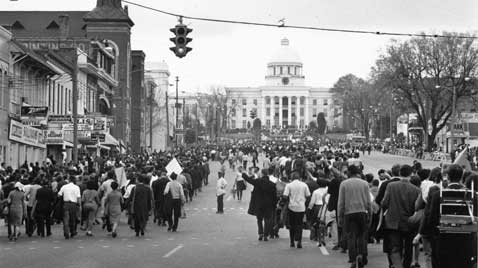
But who can blame us when we have been taught the Civil Rights movement as if a bunch of brown and black folks descended on the capital, marched on a few streets and suddenly the once racially divided world was healed forevermore?

More than 50 years since the Civil Rights movement first began, many of us fail to recognize that the average net worth (assets minus debts) of white Americans ($113,000) is 20 times the average net worth of blacks (about $5,600) and 18 times the average net worth of Hispanics ($6,325).

Somehow we missed the lessons about what contributed to these disparities. We fail to acknowledge that the FHA gave home loans to whites only for the first 30 years of its existence, thereby helping to create the white middle class today. We missed the lesson about the government selling 270 million acres of land for next to nothing to whites-only under the Homestead Act and how 40 million of us whites are descendants of those who acquired the land. Some of us are still living on that land, many of us are inheriting the inter-generational advantages of it.

We missed the lessons about how, even as my own mother was being born, people of color were being denied access to equal education and were barred from university education altogether. And we have particularly missed the reality that, though those inequalities may have pre-existed us and may not be our personal fault, they have left many of us with an overwhelming advantage.

People like me have been given extra points on college applications for being “legacy students” – an impossible classification for most students of color whose parents could not have attended college in most of the generations that preceded me [See post: Academic Admissions]. Whites like me have benefited from the inter-generational accumulation of wealth that is largely impossible for people of color whose ancestors were denied adequate wages, education and jobs. Many of us have also benefited from living in counties and towns with higher property taxes, better schools, less pollution, more hospitals and a police force who rarely profiles people of our complexion (even though, when stopped, we are more likely to have drugs on us than a person of color).
But we are often afraid to admit these and the other thousands of small but cumulative advantages we have received. Instead, some of us deride the “extra advantages” given to students of color “on the basis of race” all the while misunderstanding the reality of the statistics on affirmative action and while personally profiting from the whites-only policies of the past.

But even the uncomfortable feeling of admitting our advantage in the social system we inherited is not enough. It denies the reality that a 2004 study found that when applicants applied to the same job with identical credentials, applicants with the white sounding names received 50% more callbacks than applicants with 'black sounding names.' Stopping merely at recognizing our inherited advantage denies the reality that the people in the most impoverished African American neighborhoods have to travel longer distances to reach the nearest supermarket than people in the most impoverished white neighborhoods – thereby limiting their access to nutritious foods like fresh fruits and vegetables. 

It denies the reality that many of the worst environmental hazards are located in impoverished black and brown neighborhoods – resulting in higher rates of illnesses like asthma and lead poisoning among African American children. And it ignores the fact that college educated black mothers have higher rates of infant mortality for their children than do white mothers who dropped out of high school. Even when black women have received consistent prenatal care, they still have infant mortality rates almost double white mothers who received absolutely no prenatal care. 

These studies, and similar studies on the effects of discrimination on other health outcomes like heart disease, have consistently controlled for other factors such an urbanicity and family history and have concluded over and over again that weathering (continued exposure to instances of racism or discrimination over time) is a threat to the health of black and brown bodies.

Failing to recognize these inequalities and discuss them openly, denies the reality that this discrimination is literally killing us. It denies the pervasiveness of institutional racism and the continuation of discrimination. It accepts the advantages given to us as whites with a morbid silence that stands with the status quo and a system of oppression that, as Christians, we have a responsibility to stand against. It is a responsibility we have, not because we are all personally responsible for the creation of that system, but because Christ has called us to work toward redemptive justice in a world that is far too often opposed to it.

Thursday, March 22, 2012

Friday Fruit (03/23/12)

On Fridays, BTSF posts links to some of the week's happenings.

It's an opportunity for you to read about racial justice & Christianity from other folks, and for me to give props to the shoulders on which I stand...


Weekly Round Up:

These are some of BTSF's links of interest this week. What are yours?

Feel free to contribute your own links in the comments section, or submit items you feel should be included during the week. Self-promotion is encouraged. 

See Also:
Bias Matters: Trayvon Martin 
Troy Davis: Georgia's Strange Fruit
Incarceration: the New Jim Crow 

Monday, March 19, 2012

Incarceration: The New Jim Crow

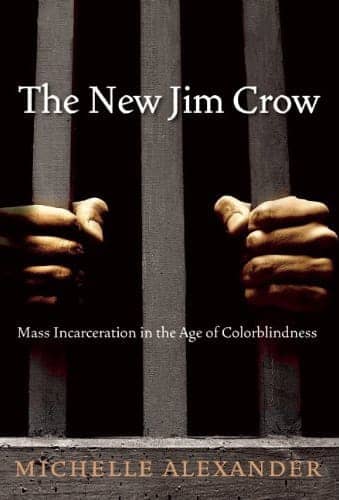
In her book, 'The New Jim Crow,' Michelle Alexander argues that "by targeting black men through the War on Drugs and decimating communities of color, the US criminal justice system functions as a contemporary system of racial control...even as it formally adheres to the principle of colorblindness."

Alexander follows in the footsteps of Angela Davis and others that have decried the targeting of people of color (particularly black and Latino men, but also women) in the criminal justice system. Alexandra argues that just as Jim Crow took the place of slavery, the War on Drugs has filled in for a dissolved Jim Crow.

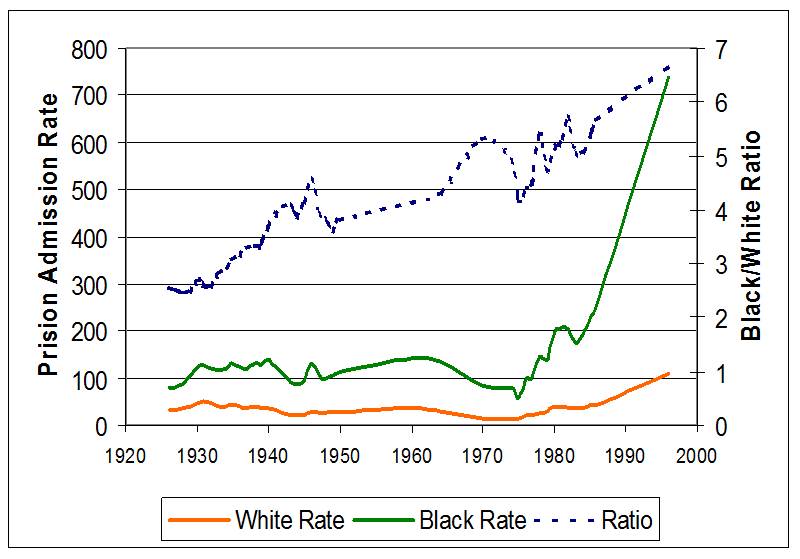
Though black folk represent only 13% of drug users (paralleling national racial demographics), they account for 35% of drug arrests, 55% of convictions, and 74% of those sent to prison on drug possession charges. Indeed, even though 72% of drug users are white, black men are 13 times more likely to be sent to prison for a drug offence than white men.

As for women, despite similar levels of drug use, black mothers are 10 times more likely to be reported to a child welfare agency for prenatal drug use than white women. Finally, white youth are significantly more likely to engage in illegal drug activity than black youth and have about three times the number of drug-related visits to the emergency room as their African American counterparts, but are far less likely to spend significant jail time as a consequence.

Thus, while our state and local governments continue to face massive threats of bankruptcy, we bloat our jails with more of our citizens than any other county per capita, in a manor that disproportionately targets people of color (see also: disproportionate criminal execution of POCs). The consequences are profound, and are strikingly similar to Jim Crow-era civil rights infringements.

As a result of a racialized criminal justice system, black folk are disproportionately stripped of their right to vote, denied participation on juries, and discriminated against for employment and housing. Those most in need of assistance are denied public housing, food stamps, access to education, and any number of other resources for restorative support. With no job, no house, no food, and no allies is it any wonder that there is a 70% recidivism rate? Every year, our legal system robs millions of the achievements made by the heroes of the Civil Rights movement.

Alexander cites some particularly troubling observations:
  • More African Americans are under correctional control today (prison, jail, probation, or parole) than were enslaved in 1850.
  • More African American men are disenfranchised today than in 1869, the year before the Fifteenth Amendment was ratified.
  • Due in large part to the mass imprisonment of black fathers, a black child born today is less likely to be raised by both parents than a black child born during slavery. 
Thus, we continue our nation's tradition of institutionally-sanctioned, and racially-selective denial of civil rights.

In a recent TED Talk, Bryan Stevenson observed that if Germany were to have a system that disproportionately imprisoned and executed its Jewish citizens, the world would be up in arms! Yet, we seem unconcerned with the USA's policies, even knowing its brutal history of enslaving and persecuting black folk.

No, she's not actually colorblind.
And yes, she's white.
In the words of H.R. Haldeman, President Richard Nixon’s Chief of Staff: “the whole problem is really the blacks. The key is to devise a system that recognizes this while not appearing to.”  Meanwhile, funding to law enforcement agencies continues to be allocated based on quantity, not quality, of arrests, allowing high-level drug conspiracy rings to thrive, while continuing to round up people of color en masse for relatively minor, non-violent drug offenses. In 2005, four out of five drug arrests were for possession, only one out of five for sales. Most people in state prison have no history of violence or even of significant selling activity.

These sorts of policies have consequences for how we in a racialized society perceive each other and ourselves. Many of the images and stereotypes held about violent and criminal people of color were created and/or perpetuated by the War on Drugs.

So how do we as Christians respond? In the bible, imprisonment was considered more a means of oppression than of justice, and we are told to “remember those who are in prison, as though in prison with them" (Hebrews 13:3). We are also reminded that "the Lord hears the needy and does not despise his own people who are prisoners” (Psalm 69:33).

Isaiah 61:1 says "the Spirit of the Lord God is upon Me, Because the Lord has anointed Me to preach good tidings to the poor; He has sent Me to heal the brokenhearted, To proclaim liberty to the captives, And the opening of the prison to those who are bound." Do we take that scripture seriously?

Finally, note what the Psalms say: “How long will you judge unjustly and show partiality to the wicked? Give justice to the weak and the fatherless" (Psalms 82:2-3).

Find a Kairos Prison Ministry in your area, and begin to minister to the folks living the consequences of our War on Drugs. Sit at their feet and learn what it means to "Let the groans of the prisoners come before you" (Psalm 79:11). 
Creative Commons License
By Their Strange Fruit by Katelin H is licensed under a Creative Commons Attribution-NonCommercial-NoDerivs 3.0 Unported License.
Permissions beyond the scope of this license may be available at @BTSFblog